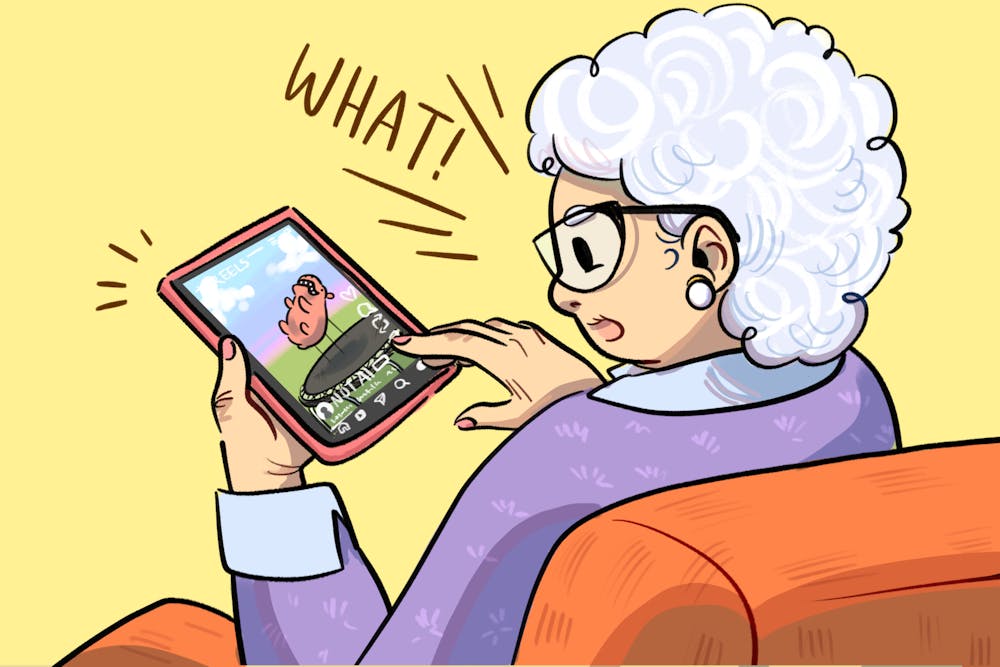
As AI tools, such as Sora and Nano Banana AI, are getting better at mimicking real life in images and videos, the classic tells, like extra fingers or teeth, are no longer principal signifiers of generated content.
In AI's evolution, ASU has even collaborated with ChatGPT and OpenAI. University professors and experts helped provide guidance on how students can become better at recognizing when and where AI is used.
"The more that audio, images, videos come out, it's going to get harder and harder and harder to tell," said Joshua Garland, center director and research professor at the Advanced Capabilities for National Security Institute's Center on Information and Narrative Complexity. "Even as an AI expert, I'm getting to the point where I can't tell a lot of the time."
He said most video-generating AI tools include a watermark to indicate that it was created by AI, but for the ones that do not, he said the two biggest tells are the hands and the lettering.
However, Garland said experts have less and less of an idea what the distinguishing factors are as AI develops.
"As soon as you know a tell, that's a great opportunity to improve the algorithm," he added.
Garland said just about anyone can be fooled by AI; while the younger generations may feel confident in detecting it because they have more training with the tool, he argues that, due to the advances in AI, that training might not pay off.
If a student comes across an image or a video that either confirms their bias or evokes an emotional response, they should double-check it somewhere else, Garland said.
Within a Reddit thread, Garland said some people can help point out if content has any of the signifiers that indicate AI generation.
But as AI continues to evolve, there are no clear ways forward, said Andrew Maynard, a professor in the School for the Future of Innovation in Society. He decided to write a book to help people become better at navigating it.
Maynard co-wrote "AI and the Art of Being Human" with Jeffrey Abbott, the founding partner at Blitzscaling Ventures, and a founder and community builder at AI Salon.
Maynard said the reason they started writing the book was that they realized AI is not going away – it's only going to get stronger.
"As it gets more powerful, there's going to be more and more need for people to have a guide or a set of understandings that help them stay true to themselves and thrive as an individual," Maynard said.
Just like needing an airplane to fly, humans are starting to rely on AI for quickly processing data and crunching numbers, said Nancy Cooke, a human systems engineering professor in the Ira A. Fulton Schools of Engineering.
"One of the mistakes that people make is trying to replicate humans," she said. "We're just so enamored by reproducing ourselves, but we already know how to do that."
However, Cooke said there are things that humans can't do, so it's better to think of AI as being complementary to humans.
As a result of trying to replicate humans in technology, it is common for people to think of AI like a human because some of its features are human-like, such as its ability to communicate. Cooke said this can lead to the misconception that AI is going to understand and empathize with the user.
But really, the problem stems from humans, said Ed Finn, the founding director of the Center for Science and the Imagination, and a professor for the School for the Future of Innovation in Society and the GAME School.
READ MORE: The GAME School brings multiple disciplines together to foster gaming innovation
He said many of the problems humans have with AI technology actually predate the emergence of AI.
"The AI problem is just the latest version of things that have been going on for a long time," Finn said.
He said the reason AI sometimes provides controversial responses is that it was trained on an internet where people have been encouraged to say "terrible things."
"When you're interacting with one of these really sophisticated AI tools, it seems like you're talking to some kind of super intelligence, but it's really just millions and millions of people's words and ideas that were put into a giant blender and chopped up," Finn said. "Now they're being reconstituted into a new smoothie for you when you ask for something."
Instead, Finn said to imagine AI in a more nuanced way.
"Think about Siri. It's not so much a little companion that's there just to help you, but it's more like a giant network of microphones feeding lots and lots of people's questions into a central set of databases," he said.
For those at ASU who might want to take a course on recognizing the effects of AI, Lance Gharavi, a professor in the School of Music, Dance and Theatre, teaches the Topic class: AI Literacy for Design & the Arts.
When he first proposed the class, it was meant for undergraduate students within the school, but with the help of the vice provost for undergraduate education, they decided to make it available for everyone and offer both an undergraduate and graduate-level course.
The class has three main areas of focus: understanding basic knowledge and concepts, introducing students to a variety of AI tools and platforms, and completing a final project relevant to their disciplines and specialties.
Gharavi said people have a lot of feelings surrounding AI, sometimes fueled by bad or inaccurate information, but he isn't trying to sell students on it or scare them away.
"Students come into my class skeptical about AI, and they leave skeptical about AI, but their skepticism is informed by so much more experience and knowledge and accurate factual information than when they came in," Gharavi said.
Edited by Senna James, Henry Smardo and Pippa Fung.
Reach the reporter at elbradfo@asu.edu and follow @emmalbradford__ on X.
Like The State Press on Facebook and follow @statepress on X.
Emma Bradford is a senior reporter for The State Press. She has previously worked at the Cronkite News Washington, D.C. bureau as a politics and money reporter. Bradford is currently also an editorial intern for AZ Big Media. She is in her fifth Semester with The State Press, previously working on the politics desk as both a part-time and a lead reporter.


