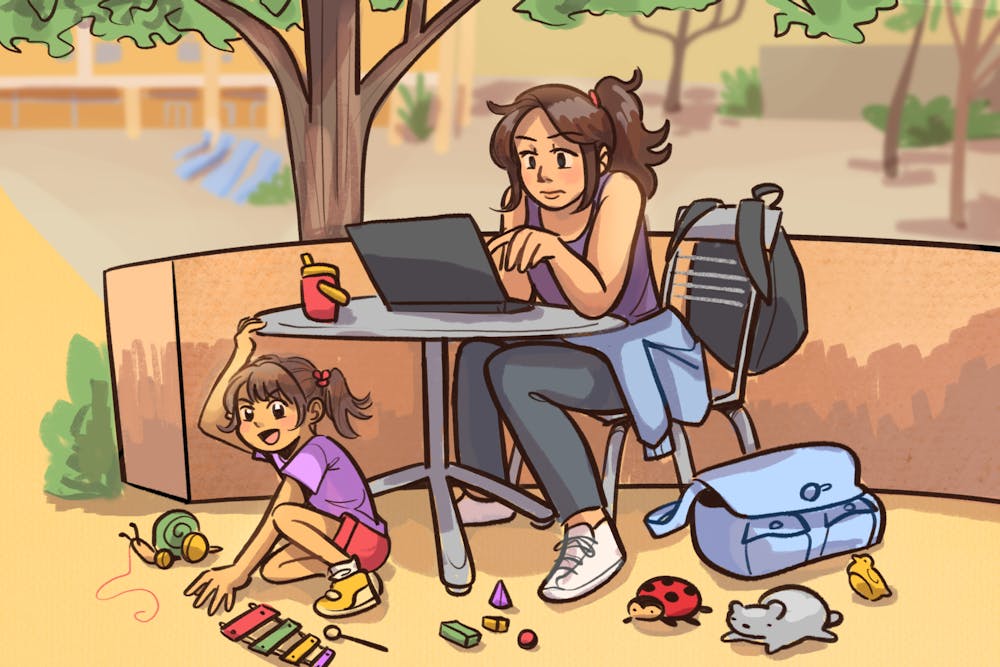
All of ASU's campuses serve as a place for learning, even for students who are just learning to walk.
Courtney Romley said the Child Development Lab is a place that cares for children ages 2-5, while providing training and support for Sun Devils.
Romley, who is the child development manager for the lab, said it is open as early as 7 a.m. and closes as late as 5:30 p.m. so enrolled families can utilize the space as they need.
Romley said the lab is a huge proponent of hands-on experience and learning. She said children typically spend their days in open-ended play where they can interact with each other and start building a community.
"It is a space where they're learning and engaging and growing," Romley said. "It's an opportunity where they have time where they can play and explore different aspects of the classroom and the outdoors with the support and supervision of our full-time staff and our college students."
Another integral piece of the program, she said, serves undergraduate students who are there to train and support the lab through hands-on professional experience.
The lab employs around 22 students and nine practicum students who play an active part in the classroom, Romley said.
She added the goal is for students to make observations, engage with the children and form relationships while having the support from the staff.
"It becomes a real team effort," Romley said. "(The students are) a huge part of our mission, and behind why we do what we do and how hard we work to make it the space that it is."
On the same campus lies another opportunity for students to get first-hand experience and research opportunities.
Natalia Gonzalez, the Child Study Lab manager and former undergraduate participant, said she discovered a passion for early childhood development during her time working at the lab.
She said it is different than working at a daycare facility because the lab is a place where students can consistently learn new things while also conducting research to find innovative ways to support children.
"I was able to implement the things that I learned from them onto the children," Gonzalez said. "I love that we are able to work with the lead teacher, and it's amazing that the lead teacher also went through the whole process of being a student as well."
Anne Kupfer, a professor and director of the Child Study Lab, said the lab is open for children as young as 15 months old to five years old, with parents needing to accompany their child if they are under two and a half years old.
Kupfer said the lab's teaching philosophy stems from Jean Piaget and Lev Vygotsky, two notable psychologists in the child development field, because children benefit from being around others of similar age while exploring and playing in the classroom.
The curriculum the lab teaches aims to educate children on problem-solving and attempt to make children love learning, to better serve them when they go on to higher education.
She said another main focus of the lab is to research and help children understand theory of mind, which is essentially a person's ability to see another perspective.
"The secret to really making changes in our culture, there is no other way other than to have children learn how to think critically, how to solve conflicts and how to value diversity, because it helps us survive," Kupfer said. "That's what the crux of our curriculum here is."
She said the typical children-to-teacher ratio is around one-to-four, with it often fluctuating to one-on-one because of ASU students who participate in the lab.
The lab, she said, is open for student parents along with community members. The lab receives funding through tuition and donations from families.
She noted the lab received a $30,000 donation from families to support an online program during the COVID-19 shutdowns.
For parents looking for options on one of ASU's other campuses, the University offers the ASU Preparatory Academy Pre-School on the Downtown Phoenix and Polytechnic campuses.
Kupfer said being on a college campus opens the children up to unique field trips, collaborative research and chances to interact with Sun Devils.
She noted the dance department collaborated with the lab to bring in students to teach the children dance.
"The children are happy, and they have the best curriculum possible," Kupfer said. "But the undergrads are just as happy."
Edited by Natalia Rodriguez, Jack McCarthy and Pippa Fung.
Reach the reporter at alillest@asu.edu and follow @allylillestol on X.
Like The State Press on Facebook and follow @statepress on X.
Allison Lillestol is a reporter for the community and culture desk. She is in her 4th semester with the State Press. She also works for Arizona PBS.