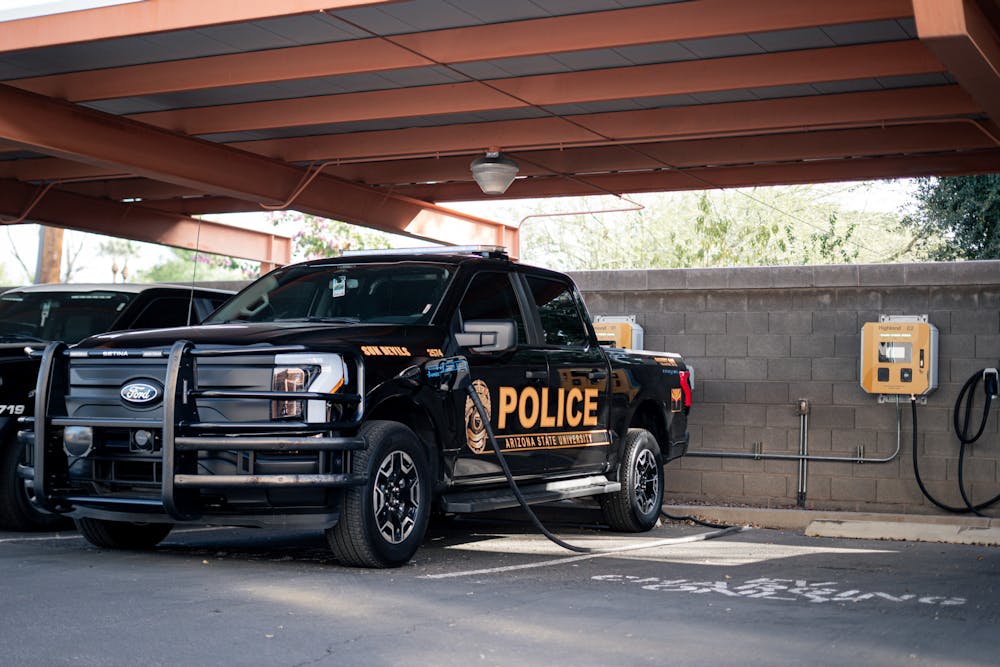
The ASU Police Department is launching a six-month pilot program that puts three electric trucks into 24/7 patrol service.
Detective Jason Anderson said the main reasoning behind testing this program is cost efficiency. Electric vehicles do not have the maintenance requirements that gasoline-powered cars do; therefore, they are expected to be cheaper in the long run.
ASU PD has already tested electric vehicle technologies on motorcycles in 2020. Anderson said the performance from this program allowed the possibility of the trial to expand to a full-size vehicle.
READ MORE: ASU senior's electric vehicle charging startup could revolutionize access to EVs in Arizona
Despite the previous trial, this technology is still new to the department, according to Anderson.
"There's a lot of unknowns right now that we have to waddle through when the program finally officially kicks off," he said.
The financial benefits of the program are being assessed by comparing the total cost of ownership, which includes the upfront purchase price, maintenance costs, cost per mile for electricity versus gasoline, idle-time energy use and vehicle availability, Amanda O'Halloran, the ASU Police information officer, said in a statement.
"Our goal is to determine whether electric patrol vehicles can provide measurable cost efficiency without compromising mission readiness or public safety response," O'Halloran said in the statement.
Anderson said that while sustainability is not the top priority of the program, the environmental advantages that come with the transition to EV will be gladly accepted by the department.
O'Halloran added that, even though the department is not conducting a direct carbon footprint comparison between gas-powered vehicles and electric vehicles, the typical environmental benefits that come with transitioning a fleet from gas to electric are expected.
The current patrol vehicles operate 24/7, and the electric vehicles will be used the same way. The key difference is that the gas vehicles produce emissions continuously while the electric vehicles do not generate tailpipe emissions during operation.
So by replacing gas-powered vehicles with battery-powered ones, it will eliminate those direct emissions during constant use.
Bhavik Bakshi, a professor at the School for Engineering of Matter, Transport and Energy, said transitioning to electrically powered vehicles makes a lot of sense from a greenhouse gas emissions point of view.
He added that at ASU, where a lot of electricity comes from solar energy, the case of electrification is even stronger.
READ MORE: Shining lights on solar energy: Opportunities amid persistent challenges
Bakshi said when evaluating the sustainability of these vehicles, it is important to look at the whole supply chain and the whole life cycle. From extracting the resources, to making the car and finally to how the vehicles will be recycled after.
He explained that the highest environmental impact for conventional fossil fuel-powered cars comes from usage. For an electric car, the emissions mainly come from the resource extraction and the manufacturing stages of its life cycle.
Therefore, electric vehicles could potentially be worse environmentally than gasoline-powered vehicles if not dealt with properly, Bakshi said.
Specifically, the materials that go into making the batteries are critical minerals, meaning it is crucial to recycle them properly, he said.
"If they end up just in a landfill or end up being used in a manner that is not circular, that could have a higher impact than what a gasoline-powered car would have," Bakshi said.
Esabella Brown, a junior studying medical studies and a member of the Environmental Advocacy, Restoration, and Technology for Humanity Club, notes another implication this program might have.
"ASU has a huge amount of influence, and even just these little changes, these little steps in the right direction, could bring more attention to it," she said. "Making people think maybe twice about where these resources are coming, and maybe cause these companies to have a little more accountability."
Brown also said exposing students to ASU PD patrol EVs could potentially influence them, along with other organizations, to think more sustainably.
"In the state of Arizona, there are several other agencies using EV vehicles, but very similar to the vehicles we're already using for our administrative tasks," O'Halloran said. "As far as we can tell, we are the first ones to implement them and try them out for patrol."
Edited by Natalia Rodriguez, Henry Smardo and Ellis Preston.
Reach the reporter at dkovalen@asu.edu.
Like The State Press on Facebook and follow @statepress on X.
Diana Nychyporuk is a Podcast Reporter at The State Press. She previously worked as a reporter for the Community & Culture desk. Diana is pursuing a degree in Journalism with a minor in Political Science.