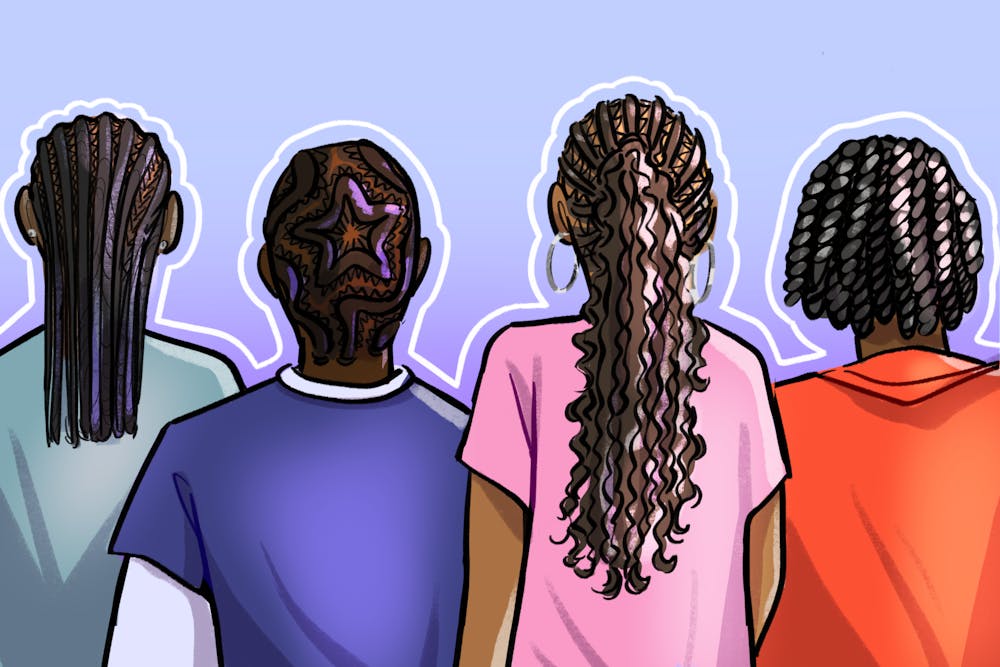
Throughout history, Black hair has taken on many forms and meanings. Hair has symbolized resistance, freedom and pride within the Black community for centuries.
For various African societies in the past, the style of a person's hair often represented parts of their identity – the tribe they belong to, their marital status and their beliefs.
"Hair is a very symbolic expression of culture and identity, and we have seen this for a very long time in the history of people of African descent," Lisa Aubrey, an African and African American studies and political science professor, said.
Popular Black hairstyles, including cornrows and locs, were used in the past as a means of communication and survival.
During the transatlantic slave trade, many African women would braid rice and other grains into their children's hair to ensure they had food, according to the Library of Congress. Braids were also used to hide directional instructions or maps that would guide them to safety.
Locs have been traced back to Mau-Mau leaders in Kenya who wore the style in resistance to Colonial rule, according to the Smithsonian Institution.
"When you see the warriors, when you see the leaders of the fight, they are wearing locs," Aubrey said. "So locs have become a symbol of liberation, a symbol of courage and strength."
Historically, the right of expression for the African Diaspora has been a battle. Legislation, including the 2019 CROWN Act, has only recently been put into place to protect against hair discrimination.
The act directly protects individuals by providing statutory protection to hair texture and styles such as braids, locs, twists, etc. As of 2024, 25 states have passed the CROWN Act, according to the Economic Policy Institute.
"It's a Eurocentric mindset about what are acceptable standards of beauty and acceptable standards for living, which are defined in European terms," Aubrey said.
Today, these hairstyles are still worn to express and celebrate the history behind them. The Cutlective Beauty and Barber Studio provides these services for Black students on campus.
READ MORE: Arriving in style: The Cutlective Beauty and Barber studio at Memorial Union
The Black-owned salon is located on the lower level of ASU's Memorial Union. With services ranging from locs to braids and sew-ins, the Cutlective has it all, owner Keshanda Jones said.
The salon takes a holistic approach to beauty, treating clients from the inside out, Jones said.
"How we present ourselves has an effect on our mental health and our self-esteem," Jones said. "When you're feeling good about yourself, then you're able to project that to the world as well, helping with your confidence."
To Jones, the services the salon provides go deeper than the physical roots of hair, to the root of Black heritage.
"Even the expression of say, cornrows and things like that and how we use it in the past, as mapping for our ancestors," Jones said. "Being able to do certain styles, and it adapting just because of the location of where we are."
While The Cutlective is primarily a salon, Jones said she wants the space to serve as an environment for students to come in, recharge and find a supportive community.
Akira Wilson McKinney, a sophomore studying biological sciences, pharmacology and toxicology, is a student worker at the Cutlective.
Wilson McKinney said she taught herself how to braid and style hair using YouTube videos and simply practicing on herself. At the salon, she has done braids and quick weaves on her clients.
Growing up, Wilson McKinney said she viewed hair as something that classifies her self-worth.
Prejudiced terminology referring to straightened hair as "good hair" and natural hair as "nappy" or "bad hair" has been associated with several mental health outcomes, according to research from the National Library of Medicine.
Wilson McKinney said she would like to see this terminology shift from views on the texture of hair to the health of hair.
"Being a STEM major, I reflect a lot on the products that I put onto and in my body," Wilson McKinney said. "So while hair expression is important, understanding what we're doing to ourselves with these products is just as important."
Wilson McKinney said when it comes to hair expression, whether it's braids, locs, a low cut or a bob, she loves it all.
"It makes me happy when I see Black people doing what they want with their hair at the end of the day," Wilson McKinney said. "Coming from a time where we weren't allowed to in the past, and laws were made to regulate how we look, and rules were made to regulate how we can wear our hair in different spaces. Just taking control of our bodies in that way is so important."
Edited by Natalia Rodriguez, Jack McCarthy, Emilio Alvarado and Pippa Fung.
Reach the reporter at dbell39@asu.edu and follow @dhemibell on X.
Like The State Press on Facebook and follow @statepress
Dhemi Bell is the editor for the Community and Culture desk. This is her third semester with The State Press, working previously as a part-time Community and Culture reporter.