Every morning, it was the same routine. Rose Jacket's grandparents awoke before the sunrise to prepare ingredients to make dough for fried bread, and mince various vegetables for mutton sandwiches and stews to sell. Jacket and her younger brother often assisted them in these preparations before heading off to school. As they loaded the car, pots clanged and clattered as they started their hours-long drive to the reservation.
While Jacket, a senior studying English linguistics, and her brother were at school, her grandparents sold food, beadwork and Kachina dolls — carved figures representing Katsina spirits and often given to girls as a gift — at their flea market stall in Shiprock, New Mexico. Sometimes they'd come home just before sunset, which occasionally worried Jacket due to their old age.
"It's hard to see at night." Jacket said. "It's like 'Are they going to be okay when they get home?,' 'Am I gonna see them again?'"
While most kids spent their newfound time playing games or relaxing during the summer, Jacket spent that time helping her grandparents. Although she'd been assisting them with work for as long as she could remember, she never felt forced or discouraged.
"That feeling of wanting to help and put in my own effort and work, that was what brought it (curiosity)," Jacket said. "They never forced us into it, they never told us to stop doing it, they just let us be. They trusted us, that we would make the right decisions."
Although the flea market occurred daily, profits varied. Sometimes, Jacket's grandparents made enough to cover basic living expenses like rent and utilities. Other times — when they earned more — they'd spend it going out to share a meal. However, these markets were periodically a financial burden due to the cost of gas and the risk of wasting food from low sales.
"Grandma's such a sweetheart, she would always try to give it (leftover food) away to people who need(ed) it," Jacket said. "If they couldn't pay for things, she would tell them, 'Do you have something to trade for, like jewelry?'"
This is one memory Jacket often revisits through the Native Narratives programs' bi-weekly Friday lunches. These are gatherings with other students in the program, where the coordinators cater food and occasionally, other, unfamiliar cuisines. Jacket said the food became a tool to share and converse over, adding that it's an opportunity to learn about other Native American cultures.
"It brings people together," Jacket said. "Rather than sitting there and staring at each other awkwardly, it's like let's start with the food, 'What do you like about it?' And it starts to open those side conversations."
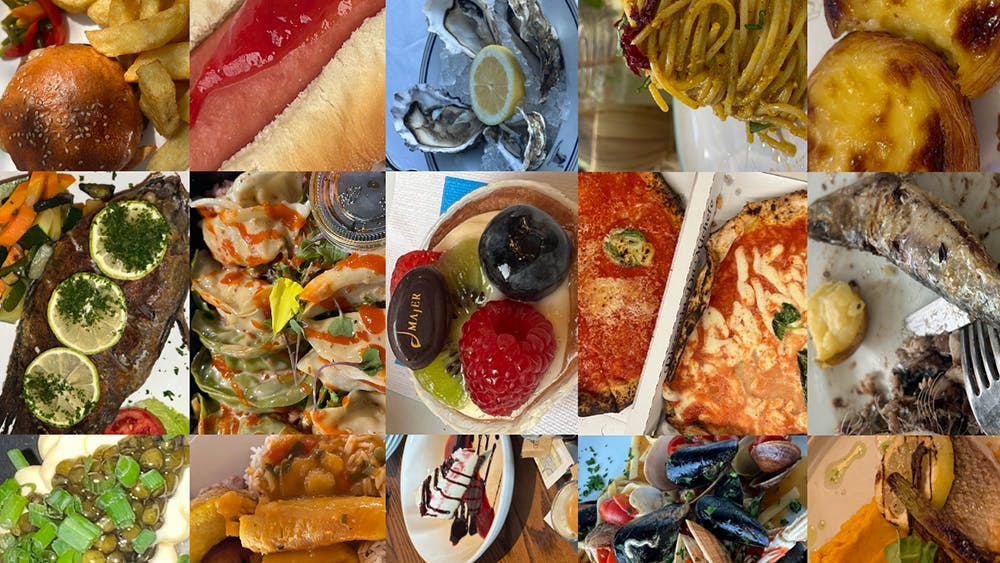
Like in Jacket's experience, food goes beyond nourishment — it bridges the gap between people and culture, connects us to our past and sparks conversation.
Food's connection to community
Asian Routes and Cuisines is a newly-established club that introduces Asian cultures through food experiences. Yenigalla Gopikarani, a sophomore studying computer science and the club's events lead, described food as a natural method to bring people together.
"When you eat food, you're not just eating a dish, it's like you're exploring, experiencing a history and an identity," Gopikarani said. "We want people to have the same feeling, so we believe that gatherings are one of the most important ways people form connections."
In the United Kingdom, there is an education charity and social enterprise called the Eden Project. Since 2009, they've hosted an annual event called The Big Lunch, where members of the public are invited to get together and share meals. The purpose of this is to foster a sense of community, create safer neighbourhoods and decrease isolation.
In 2025, The Big Lunch hosted approximately 10.5 million people and as a result, the Eden Project research noted that 85% of the attendees said it helped them understand individuals with different cultural backgrounds. Additionally, 82% of the participants said it positively affected their mental health, while three in four people said this event decreased their loneliness.
Gopikarani founded ARC in November 2025 after realizing most clubs at ASU focused on a distinct culture, rather than multiple. There also weren't pre-existing clubs that specifically utilized food to explore Asian cultures.
"We wanted people to explore all the Asian taste buds and recipes in one single club so that they can know the difference," Gopikarani said.
For their first event on Feb. 6, Gopikarani said they'll have three food stalls representing different regions of Asia. One will contain South Asian cuisines from countries such as Pakistan and India. The second, East and Southeast Asian countries like China and Vietnam, and the last will strictly contain East Asian dishes from countries like South Korea and Japan.
Similar to the stalls for ARC's event and Jacket's memories from selling at flea markets, Gopikarani recalls visiting the local food stalls of her home Hyderabad, South India, to get her favorite bite; Panipuri, a popular South Asian street-style snack. Every day, the smell of fried, hollowed out discs of dough filled with a combination of spiced chickpeas, curry and a sweet, spicy and tangy flavored water attracted the senses of Gopikarani and her friend.
"Every single day we used to go there and eat it even if our parents won't allow us," Gopikarani said. "It used to be so fun eating it and I could eat it for breakfast, lunch and dinner."
Along with being raised in South India, it exposed Gopikarani to many food traditions as India is often referred to as a subcontinent due its vast amounts of cultures within its territory. As a result, it shaped her view of food as it's considered a spiritual experience that represents belief, gratitude and community rather than simply for nourishment.
In the spiritual aspect, Gopikarani said in India, there is a tradition called "prasadam" or "prasada" where people serve food to deities during Puja, a ceremonial worship; the food is then shared with the people. One dish that's served is called pulihora, a South Indian rice dish made with turmeric, tamarind, peanuts and other spices.
"Whenever we do prayers for the god, we serve that food to the god and then serve it to people," Gopikarani said. "It's like God's blessing."
Food's connection to culture
Suyash Malepati, a sophomore studying biomedical sciences and ARC's treasurer, said their other goal with the club is to help international students adjust to their life away from home by sharing cultural dishes. Malepati, who is an international student like Gopikarani, recalled his first year at ASU and not being able to find enough Indian cuisines. However, he would use food to start a conversation if he found a fellow individual from Bengaluru, India — his home city.
"After moving to the U.S., I genuinely missed my cuisine," Malepati said. "Instead of just randomly talking, include food too, you're from the same place so I feel that you should include food also with the conversation."
Not only did Malepati miss his cultural dishes, but had to adjust to American dining customs. For example, in India, Malepati said when eating out, one person pays for everyone and the check is later split. However in the U.S., it's typical for everyone to just pay for themselves.
"(At) fast food restaurants in the U.S., first you order, you pay for your food and then you get to eat," Malepati said. "Whereas in India, you get to order first, you eat and then pay."
Pualani Harper, a junior studying health sciences and family human development, was raised in Guam and has a Chuukese background. Similar to Malepti, she also experienced cultural differences like individuality as she grew up in a family-oriented environment.
"(When) cooking for people, I always ask (if they want to share the meal)," Harper said. "Whenever they cook, they don't ask, I don't expect people to give if they don't want to. I was used to that, so I would expect people to also have that same mentality."
In Harper's home, making Kon, a traditional Chuukese dish made from pounded breadfruit paired with coconut milk, is a family ordeal. After preparation, it is used as an offering symbolizing peace, love and hospitality. Harper said it's also typically used to celebrate Asian Pacific Islander Month.
"We all cook it together," Harper said. "The women and the girls will cook it but the men after that will do the pounding (of the dough) and we watch or they'll tell stories."
As Harper watched the women cook the breadfruit, her mother often revisited old memories and stories from her youth.
"It's like the mother and daughter moment where you're in the kitchen just cooking and preparing," Harper said. "She would tell us about how she grew up making it (Kon) but sometimes it would be her telling us stories about myths or folklore."
Although food is a gateway to a culture, Natalia Velador Carrillo, a sophomore studying journalism and mass communications, said it can also reveal how the people have adapted to matters like economic conditions.
Velador Carrillo, who studied abroad in Cuba, touched on the frequent power outages and scarcity of food. Cuba is undergoing a potential humanitarian crisis following the U.S.'s threats to impose tariffs on countries that supply oil, according to the United Nations.
"You can go to any store (in the U.S.) and you'll find a pomegranate in season when it's not in season," Velador Carrillo said. "Over there, it's not like that. I would order something and they wouldn't have it because they didn't have the product even if it was seasonal."
If a dish is available, Velador Carrillo noted tasting peculiar flavors with ingredients like cheese as they were frequently substituted with other affordable alternatives. Additionally, in convenience or grocery stores, while she could buy multiples of a product, locals only bought necessities.
Although Velador Carrillo said certain dishes they ate weren't the best, she also added that it's not a reflection of the culture, but a testament of what the people are able to do with the resources they have. She also said that food can be a tool to learn about a country or culture's affairs.
"We missed out on a lot of good cultural dishes that they were really proud of making and creating because they just couldn't afford the ingredients," Velador Carrillo said. "That in itself shows where they are … you have to question, 'Why can't they afford this?', 'Why can't they import this?'"
Everyone is connected to food as it's a necessity for nourishment; however, it's also a tool to learn about both another individual and culture. That said, Velador Carrillo expressed the importance of an open mind and willingness to learn and understand because everyone's palate is different depending on where they're from.
"Dig a little deeper and understand why something is the way it is," Velador Carrillo said. "Food doesn't just happen, it takes a lot for it to be made. People just don't really think about food as such an important thing but it really is."
Edited by Leah Mesquita, Natalia Jarrett and Abigail Wilt. This story is part of The Love Issue, which was released on February 25, 2026. See the entire publication here.
Reach the reporter at akpaulic@asu.edu and follow @akp.reports on Instagram.
Like State Press Magazine on Facebook, follow @statepressmag on X and Instagram and read our releases on Issuu.