A conservative media watchdog organization secretly recorded two ASU faculty members discussing ASU's diversity, equity and inclusion policies by posing as prospective students.
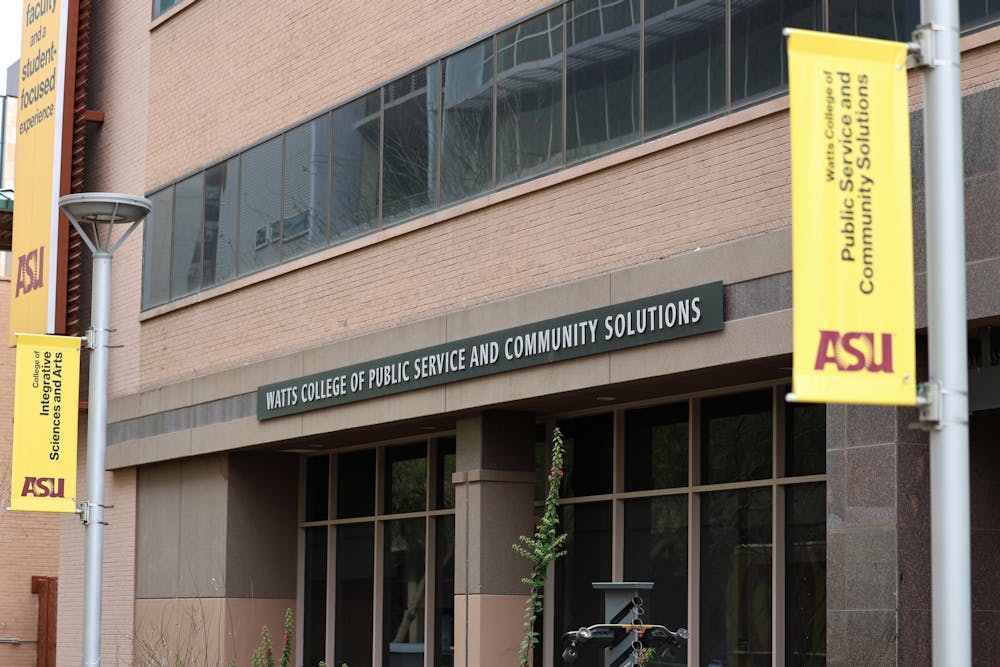
Accuracy in Media is a nonprofit organization that uses "investigative journalism and cultural activism to expose corruption and hold bad public policy actors accountable," according to their website. Staff members from the organization recorded and released two undercover videos of faculty members from the Watts College of Public Service and Community Solutions that purported to demonstrate University DEI policies.
On Jan. 5, AIM published a video, obtained with a hidden camera, of Rebecca Loftus, a professor and an associate director of the School of Criminology and Criminal Justice, describing ways the school has shifted its language to follow policies against DEI while maintaining practices that promote inclusivity.
In a video published Jan. 29, Chandra Crudup, a professor and an associate dean of the Watts College, spoke to an undercover AIM staff member about the Inclusive Design for Equity and Access Office and ways the University has changed its language to avoid scrutiny.
In both videos, the AIM staff members posed as prospective University students to meet with the faculty members, according to articles published alongside the videos.
Adam Guillette, the president of AIM, is seen at the end of each video confronting Crudup and Loftus about their statements, claiming the University is violating state and federal policies. According to AIM, Crudup declined to comment when approached by Guillette, while Loftus said to "talk to our Director."
The Arizona Board of Regents policy manual prohibits "unlawful discrimination, harassment, and retaliation" on the basis of a protected class. The state constitution also prohibits preferential treatment or discrimination using a similar standard.
Executive Order 14173, which President Donald Trump signed on Jan. 21, 2025, includes provisions against the use of DEI or affirmative action policies in institutions of higher education.
A University spokesperson said in a written statement that the University fully complies with federal law and does not discriminate in admission or scholarship decisions.
"Not only would doing so violate Arizona Board of Regents and ASU policy, but ASU has since 2010 operated under a state constitutional provision that prohibits preferential treatment or discrimination on the basis of race, sex, color, ethnicity, or national origin in public education," the spokesperson said in a statement.
The spokesperson said in a statement that "ASU does not comment on secret video recordings of its employees who are not authorized to speak on behalf of the university" and thus had no comment on the videos.
Loftus and Crudup both declined to comment on the videos.
Guillette said AIM performs "hidden camera investigations" into the DEI policies of higher education institutions across the country.
"We have an incredibly talented team of hidden camera investigative journalists who use a variety of ruses and a variety of technological tools to help expose the law-breaking, malfeasance and fraud," Guillette said.
Guillette said this method has been used to expose DEI policies at various universities. AIM has published secret recordings from North Carolina State University, the Ohio State University, the University of Kentucky, Florida A&M University and the University of Utah.
"I'm really proud of what we were able to accomplish in Arizona State, even as much as I imagine the taxpayers are incredibly frustrated by what we've exposed," Guillette said.
The Society of Professional Journalists offers guidelines for reporters on undercover news-gathering methods.
According to the SPJ Code of Ethics, journalists ought to "avoid undercover or other surreptitious methods of gathering information unless traditional, open methods will not yield information vital to the public."
Stephen Adler is the director of the Ethics and Journalism Initiative at New York University and a former editor-in-chief of Reuters. He said he does not see the AIM videos as journalism but rather "undercover political activism."
Adler said journalists should be upfront about their identity for the sake of accuracy and honesty.
"Our pact with our audience is that we're not going to lie to anybody," Adler said.
Guillette said hidden camera investigative journalism is "the most honest and moral and transparent form of journalism" because it captures conversations with subjects of coverage without the interference of public relations professionals, and provides greater context than other mediums.
While Adler said transparency in the journalistic process is critical, he also understands how AIM's methods and coverage may be subjectively interpreted as vital to the public.
"If you feel strongly that the university is doing something that's both against the law and immoral or wrong, then you want to expose it," Adler said.
However, Adler said journalists should still strive to use more forthcoming ways of gathering information.
"You want to treat people well," Adler said. "If people have done something wrong, you want to report on it, but you also want to be fair to them."
Edited by Carsten Oyer, Senna James, Emilio Alvarado, Sophia Braccio and Pippa Fung.
Reach the reporter at apruiz@asu.edu and follow @andiruiz2405 on X.
Like The State Press on Facebook and follow @statepress on X.
Andi Ruiz is a politics editor at The State Press. She was formerly a lead politics reporter and anchor at The Cut Network. This is her second semester at The State Press and is committed to bringing credible and accurate information to the ASU community.