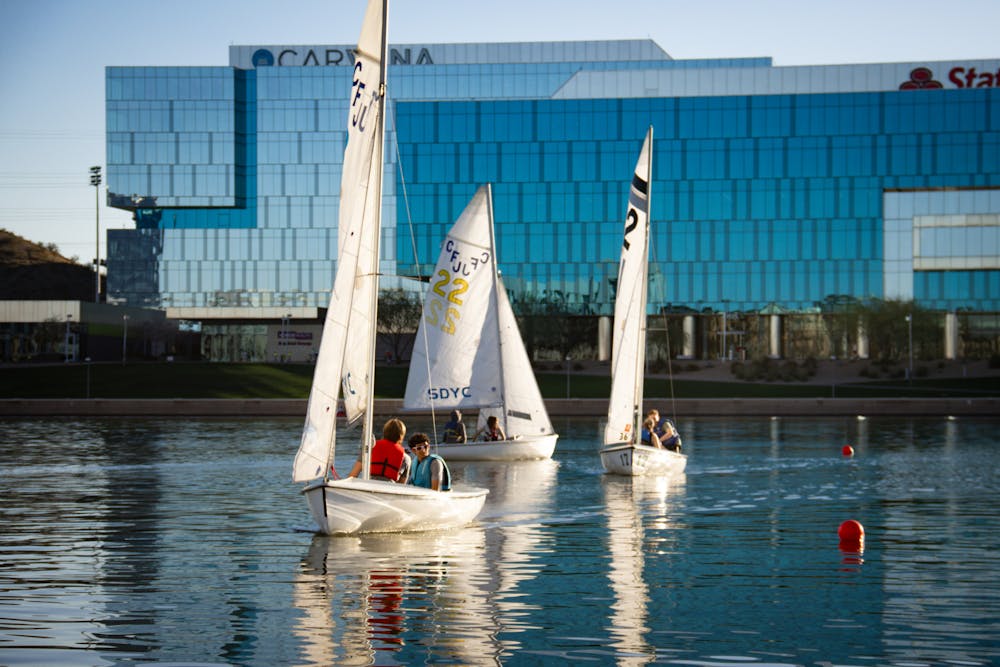
Though the infamous Tempe Town Lake can often be seen as a comedic accessory to the Valley, its facility serves many maritime organizations in Tempe, including the University's club team, Sailing at ASU. While the lake is not ideal for optimal seafaring activity, the team has adapted by implementing multiple practice measures as they learn how to sail beyond the desert.
As part of the Pacific Coast Collegiate Sailing Conference, Sailing at ASU regularly competes against over a dozen schools from California, along with the University of Washington, Western Washington University, the University of Oregon and the University of Hawaii. While their practices stay local to Tempe, the University sailing team will attend around 11 regattas in the spring semester, traveling as far as Hawaii and the Pacific Northwest to race.
"It's really fun to go to California, Washington, Hawaii, and represent Arizona, because it's not expected that we would have water sports here," junior skipper and public relations director Viviane Carroll said. "It's not expected that we would know how to sail and be able to compete at an intercollegiate level."
Recently, ASU competed at the Peter Wenner Rainbow Invite, hosted by the University of Hawaii in Oahu on Jan. 17. Among the 18 teams that raced, the Sun Devils placed 12th overall.
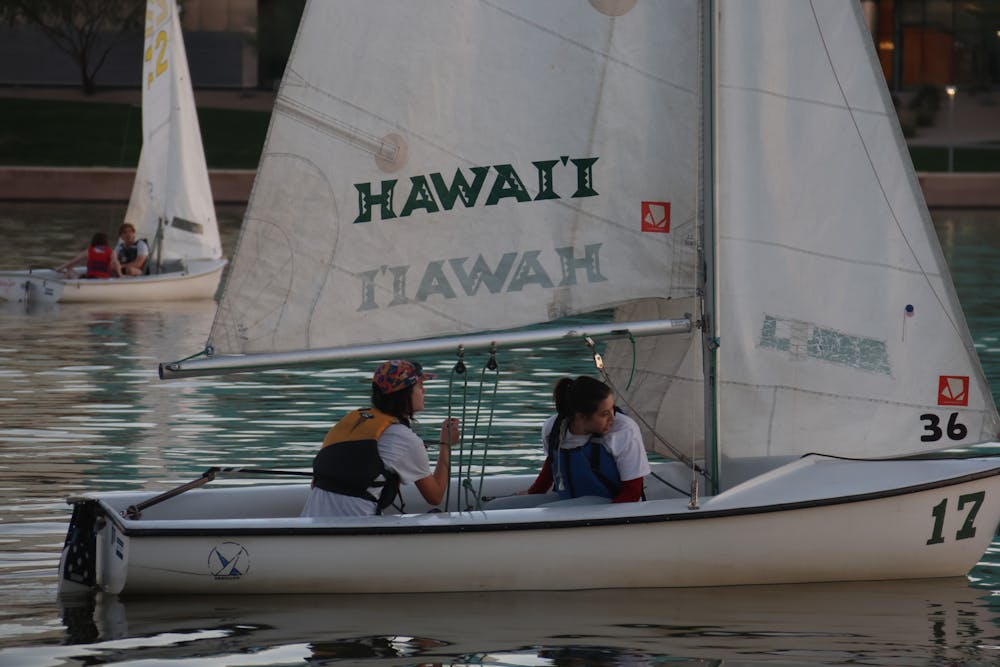
The majority of their regattas are on the ocean against coastal schools; Tempe Town Lake remains the team's domain, since the Arizona team has few practice options.
One concern among the team is the lake's water quality, as Tempe Town Lake has a reputation for being relatively dirty and unsafe to swim in. The question of whether or not they are endangering their health when practicing in the lake has become a joke within the group, junior skipper and team president Erin Welker said.
"While the lake's water quality meets all standards for the recreation that is regularly allowed at town lake (boating, paddleboarding, fishing, etc.), swimming and other full body contact events are not allowed, and Tempe does not routinely test water for full body contact unless a permitted full body contact event is planned," Maegan Pardue, a public information officer for the city of Tempe, said in a written statement.
READ MORE: Water Ski brings Sun Devil siblings together
While sailing usually keeps the team out of the water, submersion is inevitable when practicing capsizing. Capsizing is not frequent when racing, but it can take place when tacking and gybing, or when the wind is particularly strong, Welker said.
The Sun Devils also have to adapt to practicing with weak winds, yet still prepare themselves for the knots they face in competitions in an oceanic climate.
In this case, the south side of Tempe Town Lake — parallel to University Drive — is shaded with high-rise buildings, blocking any wind that may come from the south, junior crew and racing captain Samantha George said. To combat this lack of wind, the team will move its fleet east of the lake, avoiding any buildings that may slow the wind's speed. This does prevent them, however, from rotating boats from their usual dock.
Overall, Welker and George said the wind conditions can pose inconveniences.
"This lake can be really switchy. There have been times where genuinely the wind vortexes," George said.
With experience in sailing on Tempe Town Lake himself, Emory Heisler, the education director for the Arizona Sailing Foundation, agreed that Arizona wind may not be preferred for sailing races, but said the lake may actually improve the team's skills, as it has helped him get better at adjusting to poor wind conditions on a whim.
"When it starts to get shifty over there, that's where we excel," Heisler said in reference to his own experience competing on the ocean. "It's easy for everybody to sail in consistent wind, but when you've got really fluky wind ... it takes an extra level of skill."
But when the team races at competitions with unusually strong wind, Welker said it is difficult for them to navigate, because they lack the proper practice sailing in those conditions.
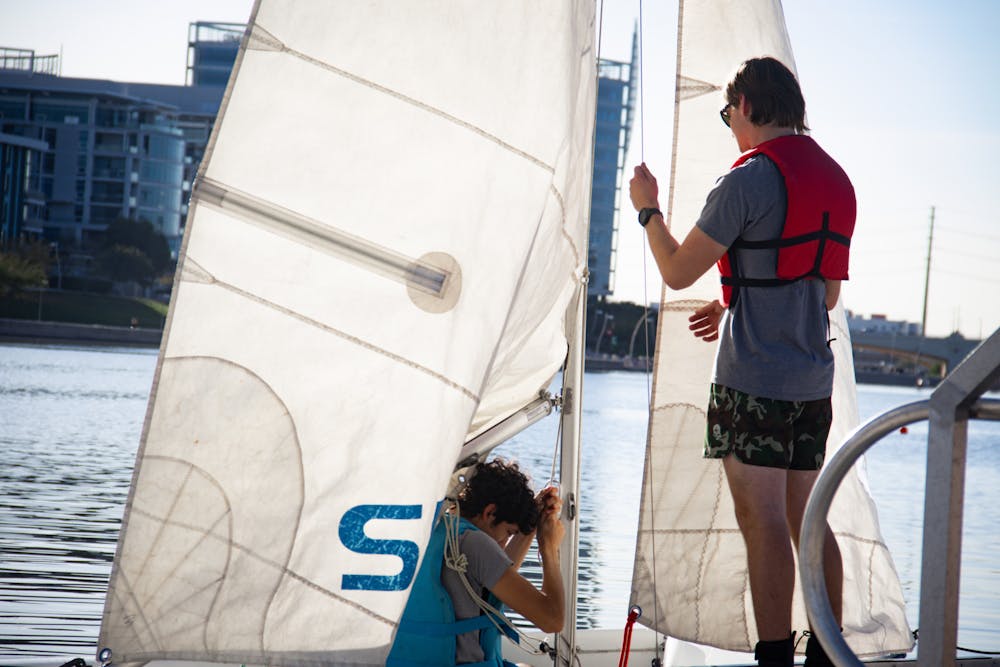
To prepare beginners on the team for sailing in harsh weather, Welker said she and George emphasize the basic knowledge of sailing, as it transcends any climate. Both said because regattas are often the only time the team has access to the ocean, they use each regatta as a form of practice for their beginner sailors, so they can learn as they go.
Carroll, an Arizona native, had no experience with sailing or with the coast, and felt overwhelmed at her first competition by the ocean waves and wind speed. She and her then-skipper worked together to teach her how to race in those types of conditions by using all of the fundamental sailing principles learned from practice.
"Over the course of our six to eight races ... we were sailing perfectly by then," Carroll said.
In addition to slow wind on the lake, both Welker and George said the space is unfavorably small, causing them to run into rowers, people involved in recreational water activities and other sailors.
"I don't like getting in the rowers' way. They don't like us in their way. I think a little less interaction would potentially be nice," Welker said. "But that's also something that's kind of lovely about the lake, is you're always sharing it with people."
Although Tempe Town Lake has posed many tests for the Sun Devils' perseverance, it does have qualities that they appreciate, one being its location.
At just a one-minute drive from the University's Tempe campus, Welker said the lake's proximity allows for longer and more frequent practices. Other teams in their conference may have to drive 30 minutes or more to get to the coast, she said.
"We're really lucky as a program in that way, and that's part of why I think we're able to support the club that we have," Welker said. "You could conceivably walk here."
Sailing at ASU will be bringing the PCCSC to the desert later this month for their third annual Arizona regatta: the Cactus Cup.
The regatta is set to take place from Feb. 28 to March 1 at Lake Pleasant in Central Arizona.
Despite the regatta being on the Sun Devils' home turf, Welker said this doesn't guarantee they will have the upper hand, as unpredictable wind patterns aren't specific to Arizona.
"The wind is fickle. It will come and it will go no matter where you are," Welker said. "But we do know how to run the desert."
Edited by Niall Rosenberg, Senna James and Pippa Fung.
Reach the reporter at ehprest1@asu.edu and follow @ellis_reports on X.
Like The State Press on Facebook and follow @statepress on X.
Ellis is one of the Digital Producers at The State Press, where she publishes stories and works with the engagement team. Ellis has previously worked at The Arizona Capitol Times as a reporting intern and currently works at Arizona PBS as an assistant in the marketing department. This is her fourth semester with the The State Press, where she previously worked as a politics reporter.


