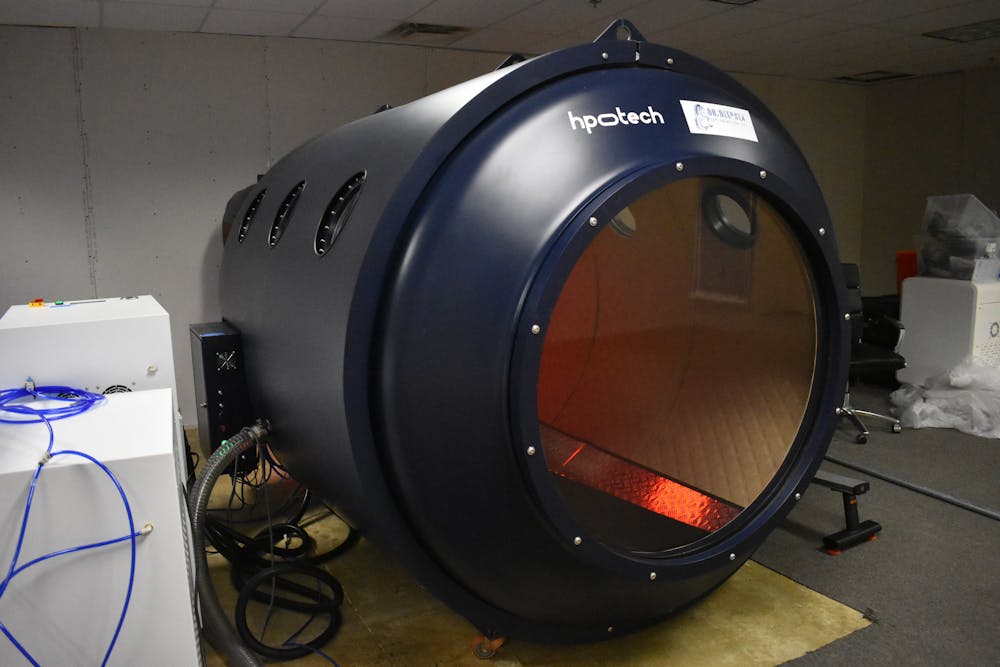
An ASU research team brought together University faculty and health care providers to research how to extend lifespan and quality of life using innovative interventions, including a hyperbaric chamber installed in late January.
The team is competing in the international XPRIZE Healthspan competition, the largest the organization has ever hosted, with 774 teams registered and a $101 million cash prize for the winning team. Judith Klein-Seetharaman, a professor in the College of Health Solutions, created ASU Team Healthspan specifically for the competition.
"We have been participating in that competition since it started," Klein-Seetharaman said. "The ultimate goal of the competition is (to) buy 20 years in an intervention timeframe of one year."
The ASU team's showstopper is a unique, custom-built chamber, for which team member Joe Dituri initiated the design. The "multibaric" chamber delivers both hyperbaric and hypobaric conditions, which allows professionals to control the amount of oxygen a participant receives.
Klein-Seetharaman said she believes metabolic health is central to overall health and to the prevention of age-related diseases. She added that the project attempts to decrease biological age.
"You might still be 90, but maybe biologically, you'll be 70," Klein-Seetharaman said. "Then you have what we call health span, so the time in your life that you can function without any health complications."
Klein-Seetharaman compared using the hypobaric option of the chamber to climbing Mount Everest: the chamber simulates elevation change as the oxygen concentration of the air inside gradually decreases. She said those changes in oxygen levels force the body to adapt in the moment, which builds resilience over time.
With a background in molecular science, Klein-Seetharaman is excited about the new cellular-level interventions available to the team. Using a supercomputer, the team can run models to predict potential target sites for molecules in the body, which helps them prioritize testing options.
"Because of all the recent advances in protein structure prediction, we now have unprecedented opportunities to actually predict all the possible targets that a molecule can bind to," Klein-Seetharaman said.
Sarah Calcaterra, a senior studying biochemistry, said she got involved with the lab through the free hyperbaric training they offered. Additionally, she got the chance to test out the machine herself.
"It's like being on an airplane, but your ears also pop like you do when you get to the top, and then when you come down, they pop again," Calcaterra said. "It was like going 10,000 feet in the air without actually moving a single foot."
Calcaterra said the chamber is not only hyperbaric, but also hypobaric. She added that scientists have studied both types of therapies, but the team is trying something new by researching the effects of both in the same trial.
"When you're in a (hyperbaric) situation, you have the 100% oxygen in the face mask, and you're basically constricting the pressure in your lungs and forcing more oxygen into the blood," Calcaterra said. "The hypobaric is the opposite. You become oxygen-deficient at hypobarics."
READ MORE: AAAS annual meeting highlights ASU's growing role in national science research
Daniel Gonzalez, a junior studying biochemistry, assists with clinical trial data for the lab and works with patients participating in the ASU Team Healthspan research. He said he is focused on assisting patients with exercise and recovery practices.
Gonzalez emphasized the project's focus not only on increasing lifespans but also on longevity. He said the team is working to increase the quality of life for older individuals so they can enjoy their lives with fewer health concerns.
"(Patients) are able to actually enjoy (their) life, instead of actively trying to save up money for health bills and treating these things," Gonzalez said. "We can work proactively and improve your health as you're younger, so that you can invest in your life in the future."
Correction: A previous version of this story incorrectly described how the chamber simulates elevation change. The story was updated on Feb. 19 at 7:43 p.m.
A previous version of this story also described the chamber as hyperbaric. The chamber is both hyperbaric and hypobaric. The story was updated on Feb. 25 at 8:35 p.m. to reflect this distinction.
Edited by Kate Gore, Henry Smardo and Ellis Preston.
Reach the reporters at dforres5@asu.edu.
Like The State Press on Facebook and follow @statepress on X.