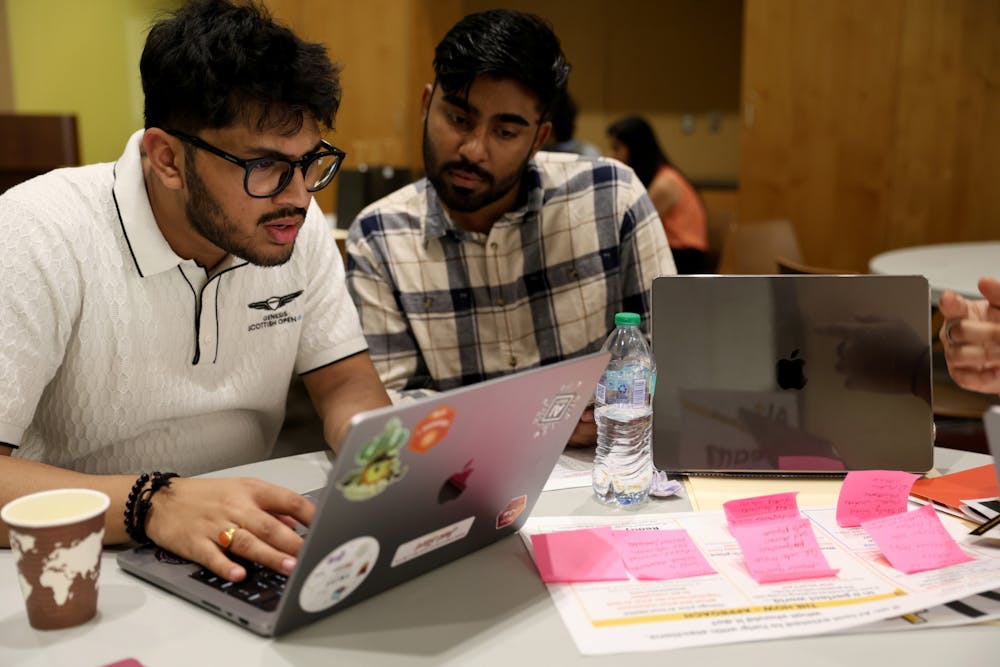
Students developed concepts for AI tools designed to solve election-related problems at a two-part hackathon on Thursday and Saturday.
The first day of the event featured 17 teams that brainstormed an idea for their prototype. At the end of the first session, five teams were selected to move forward in the process of creating their AI tool and competed for a financial prize in the second session.
The AI + Elections Hackathon is part of the AI + Elections Clinic initiative within the Mechanics of Democracy Lab, led by Executive Director Bill Gates and Director of Curriculum Development Allison Lester.
Lester said the event allows election officials and ASU students to build something that could be useful for addressing election-related issues.
"I want participants to take away that democracy cannot outsource its infrastructure to unchecked technology," Lester said. "We need to be a part of co-creating the guardrails, the ethical, responsible use of the technology that can support our lives."
Lester said the hackathon could benefit all students, even those without technical experience.
"Our strength is this interdisciplinary creativity that we can grow ideas from," Lester said. "So this is a really exciting opportunity where you have people from so many different backgrounds that can not only support each other on the actual tool development, but also bring so much creativity."
The first day included participation from election officials. Angie Garcia, an election specialist for Pinal County, attended the event to assist the teams with the brainstorming phase.
"The afternoon was good because I was able to bring my experience to the table," Garcia said.
Garcia added that she was able to provide insight to the students based on her work in elections to help them put their design together.
"They had, already, an idea in mind," Garcia said. "What they needed was feedback."
Lester added that the election officials also spent the morning receiving training on AI models before collaborating with the students.
READ MORE: Maricopa County's inactive voter removal raises concerns about voter education
For students, collaboration with officials shaped both the direction of their project and their understanding of AI's role in civic systems.
The students tackled various problems from both broad and narrow perspectives. They worked to implement AI in the best possible way, not to use AI because they could, but to make things better and more efficient.
Shubham Tiwari, a master's student studying information technology, said he was drawn to the event because of its concept as a collaboration to build something meaningful with election officials.
His team focused on compliance issues across the government's county websites, which needed a quick fix as a deadline to comply with new regulations approaching in April. Many counties' documents, including financial disclosure statements, are scanned, handwritten or formatted in ways that are not ADA-compliant.
The team developed an AI system to convert those documents into an accessible format and make them ADA-compliant. As part of the process, they planned to structure the information to enable future data analysis.
Tiwari said AI is necessary because existing optical character recognition tools are not reliable when converting handwritten or cursive text. For its idea and creation, the team was awarded the first-place prize and $750.
"You're not just building some tool," Tiwari said. "You are really trying to make an impact in terms of creating transparency in society."
Another team sought to solve their challenge from the voter's perspective. Dvir Hamu, a senior studying computer science and Nathan Sheyman, a junior studying computer science, developed an SMS-based AI chatbot called AZ Vote Assist, aimed at simplifying how voters access reliable information. They won second place in the event.
The tool will allow users to text questions to and receive jurisdiction-specific details about polling locations, identification requirements and ballot information with language translation options. The idea emerged from the difficulty of finding election information, which is fragmented online and often spread across multiple city, county and federal websites, Hamu said.
"Finding this information takes a long time, and that disengages a lot of voters from actually going to vote," Hamu said.
Election officials and mentors helped the team refine their idea's scope and identify realistic boundaries. The students said that feedback pushed them to think beyond functionality and consider security, guardrails and implementation risks if the tool were ever adopted in a real system.
"It really teaches you how to create an idea and really develop it farther," Sheyman said.
As the teams worked on prototypes and their pitches, the event emphasized the need to balance innovation with responsibility when developing civic technology. For Lester, that balance is the core of the initiative, bringing students and elections officials into the same room to design tools thoughtfully rather than reactively.
"When you have multiple perspectives together, you get more context, challenge more assumptions, you get more perspectives," Lester said. "That's what makes this hackathon feel unique and exciting, and also hopefully will lead to really creative, principled innovation. That's what we're all about at ASU."
Correction: The first name of Allison Lester was updated on March 10 at 3:30 p.m. at the request of the source.
Edited by Kate Gore, Jack McCarthy and Pippa Fung.
Reach the reporters at ngmohta@asu.edu and msweador@asu.edu and follow @miasweador on X.
Like The State Press on Facebook and follow @statepress on X.
Nikhil Mohta is a sophomore studying B.S. in Finance and is currently a Business Community Leader for the W.P. Carey School of business. He is also an active member in various clubs on campus like PIERA.