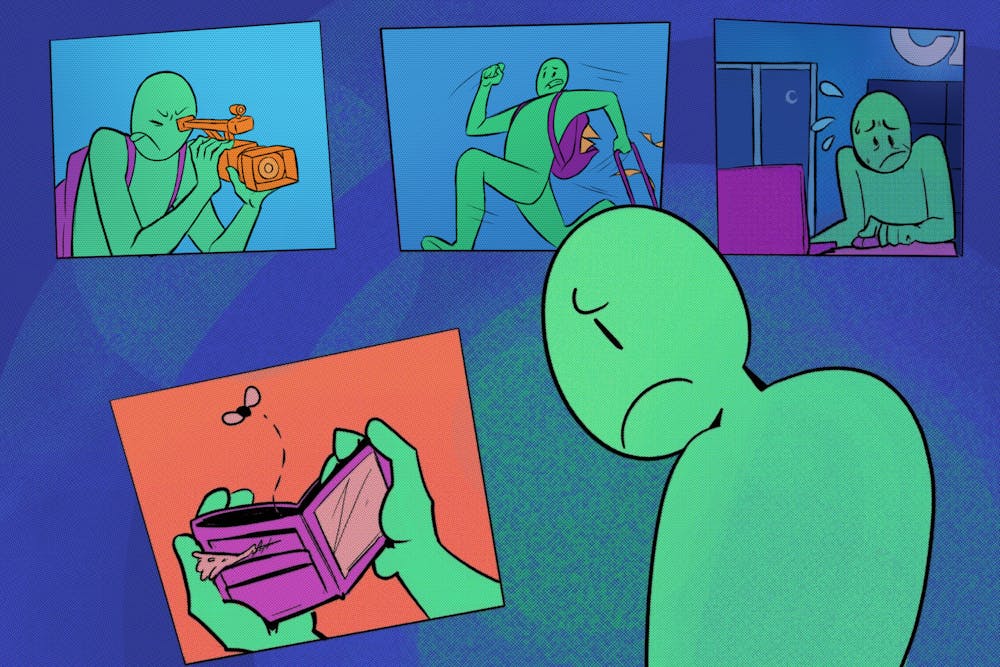
A typical Tuesday for me involves stepping into an office in business casual attire and sitting at my desk as I prepare for a morning meeting.
I create video and graphic content, email back and forth with my client regarding campaign edits and write copy for paid ads alongside my colleagues.
This is an average day in my life as someone who works as a digital marketing specialist for a local agency. Only this isn't a real job. This is an ASU class.
When I first signed up for the Cronkite Agency capstone course, I was in awe of the idea of working for a real-world company and the idea that my content could reach people outside of the Walter Cronkite School of Journalism and Mass Communication.
But after spending the spring semester of my junior year sacrificing 16 hours of my time weekly, I realized that I had provided the school with free labor without many benefits.
At the Cronkite School, every student is required to take a capstone course at least once in their college career.
Capstone course opportunities range from receiving marketing and public relations experience within the Cronkite Agency, producing broadcast and digital content at Cronkite News, to carrying out long-form investigative journalism projects at the Howard Center for Investigative Journalism.
The capstones seem to simulate a real-world environment in every way that a professional job would. The classes take place twice a week, with in-person work ranging from six to eight hours per session.
Students spend all day producing content to benefit a specific client, whether that is a local business or a news organization like Cronkite News. The only thing missing is one of the most important aspects of a real-world job: a paycheck.
"This is a class," Cronkite School Dean Battinto Batts said. "You sign up for the class, this is what the experience is going to be."
Batts described the experience of the Cronkite capstones as a "trade-off" — the sacrifice of pay is made up for in the experience that helps you get a job. But I believe that when carrying out the amount of work that Cronkite students do in their capstone courses, experience cannot be a substitute for pay.
According to Batts, the Cronkite School uses a "teaching hospital" method, meaning students are taught the basics, and by the time they graduate, they are fully prepared to enter the job force within their preferred industry.
"(Cronkite students) understand what it's like to work in a real news environment, and that's why the recruiters want our students," Batts said.
I can understand how this methodology and the simulated experience of a real work environment can provide valuable knowledge to students and experience to their resumes. However, at the end of the day, a line on your resume from a school program doesn't pay your rent.
My junior year experience in the agency consisted of hard work that felt like a real job with real pressure to meet numerical goals for our client.
The intensity of the work was similar to or even greater than the paying jobs and internships I have held in my career. The only difference was that at my real-world jobs, I received pay, time off and respect for work-life balance.
Even though I was only required to take one semester of a capstone course for my degree, I made the decision to participate in the agency again because I had extra room in my schedule and wanted to gain more experience before graduating.
But when I returned to the class in January of this year, my initial disappointments with the program were reaffirmed.
When you attend the agency twice a week, you are only allowed one day off throughout the five-month semester before your grade is impacted. It was also recently suggested that I shorten one of my lunch breaks because it overlapped with a team trip.
These instances, compiled with the intense workload within the program, make it hard to see why the capstones are like a job in terms of pressure, but cannot be treated like one in terms of benefits. Cronkite cannot have it both ways.
Some students do not view the lack of pay within the Cronkite capstones as an issue. Maria Loiseau, a senior studying journalism and mass communication, participated in the Cronkite News Washington, D.C., capstone program as a broadcast reporter.
While Loiseau said the capstone experience feels like a job, she does not believe that Cronkite should have to compensate their students for their work in the program.
"It's our step into the real world while still being under a safety blanket," Loiseau said. "Personally, I do understand why Cronkite doesn't pay."
However, Loiseau did acknowledge that in a previous journalism course where she had to commute to Scottsdale weekly for her beat coverage, Cronkite offered no financial support for travel costs.
"In those first two years of college, a lot of people don't have a car," Loiseau said. "They don't have the time or the academic stability to go get a job. That's something that's always been on my brain with Cronkite."
At the moment, financial support for capstone students is only available in the form of six $5,000 stipends, three each for those participating in the Cronkite News L.A. or D.C. bureaus. It is only "limited" and "need-based." The school also helps with travel and transportation costs for students relocating to these cities for the program.
Some capstone programs, such as Cronkite News, offer funding for out of state trips where students have the opportunity to cover stories outside of Arizona.
Additional scholarships are available only for participants of the Cronkite D.C. Bureau. For Cronkite News' home base in the Valley and the rest of the Cronkite capstones, the students are left to fend for themselves.
When asked about the possibility of paying future Cronkite capstone students, Batts was open to the idea, saying that it comes down to receiving support from a donor, since raising tuition or student fees to fund it is not an option.
"The resources that we have now mandate that (the capstone) is really a class," Batts said. "And paying students for that work is just not something that we're really able to do."
While I have not seen any compensation for my work or for my peers' work in the Cronkite capstones throughout these past four years, I hope that one day Cronkite can respect the labor of their students enough to pay them for it.
Editor's note: The opinions presented in this letter are the author's and do not imply any endorsement from The State Press or its editors.
Edited by Natalia Rodriguez, Henry Smardo and Pippa Fung.
Reach the reporter at wmaddox@asu.edu.
Like The State Press on Facebook and follow @statepress on X.
Wendy is a junior studying journalism and mass communication. This is her first semester with The State Press. She has also worked at ASU Gammage.