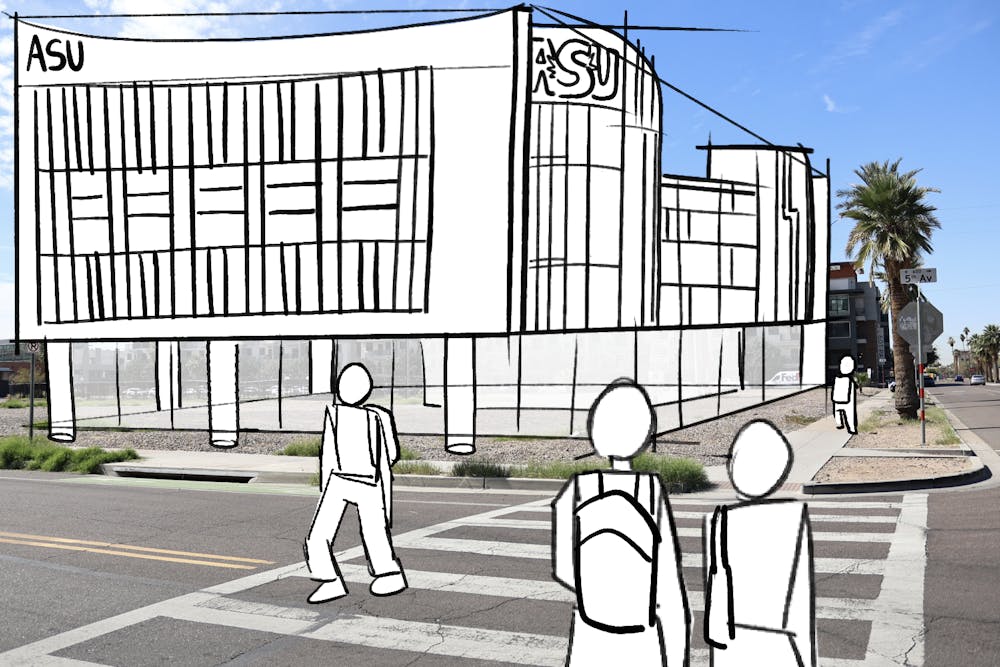
Officials from the John Shufeldt School of Medicine and Medical Engineering said the school hopes to create a new kind of doctor: the physician-engineer.
"Our medical engineers are going to be trained in AI systems," ASU President Michael Crow said in an exclusive interview with The State Press on March 24. "They're going to be trained in engineering, and they're going to be trained in medicine, and we think it's going to produce a more comprehensive, capable doctor."
The school's curriculum blends medicine, engineering, emerging technology and health humanities into a dual-degree program. Every graduate will earn a Doctor of Medicine with a Master of Science in medical engineering.
READ MORE: ASU to launch new medical school in 2026 with nine-figure gift from alum John Shufeldt
Crow announced ASU Health in 2023 as part of the Arizona Board of Regents' AZ Healthy Tomorrow initiative to address Arizona's health care workforce shortage. Nationally, Arizona is ranked No. 34 in health care performance, No. 42 in access and affordability and No. 49 in prevention and treatment, according to ASU Health.
On March 24, the city of Phoenix approved a $50 million investment into ASU Health, the City's largest direct investment contribution to a single bioscience project, according to the City.
ASU Health will expand its reach in the fall with the opening of the medical school.
Thinking about medicine like an engineer
"What I want them to be able to do is problem solve, and grow with AI and grow with technology so that they remain cutting-edge tool-users," Heather Clark, the senior associate dean for engineering integration, said.
The engineering core classes stand alone, separate from the medical courses, with a dual-cohort style. Students will attend their engineering classes alongside medical engineering master's students from the School of Biological and Health Systems Engineering to further integrate the disciplines.
"What I hope is that in 10 years, they're in the clinic, and they see a patient and they think, 'Wow, I need a better tool,' and reach out to their friends in engineering who are taking those classes right there with them, and they can start to tackle those problems," Clark said.
The four-year program is broken down into three phases.
In the 16-month pre-clerkship phase, students learn how the body and medical instruments generate and verify clinical data, how to create and use new AI tools and how to use those tools to reinforce their learning.
"We are thinking about the heart through the lens of engineering as valves, pumps, fluid flow and how those change in disease, and more importantly, how do we know it," Clark said. "We know what signals it is generating and then using AI to say, 'Okay, could we do this a little bit better?'"
READ MORE: ASU lab embeds AI into wearable medical systems
In the 12-month clerkship phase, students complete six rotations in clinics, each followed by an "innovation week" where students design projects based on their experience.
In the final, 18-month post-clerkship phase, students complete an innovation project identifying a problem, designing a solution and implementing it using digital technology.
Students can pursue their own ideas, partner with physicians in the community or work in the new medical technology innovation suite.
The suite is a patient-free space where students can develop digital tools. Clark said the University is building five suites, each tailored to a different area of health care, linked by an AI hub.
"I really want to keep their mindset towards innovation so that they are continuing to innovate and question and think about how things could be different and reaching out to peers, so that they can put together solutions and start companies and really keep revolutionizing health care," Clark said.
A tech-forward approach to clinical education
At the Shufeldt School, traditional methods of teaching clinical skills and anatomy, like cadavers and dissections, will be replaced by virtual reality labs and digital patient avatars.
Elizabeth Baker, senior associate dean of medical education, said this change gives students a more realistic look at human anatomy because it mirrors functioning bodily systems and tissue better than a cadaver. Baker also added that it avoids potential issues related to cadaver preservation and ethics.
"We can really put ourselves in this emergent technology that allows us to see things in the functional way in which it would have looked in the person while they were alive," Baker said.
Students will also interact with a series of AI patients and people acting as patients.
READ MORE: How ASU is using artificial intelligence to train the doctors of tomorrow
These practices will be integrated into a flipped classroom model, where students prepare themselves independently through assigned readings and video lessons, then come to class to apply their knowledge to cases.
Baker implemented the model at Rush Medical College, where she has spent over 30 years of her career. She decided to come to ASU because she wants to improve health care at a systems level.
"I really have seen firsthand how our system doesn't necessarily work for the average person," Baker said. "(I was) thinking about how exciting it would be to train a new generation of students to think a little bit differently about medicine and really to be problem solvers."
Approaching care with a health humanities toolkit
Another key aspect of the school's plan to address Arizona's health care needs is its health humanities focus.
With the help of other humanities leaders over the past few years, Cora Fox, associate dean of health humanities, formed four core competencies for the curriculum: narrative; ethics, ethical reasoning and critical thinking; structural and systems; and intercultural.
Fox said narrative competency is understanding how stories work and recognizing that the stories told about health are important and directly impact patient outcomes.
To navigate local cultural values, ethics competency goes beyond bioethics and explores its relationship to public health, disability, technology, entrepreneurship and environmental ethics, Fox said.
She said intercultural competency is understanding how cultures work and how to communicate across them.
Structural competency is understanding how people exist within cultural structures and health care institutions, she said.
"The integration of these humanities competencies into the curriculum is often done by medical schools that have been established for a very long time, and so they're trying to put it in on the edges of the curriculum," Fox said. "It's a very different exercise than what we're doing here, which is building something from the ground up in a very ASU way."
The competencies are designed to equip the students with a toolkit to address Arizona's health needs while also understanding those communities before offering solutions.
"We need to create a way of approaching those problems that puts human beings and communities at the center," Fox said.
Fox also emphasized the importance of a mutualistic relationship between clinicians and their patients, where the needs of both the caretaker and the recipient of said care are met.
"Sometimes health care providers don't like the term 'provider,' because it's not like you make a package of care and you provide it for somebody, it's a relationship," Fox said. "We want to make sure that we pay attention to the emotional, the well-being, the resilience needs of the carers in that relationship."
What prospective students are saying
Armin Abdollahzadeh, a junior studying medical studies, is interested in attending the Shufeldt School for its focus on engineering and entrepreneurship.
Abdollahzadeh said he wants to open clinics in underserved, rural areas in Iran and Mexico, the countries his father and mother were born in, respectively. He said the school's focus on impact aligns with that goal.
"(It's) not just being a regular physician," he said. "(It's) also thinking outside of the box and being able to develop different solutions and deliver those solutions as well."
Haley Patel, a sophomore studying medical microbiology, said she was drawn to the school because of its ability to address Arizona's health disparities.
She also said she wants to work with the school's partner, HonorHealth.
"They see so many wide (varieties) of patients," Patel said. "It would be beneficial to see those cases and learn more about how I am able to close that gap."
According to the Office of Admissions, the Shufeldt School has received 832 applications, invited 224 applicants for interviews and accepted 24 students.
"We need people who are ready for an adventure," Baker said. "We're going to be very adaptable ... We are not going to have everything perfect the first go around, and we need our students to create with us, to say, 'This was great, and here's something that we could do better next time', and to be invested in making this curriculum the best it can be."
Edited by Kate Gore, Henry Smardo and Pippa Fung.
Reach the reporter at sevoorhe@asu.edu and @sydneyontheair on Instagram.
Like The State Press on Facebook and follow @statepress on X.
Sydney Voorhees is a science and tech reporter, focused on STEM-related initiatives at ASU and their influence on the local community and beyond. She is a Journalism and Mass Communications major with a minor in Global Studies. In addition, she is also a news anchor on The Cut Network and a political reporter for The Flare TV.