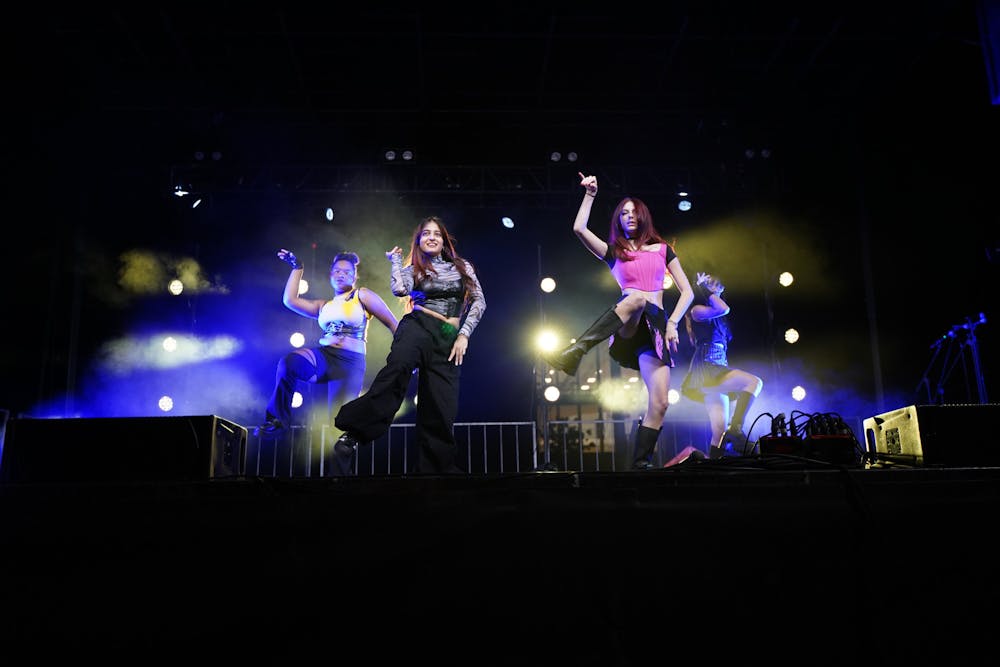
ASU is home to a variety of cultures, identities and students who seek to find their niche on an ever-growing campus.
From K-pop group productions to Latin and ballroom routines with storied cultures and histories, dance clubs represent the intersection of expression and sports that so many students look for in college.
READ MORE: Celebrating diverse voices: ASU artists break barriers through creativity
K-pop Dance Evolution and Devil DanceSport provide opportunities for students from a variety of backgrounds to explore dance styles and rhythms from around the world.
Jon Aceves, a sophomore studying marketing and a graphic design intern for KoDE, characterizes the club as a "safe space" for any and all to meet and celebrate their shared love for K-pop and dance.
"I would describe KoDE as a club that teaches K-pop choreography and immerses yourself into the world of understanding different K-pop dances and getting to know the different types of groups through the choreography and through the music," Aceves said.
Friday meetings are a place for KoDE members to convene, learn part of a K-pop routine and enjoy the rhythm of the music with their peers.
The cultural aspect of K-pop dances influences how the club hopes to pay homage to the origins of its routines alongside the larger Asian music scene as a whole.
"It's very important that we appreciate the culture, not just of K-pop which our club is based off (of), but we can branch out to other types of pop and understand the cultural significance of it in a different sense," Aceves said.
KoDE's social media also plays a large role in how Aceves and other graphic designers for the club showcase the aesthetics and imagery associated with K-pop. Curated posts, bright colors and famous K-pop stars place KoDE's Instagram in dialogue with the culture it celebrates.
Similar to KoDE, Devil DanceSport is open to all ASU students, with presence on both the Tempe and Polytechnic campuses. The club hones in on ballroom and Latin dance, with focus placed on the prevalent styles of waltz, tango, foxtrot, cha cha, rumba and East Coast swing.
A tribute to culture is innate to these styles; cha cha and rumba originate from Cuba, and tango is a mix of European, Argentine and African styles.
Hunter Trujillo, a junior studying aeronautical management and technology, serves as a director of Devil DanceSport on the Polytechnic campus. As a dance instructor, he brings a knowledge of the history of certain dances from his earlier years learning ballroom and Latin styles.
"It's really important to focus on where the dance comes from so we can understand why it's like that," Trujillo said.
Additionally, Devil DanceSport emphasizes the role of individuality and personal expression that is so inherent to dance. Each style has its own traditional moves, steps and routines associated, but members and competitors have free rein to style certain movements to their liking.
READ MORE: In motion: The mind of a dancer
"We put so much of ourselves into the dance and into our styling," Silas Kirby, a sophomore studying aerospace engineering and the social media and outreach coordinator for Devil DanceSport said. "The judges get to know who we are through how we're doing these moves."
Dance lessons and sessions at Devil DanceSport are free for anyone at any level, and the sessions are taught by ASU alumni and dancers throughout the Latin dance community, Kirby said.
At the heart of both KoDE and Devil DanceSport is a dedication to the accessibility of niche styles of dance through free meetings and lessons as well as a desire for building communities based on that shared love of culture and movement.
And beyond that, at the center of every dance club at ASU and every dancer that joins in the performance, is an undying passion for the beauty of moving one's body in time with a song, in rhythm with every dancer in the room.
"When we show up on Friday, we're all dancing as a group, and we're just having fun experimenting a little — that sense of community, that's what I really feel is what dance is about," Trujillo said.
Edited by Niall Rosenberg, Senna James, Emilio Alvarado, Sophia Braccio and Pippa Fung.
Reach the reporter at bcsmit41@asu.edu.
Like The State Press on Facebook and follow @statepress on X.
Brooklyn Smith is a sports reporter for The State Press and an English Literature and Economics student at ASU. She is in her 2nd semester with The State Press.