I'm sore.
It's not exactly a mystery as to why. My eight months studying abroad in Barcelona have worn me to the bone. I'm walking 15,000 steps a day through cobblestone streets, grabbing lifts before class and enduring sleepless nights, whether I'm dancing until sunrise at a techno club or suffering through another Ryanair flight. I feel a little old saying this, but my legs are shot.
Despite my fatigue, I've never felt more awake. My body aches, yet it's pleading to move, to find the unfamiliar and let it shape me.
I don't want this soreness to end. I want my legs to hurt forever.
Almost paradoxically, movement starts by staying home. Every day, I make the half-hour odyssey from campus to my homestay for lunch, and every night I hurry across the city to make it back by 9 p.m. for dinner with my host family.
The logistics can be inconvenient, yet the effort to move always pays off.
During these gatherings, the conversation takes center stage over the ingredients. Sharing a home-cooked meal tends to lower our guard. Stories are poured onto the table like the wine into our glasses. Differing values, opinions and politics naturally spill out.
Although my Spanish and Catalan could certainly use some work, what I've gained from talking around the table has outweighed my grammatical flaws, revealing to me a greater sense of camaraderie that I want to see mirrored in the culture back home.
READ MORE: Insight: The American day is due for a facelift
Movement can be small — I saw two German students in my political science class, moved a couple seats closer to them and spent the rest of the semester embroiled in friendly arguments about national identity that quietly influenced how I thought about my own.
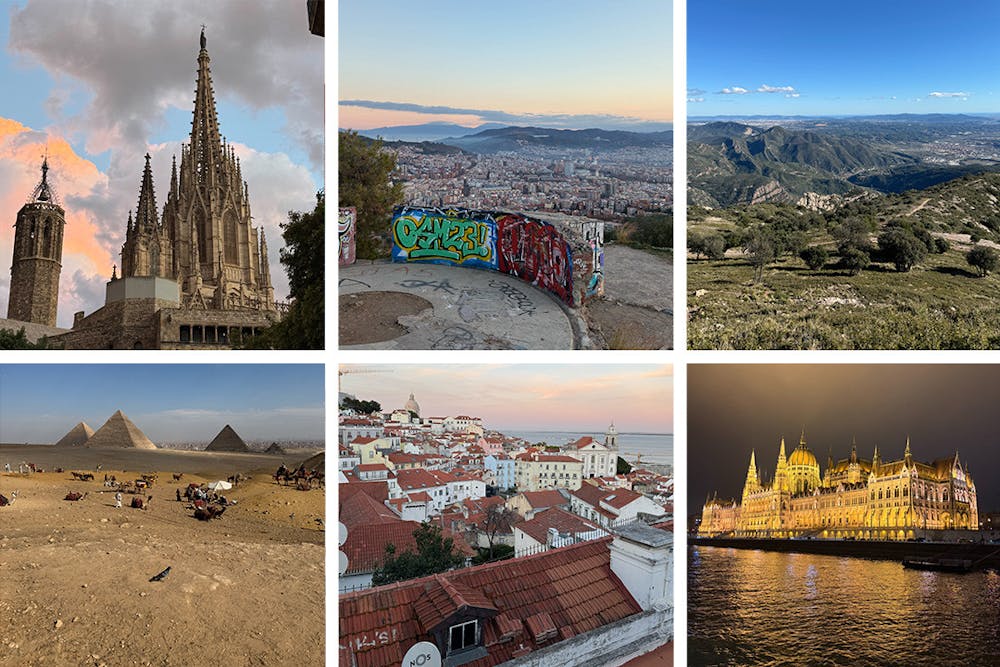
Movement can be large — weekend trips pushing through the steep hills of Lisbon's Alfama district and the basalt-capped mountains in Egypt's Black Desert have rewarded me with sublime landscapes that neither memory nor camera can do justice.
Distance pales in relevance to discomfort. The language barrier is an omnipresent reminder that each country I visit is not my home, and it stings when my attempts at Catalan are met with confusion and a terse English response, instead of connection.
Nevertheless, it's necessary. While it's easy to move through a tourism-saturated area like Barcelona just speaking English, you'll end up keeping the city at arm's length.
The attempt matters more than the execution. Being willing to be bad at something on someone else's behalf signals respect and opens the door for culture to flow (alongside cheaper prices at the markets).
READ MORE: Language in pieces
Above all, movement is anything but secure. The roads can be smooth — those late-night walks with my friends will remain some of my fondest memories — but they're often bumpy. I still get a bad taste in my mouth when I think of frenetically sprinting through the Gothic Quarter after two men who stole my phone last December.
I was forcefully reminded, if not humiliated, by the city that I didn't belong. No matter how much I learned the languages, avoided the tourist traps or memorized Barcelona's rhythms, I was fundamentally an outsider. I didn't sleep for two nights after arriving at that conclusion.
The harshest bumps in the road have never manifested in walking, but rather the reckoning that follows. I'm forced to confront my ignorance no matter where I find myself.
Each time I hear conversations flow out of cafés, marvel at landmarks older than my country or move through vast swathes of natural beauty, I'm reminded of how insulated my frame of reference is after spending the first 21 years of my life in Arizona.
I'm just a kid from the desert wandering through medieval European alleyways. I've seen so little of the world, and I understand even less.
For someone who prides himself on knowing a little about everything, consistently finding myself face-to-face with the limits of my understanding has proven to be humbling.
Bruises to my ego aside, I still push to get up. Movement comes with hard truths, but it also offers a chance to rebuild — to ask more questions, make fewer assumptions and trust that I'll go to bed a little more aware than the person who woke up that morning.
There's still so much left to experience, and it would be naïve to expect the road ahead to be without obstacles.
Unfortunately, there's a deadline stamped in my visa, a firm reminder that travel is a temporary privilege steeped in cost and red tape. I'll leave Europe with the unfortunate reality that I didn't see all that I wanted to, and I don't know when I'll have the chance to return.
Fortunately, movement was never restricted to Europe.
Although my days of meandering through Barcelona's dim, yellow-lit corridors are behind me, there's plenty of movement back home. I'll just have to seek it out.
Granted, getting around is a little harder by virtue of the Valley not exactly being walkable, and there are certainly fewer avenues for communities to reveal themselves. Nevertheless, I'd be wildly arrogant if I said I had either my hometown or college town under my belt — much less Arizona.
There's no shortage of unspoken conversations to be had, overlooked corners to explore and familiar stops to revisit with my changed eyes.
I'll just need to take a foam roller to my legs first.
Edited by Sophia Braccio, Jack McCarthy, Emilio Alvarado and Ellis Preston.
Reach the reporter at stroeste@asu.edu and follow @samtroester on X.
Like The State Press on Facebook and follow @statepress on X.
Sam Troester is The Echo Editor at The State Press. He is a senior studying political science and is in his fourth semester with The State Press.