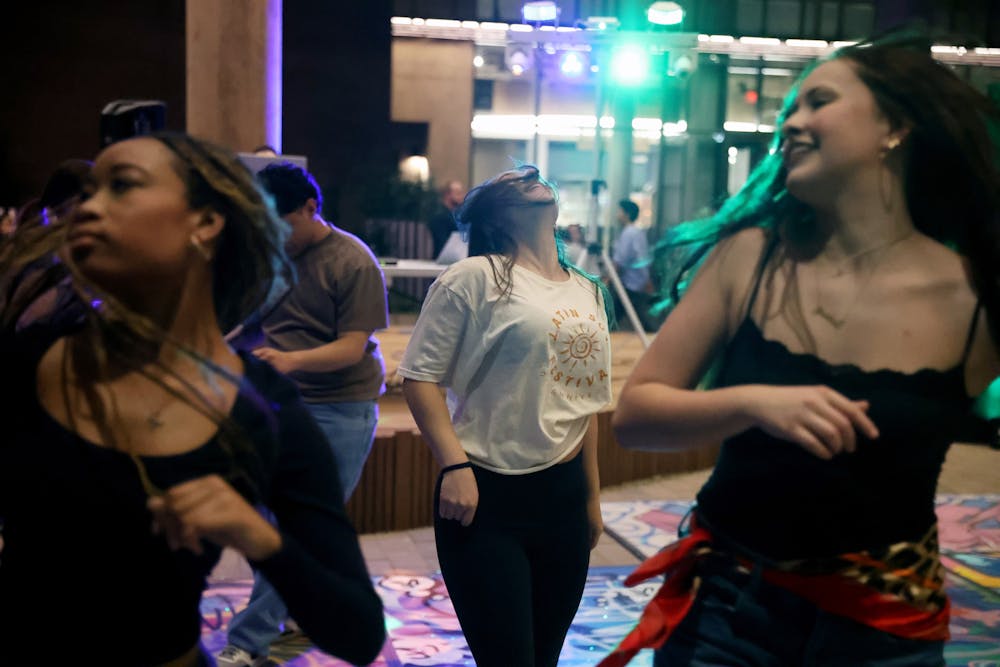
Latin Sol Festival, an annual celebration of Latin dance and culture, marks its 10th anniversary with more than 1,000 community members coming together on the dance floor.
The celebration, which takes place on the Tempe campus, consists of workshops taught by artists, performances and socials, which are partner dances done for enjoyment rather than competition or performance.
The celebration implemented new things such as a live band, new spaces for workshops and moving the socials outdoors, Gala Garrido Carralero, a doctoral student studying musical arts and festival co-director, said.
David Olarte, a professor at the School of Music, Dance and Theatre, created Latin Sol back in 2017.
When he started working at ASU, creating the salsa curriculum, he realized Arizona lacked this type of festival, and it was preventing students from having a chance to be fully immersed in the culture.
"It's an opportunity where you can just grow as a dancer and as a person," Olarte said. "I felt like this festival, if we could have it on the campus, if it was free, ... it could be accessible to any student that was curious about salsa or about community."
Despite being the founder and faculty sponsor, Olarte is no longer at the head of the event. Latin Sol is proudly student-led, co-directed by two students — Garrido Carralero and Catelyn Chang, a graduate student studying biology.
Vincent Tran, a senior studying computer information systems, who is also part of the committee, was in charge of consulting, marketing and web design, as well as Anahi Garcia, a junior studying mechanical engineering, who is in charge of graphic design.
"Because it's student-led, it becomes student-centered," Olarte said. "If a festival is going to represent ASU on campus, it's got to represent the students that it's supporting."
For Garrido Carralero, taking on this leadership role heavily stemmed from her position as a graduate student.
"This is a moment when you need to start taking initiative in doing things," she said. "And of course, it will depend on the person, but being able to be part of creating something — this is a reward."
In Tran's case, he said he "got way in over (his) head" when he initially signed up to be a member of the committee. He expected the committee to have more executive members, which it did not, creating a heavier load on the four students.
"At the end of day, it was just even more rewarding, I'd say, like, 1,000 times more rewarding, seeing it from the perspective of a planner and an executive member of the committee, than it was as a participant," Tran said. "I don't think it would even be remotely near the same satisfaction."
At the event, one of the students dancing on stage was Ashia Rose Cardines, a senior studying sociology. One of the most powerful moments at the festival for her was a poem read about colonialism and current-day struggles.
"Despite everything happening, we're still dancing, and dance is a form of resistance to those negative things happening," she said. "When we lean on each other and create that community, it definitely helps."
The festival places a big emphasis on the culture behind the art. Its programming consists of bachata, cha cha cha, Latin hustle and Afro-Cuban movements alongside salsa.
Each artist is asked to teach not only the steps but also the history and meaning of the movements.
"Latin Sol brings all these together in the same place, not just to celebrate but to revindicate what this culture and traditions means," Garrido Carralero said.
The community this event creates is the most important part of the festival, Garrido Carralero said. It creates an opportunity for people to come together and have fun without competition.
"We are just a whole community that is going to support you no matter what, and you're not going to feel judged,” she said.
Edited by Natalia Rodriguez, Henry Smardo, Emilio Alvarado and Ellis Preston.
Reach the reporter at dkovalen@asu.edu.
Like The State Press on Facebook and follow @statepress on X.
Diana Nychyporuk is a Podcast Reporter at The State Press. She previously worked as a reporter for the Community & Culture desk. Diana is pursuing a degree in Journalism with a minor in Political Science.