Growing up, my grandmother would always read me the old Arabic folklore story "I Love You Like Salt."
A king summoned his three daughters and asked each of them how much they loved him. When the third responded, "I love you as much as I love salt on my food," the king ousted her from the kingdom, believing that comparing her love for her father to loving salt on food was insignificant. Years went by and one day, the king was unknowingly served saltless food by his estranged daughter. As he tasted the bland, unappetizing meal, he broke down in tears, having realized only then how much his daughter loved him.
The story may seem silly at face value, but there are many lessons to be learned from it. Some people say, "You don't know what you have 'til it's gone." Others may say, "Everyone loves differently." One might also say it's important to "ask questions before you rush to conclusions." For me, I would say we need to open our minds and be a little bit more creative. Maybe this is what my culture needs more of.
I have always wondered why the king didn't ask for an explanation. Why did he so hastily banish his daughter from the kingdom? In the years that went by between exiling his daughter and trying unsalted food, he didn't once think to understand how much salt does for food? While this is just folklore, I think it can be used to analyze Arab culture in a deeper way.
Whenever I am asked where I'm from, I always feel proud to call myself a Jordanian and an Arab. I feel proud of my identity, my family and my roots. But, I'm far from patriotic about everything. In fact, a deep sense of pride would probably be a fault in our culture. I often hear Arabs claim that we come from a "perfect" culture, one that has contributed to the world through algebra, algorithms and geometry. And while yes, it is true we've given so much to the world and we had a golden age, I still think we're far from perfect today.
A lack of acknowledgment
Today, our economies are, for the most part, worn out and the youth are left with little opportunity back home. Every year, migrants leave the Middle East due to war, poverty, lack of opportunity and even religious or ethnic persecution. I certainly wouldn't call our region of the world "perfect."
I'll start with one of the first detriments — our pride. I find that many diaspora communities tend to feel a deep sense of it for their homeland, and we are no different. Many of us proudly claim our Arab heritage and identity, but why do we claim it's the best?
But if we are the best, why have millions of us left our home countries and sought to build new lives abroad? I think we may struggle to admit that pride has gotten in the way of progress. Why change your culture or progress when you feel it's perfect?
I've found it increasingly difficult to travel back home each year and face the growing poverty and difficulty many go through. I am often reminded that even the smallest of delights is a privilege compared to what many have back home. Even my home country, Jordan, which is considered to be a "safe haven" and a point of regional stability, has been greatly affected by the ongoing wars in neighboring countries, a refugee crisis and a desperate tourism industry.
When we sit in our homes in the diaspora comfortably and call our homelands perfect, we erase the struggles our people go through. I would compare our pride to that of the king. By calling our countries "perfect," we do what he did to his daughter — jump to a conclusion without interpreting what we've actually seen or heard.
When you travel home and deny the reality of what you are seeing, there will eventually come a summer when you go home and feel shocked at how bad it's gotten overnight. The king had years to try saltless food, and we had years to see the growing issues surrounding our community, but we didn't intervene until it came knocking on our doors.
Rules for she but not for he
Our culture also insists on clinging to old age gender stereotypes, resulting in a deep level of gender inequality. I see many Arabs grapple with this idea by saying our culture "just likes to protect women" or "it's just our family values."
Being conservative and being misogynistic are not the same thing. If our culture was interested in protecting women, we would work to end domestic violence, preserve autonomy in marriage and bring awareness to breast cancer — which is heavily stigmatized in the Arab world. All of these things deeply affect the lives of women, but instead, we claim that preventing women from traveling alone or leaving the house past 8 p.m. is "protection."
As an only child, I never experienced first-hand gender inequality in my family, but I have witnessed it with my friends and cousins. I have friends who need to abide by one set of rules, while there is a different set of rules for their brothers. While her curfew is 8 p.m., her brother is out past midnight playing cards with his friends. This reflects a deep distrust in women because the belief is, "If she's out past 8 p.m., she must be doing something wrong or bad." Men, on the other hand, are either trusted to do the right thing or they are allowed, and even encouraged, to do the wrong thing.
This misogynistic attitude seeps into so many aspects of Arab life, especially marriage. No matter how far removed they are from the motherland, Arabs often desire to marry young. In fact, we're told it should be the main goal and ultimate purpose of our lives. And just like with everything else, women are expected to sacrifice the most for it.
But how can Arab women feel so comfortable marrying young when we are not even guaranteed the right to pass our citizenships to our children? Or be ensured proper custody rights in the case of divorce? In most Arab countries, women can not pass down their citizenship to their children because citizenship is tied to the child's paternity. I have heard countless stories of custody battles in Jordan that resulted in a father taking the children to live overseas without the mother's consent.
In my experience, I've found Arab women to feel intrigued by the idea of "princess treatment" from a husband. While I don't hear much of this talk back home, I do hear a lot of it in the diaspora community. I recall a friend a few years back telling me that her dad paid her college tuition because "it was expected in our culture" and "he loved her, unlike other people's dads." While yes, our culture does play into the heteronormative gender roles where men are responsible for meeting their family's financial needs, this doesn't mean all families live in such luxury.
Do the fathers in Syria who lost their livelihoods to a civil war not love their kids because they can not pay private university tuition? Do fathers in Lebanon who lost their life savings in the currency crisis not love their wives because they can not afford to enjoy lavish restaurants? Obviously, the answer is no. And just because a man can provide, in a financial sense, doesn't mean he really loves his family. I have heard countless stories about emotionally and physically abusive husbands. And just like all cultures, our culture is filled with love, toxicity, joy, heartbreak and all the other emotions that come with relationships. When we make blanket statements like "men in my culture always provide for the woman," we are, again, erasing very real problems women experience.
What if?
What if our society was more creative? What if we stopped and reflected before we jumped to conclusions? Let's say the king heard his daughter's remark, paused and ordered his chef to make him a saltless meal. He could have understood right then how much his daughter loved him, avoiding a long exile and having to face this pain years later.
What if we faced our culture and said, "Yes, we do have problems, and we must work together to give the next generation a brighter future." The first step to solving our problems would be to accept their existence. Our culture has excelled in countless aspects. From our preservation of language, art, food and history, I could go on forever about my love for the Arab world. But it's hard to express my love for it when I feel rejected by it.
I often feel alone in my critiques of Arab culture. I'm often met with remarks that I've become westernized or that this is just the way things are and I must accept it. But, I know this to be false because our culture, and all others, have changed with time and by internal and external forces.
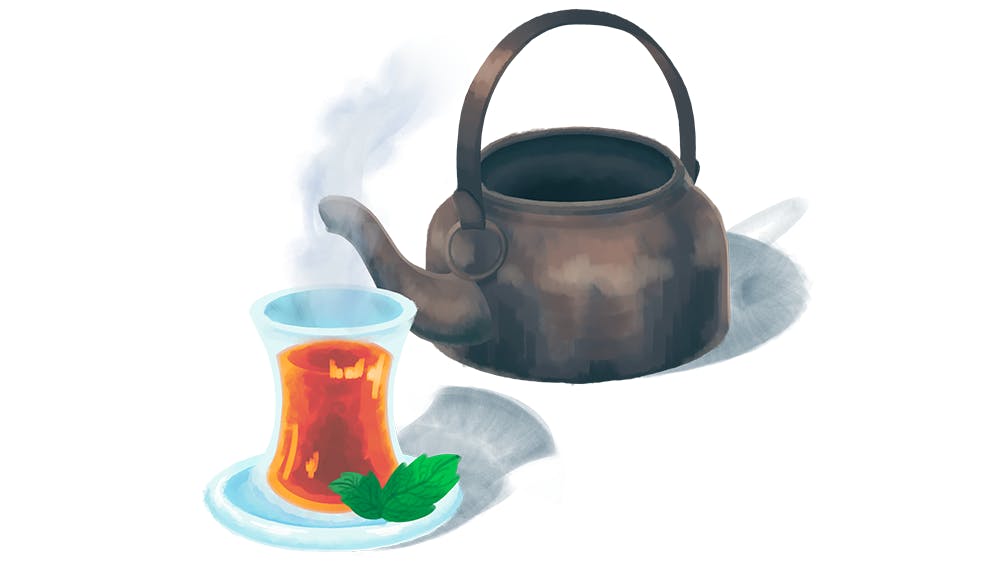
Us Arabs often drink tea at family gatherings. Tea often comes with discussion, reflection and hospitality. I've had some of my most intense discussions surrounding cultural norms, politics and religion over a cup of tea. We always drink tea made in a traditional kettle. It's not a fancy glass kettle, but a stainless steel kettle. First, you bring the water to a near boil and add it to a spoonful of sugar. Once it's boiled, you turn off the stove and add your tea bag. But, the one step that makes or breaks the tea, in my eyes, is the mint. Without it, the tea tastes bland to me. It's good, but it's not great. The mint is what adds all the flavor that sugar and a tea bag can't give you.
I'd say this is similar to our culture, which is amazing in so many ways, but it is missing something. Maybe the mint could be our acknowledgment of the very real problems we have instead of ignoring them.
Edited by Leah Mesquita, Natalia Jarrett and Abigail Wilt. This story is part of The Culture Issue, which was released on March 25, 2026. See the entire publication here.
Reach the reporter at jbanihan@asu.edu
Like State Press Magazine on Facebook, follow @statepressmag on X and Instagram and read our releases on Issuu.
Jude is a junior studying finance. This is her second semester with The State Press.