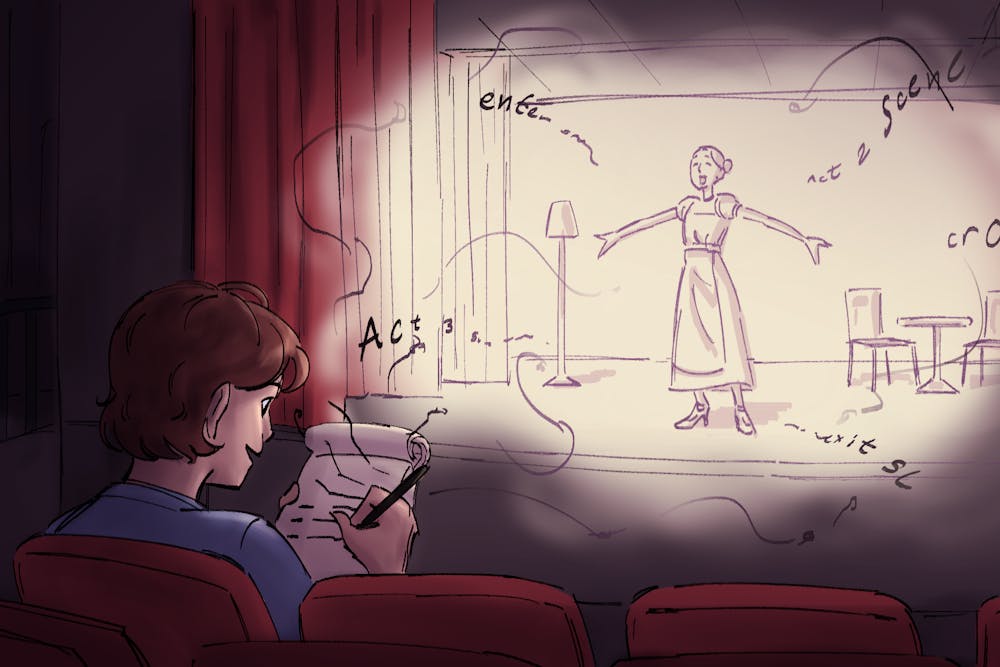
ASU's School of Music, Dance and Theatre launched a new initiative last semester, which provided students with the resources to bring original and experimental work to life in front of an audience.
The New Work Lab began taking applications in the fall of 2025 and spent the semester preparing to showcase chosen scripts. All works are held in the Lyceum Theater, giving students rehearsal space, dressing rooms, lighting, scenic props and marketing.
Idris Goodwin is a professor of dramatic writing in the School of Music, Dance and Theatre and head of the New Work Lab. He said his interest in the project was inspired by his work as a playwright for 25 years.
"We're looking for variety," Goodwin said. "We want to show the breadth and diversity of the different kinds of stories that people want to tell (and) the different approaches to theater."
Each show may be presented in different forms. Some were staged readings, a more casual demonstration where actors have scripts on stage, while others were fully-fledged productions. Each show had as many as three ticketed public performances.
After a successful first year, the New Work Lab is excited to continue the project next year, Goodwin said.
"While We Wait" is a play based on interviews with Ukrainian people experiencing the ongoing war with Russia. It was written by Anastasia Levkun, a graduate student studying theater, who also acted in it.
The piece was created with devised theater, a collaborative process that uses improvisation instead of a script.
Miranda Martinez, a graduate student studying directing, was an assistant director and dramaturg for "While We Wait." As dramaturg, her role was to research the topic and ensure accuracy.
She said pronunciation and dialect guides were a large part of her role, because some interviews had to be translated from Ukrainian.
Martinez also said part of her job was to write down on a whiteboard what actors improvised during rehearsals so they could piece the show together.
Martinez said that when the show was performed, the audience reaction was very touching and visceral. She said it was important for the crew and cast to make sure the stories being told connected with the audience.
"We could hear sniffles, and we could hear all those things," Martinez said. "That means it's hitting hard. So it seems like we had a really, really good audience experience."
Martinez also said the crew wanted the play to spread the message to keep Ukrainian hope alive.
"Universe Under Your Tongue" was written by Sparrow Dineen, a graduate student studying interdisciplinary digital media for performance.
The play follows a conversation between a parent, played by a University student, and a child, played by a seventh-grader from the community. An ASU professor served as a dancer for the show.
"It's been very cool getting these different levels of experienced performers together in a room, working through this play," Dineen said.
Dineen said he was influenced by his time growing up in India. It uses an Indian folk tale to spark conversations about the current state of the world.
"It's definitely a piece that combines these classical and ancient performing arts forms with modern technology," Dineen said.
Dineen and the cast experimented with different types of performance, including Bharatanatyam, a traditional Indian dance.
They experimented with sound, video projection and live music to create the world of "Universe Under Your Tongue." Dineen called it a prototype of his vision for the play.
"(It has this) message of hope and care for each other in the world," Dineen said. "Getting to see people express that through these words that I wrote has been really beautiful and inspiring."
"The Sixth Session" is a dark comedy by Erika Acuna Levya, a graduate student in the dramatic writing program.
Levya said the play was inspired by mental health challenges a friend experienced, as well as a book about toxic relationships.
Levya wrote the script for a class and forgot about it. She said when applications for New Work Lab opened, she decided it was time to produce the play and pull it out of the drawer.
To balance the dark subject matter, Levya said it was important for her to find moments of comedy. She added the cast used stand-up humor and signs that told the audience when they should laugh.
"Writing is a very lonely job," Levya said. "You are in your room by yourself, with these characters in your head. To see it, to share it with somebody else ... it's really beautiful to see how they get the words."
Levya said it was extremely beneficial to see how the actors interpreted her script. It allowed her to see what worked and what needed to be rewritten.
She said she wanted the play to be fun, but also to talk about hard topics and show people they aren't alone. During the performance, Levya said it made her happy to see the audience connecting with the material.
In its first year, the New Work Lab has brought students' ideas to life. Plays are still being selected and will continue to be showcased throughout the school year.
"There's no way to really describe the fulfillment you get when you have a vision, and it comes together," Goodwin said. "You're able to say, 'This thing was just a thought in my head, and now look at all these people here in this audience watching it.'"
Edited by Jack McCarthy, Henry Smardo and Ellis Preston.
Reach the reporter at ajanusee@asu.edu and follow @lexijanusee on X.
Like The State Press on Facebook and follow @statepress on X.
Lexi Janusee is a senior reporter at The State Press. She is a sophomore studying Journalism with a minor in Theatre. This is her third semester with The State Press, working previously as a full-time Echo reporter.