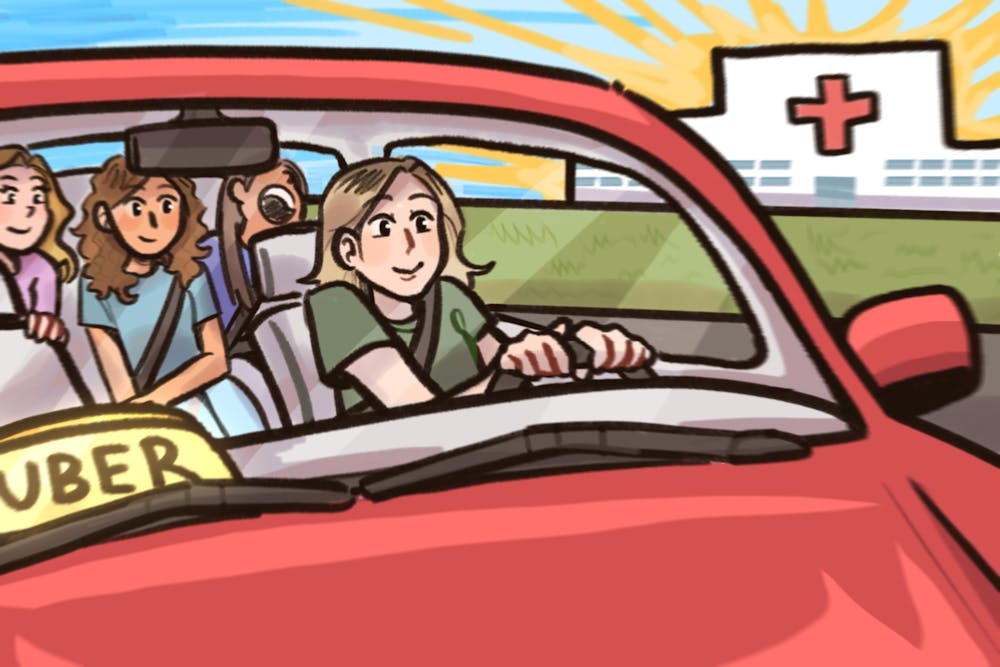
The Women’s Coalition at ASU provides Uber to students in need of transportation to medical appointments. This service is available to all students until April 30 and can be used for any kind of medical appointment.
The dread of unsteady transportation can be a stressor for students without personal vehicles. Public and University transportation can ease this burden, although they can fall short of students' health and wellness needs.
Students without personal vehicles may face the time delays of public transportation or have to use costly rideshare apps.
Shanali Islam, a junior studying computer science, said before using the service, she would carpool with others or not schedule medical appointments at all.
"Because I don't have a personal car at the moment, it was pretty difficult to even dedicate time to prioritize my health," Islam said.
Islam said she found out about the Uber vouchers — which were announced on the Women's Coalition's Instagram in October — through her friends at the coalition and has been using the service for the past few months. Islam said she wished she had found out about this resource earlier in the school year.
"The fact that Women's Coalition offers a no-questions-asked service to help reduce the stress, and being able to prioritize my healthcare, it's definitely made me feel a lot more motivated to actually take myself seriously," Islam said.
Pragalbha Ghatigar, a sophomore studying neuroscience and a programming intern at the Women’s Coalition, said the organization hopes to fill in the gaps for students in need of health services outside of what the University offers.
Students can access the voucher through the Uber for Healthcare Appointments form on the coalition's Instagram. For guaranteed approval, students should submit the form at least two days before the appointment.
The form asks for pick-up and drop-off information, as well as the date and time of the appointment. Ghatigar said voucher requests are manually reviewed and scheduled for students.
Once the form is processed, a $100 voucher is loaded onto students personal Uber accounts and can only be accessed on the day of the appointment.
"That creates a really accessible environment for each student," Ghatigar said. "I mean, $100 can go a really long way, especially when it comes to Uber."
The service is fully funded by the coalition, and the organization hopes to continue this service and expand the parameters, Ghatigar said.
"We're not planning on getting rid of it anytime soon," Ghatigar said. "If anything, I feel like the Women's Coalition is looking to expand this access to other areas, such as groceries (and) any other critical appointments that students need to get to but just can't."
Transportation insecurity is defined as the experience of being unable to move from place to place in a safe or timely manner. According to a 2024 study by the Agency for Healthcare Research and Quality, 11.1% of adults between the ages of 18 and 34 reported a lack of reliable transportation.
Lindsay Oluyede, a professor at the School of Geographical Sciences and Urban Planning, said in a written statement that transportation barriers to healthcare can be more complex than they appear.
"For students without access to a car, taking public transit is not always a simple or immediate solution," Oluyede wrote. "Potential challenges include cost and whether it is possible to reach the healthcare appointments by existing transit routes."
The immediate health of the student also plays a crucial role in transportation access. Walking to stops and managing transfers can be difficult, especially in extreme heat conditions, Oluyede wrote.
Programs like the Women's Coalition Uber voucher provide access to free and comfortable transportation, Oluyede wrote.
"This kind of support can make a meaningful difference in whether students are able to access the care they need," Oluyede wrote.
Edited by Natalia Rodriguez, Henry Smardo and Ellis Preston.
Reach the reporter at dbell39@asu.edu and follow @dhemibell on X.
Like The State Press on Facebook and follow @statepress
Dhemi Bell is the editor for the Community and Culture desk. This is her third semester with The State Press, working previously as a part-time Community and Culture reporter.