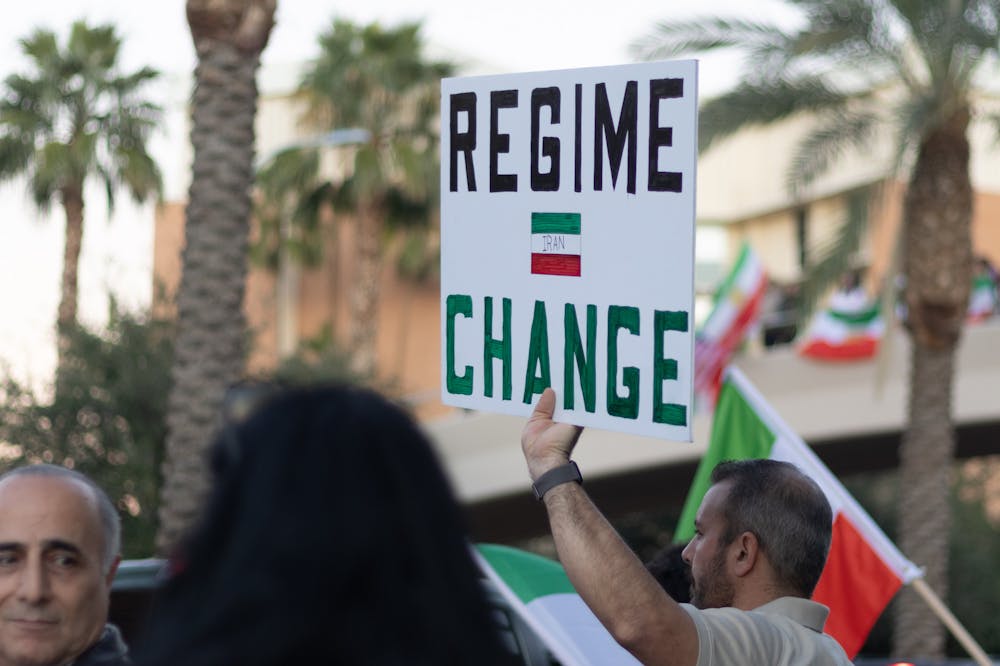
For one Iranian international student at ASU, the war in her home country has left her in a state of fight or flight.
The systems engineering student, whose name has been kept anonymous to avoid retribution against her or her family in Iran, said the conflict and history of oppression in the country have been a source of anxiety while at ASU, affecting her college experience in several ways.
Those feelings worsened when the Iranian government cut off access to the internet.
"I would see news of a bomb drop in my city, and I couldn't even call my parents to see if they're alright or not," she said. "What if now my whole family are dead? It's totally possible."
The war has led Iranian ASU students she knows to seek psychiatric care to treat their anxiety and depression, she said.
A University spokesperson said in a written statement that the University recognizes that the events unfolding in Iran may distress students with family and loved ones affected by the conflict.
"The International Students and Scholars Center supports all international students by connecting them to resources that address the source of stress," the University spokesperson stated. "Whether that involves counseling support, academic flexibility, financial hardships, navigating travel or communication concerns involving family abroad, and so forth."
READ MORE: Hundreds protest on the Tempe campus in solidarity with the Iranian people
Still, the student said herself and other Iranian students cannot look away from the difficult news about the war, as it impacts them, their families and their country.
"You can't just say, 'I'm deleting my Instagram and chilling out,' and do yoga," she said. "There's a war in your head. It's like a survival mode, and it's just been big depression, big fear involved."
She said she cannot return to Iran for fear of being killed. She has firsthand experience with violence perpetrated by the Iranian government.
"Two years ago, I was in Iran. I got shot for no reason," she said. "If I go back right now, they're going to arrest me, they're going to rape me, they're going to kill me right now just because of this conversation I'm having, just because I'm not wearing a hijab here."
As an ASU student, opposition to the war by some student groups has been frustrating for her, she said, as multiple protests and demonstrations have been held on the Tempe campus.
In March, ASU student organizations protested U.S. intervention in the Middle East. The event featured banners demanding "Stop the war in Iran."
READ MORE: Demonstrators against war in Iran met by counter-protesters on ASU's Hayden Lawn
AmirDanial Azimi, the president of the Iranian Student Association at ASU, said he was taught to scream "Death to America" and "Death to Israel" while growing up in Iran. He later moved to the United States and is now a doctoral student studying biological design.
During his time at the University, he has become an outspoken critic of the regime and has become involved with ASU's Iranian community.
"The Iran regime has an agenda where it does not care about its own people," Azimi said. "It only cares about its ideology, which is to be anti-West, and that has been the case for the past 47 years."
The killing of tens of thousands of protesters in the country at the start of the year distressed many of the University's Iranian students more than the war itself, Azimi said.
"That definitely affected us more and definitely set back a lot of students here studying at ASU," he said.
However, Azimi said anti-war protesters did not acknowledge the killing of protesters in Iran, which hurt.
An Iranian international student studying psychology said the prolonged loss of contact with family has had an emotional impact on him and other Iranian students at ASU. The student's name has also been kept anonymous to avoid retribution against him or his family in Iran.
The internet restrictions have also prevented some students' families from sending money for their education and made it harder to apply for work authorization in the U.S., he said. Without the support, some Iranian students are unable to afford the funds for ASU.
"They are self-funded, and due to this internet blackout, they have not any connection with Iran," he said.
For additional counseling resources, contact ASU Counseling Services through its website. The ASU EMPACT Crisis line is 480-921-1006.
For additional financial resources, contact ASU Financial Aid through its website or at 855-278-5080.
Edited by Carsten Oyer, Natalia Jarrett, Emilio Alvarado, Senna James and Ellis Preston.
Reach the reporter at ksmitten@asu.edu.
Like The State Press on Facebook and follow @statepress on X.
Kaitlyn Smitten is a politics reporter for The State Press. This is her first semester at The State Press. She previously served as a staff writer and correspondent for the Berkeley Beacon at Emerson College. She is a third-year Political Science major with a Writing, Rhetorics, and Literacies minor.