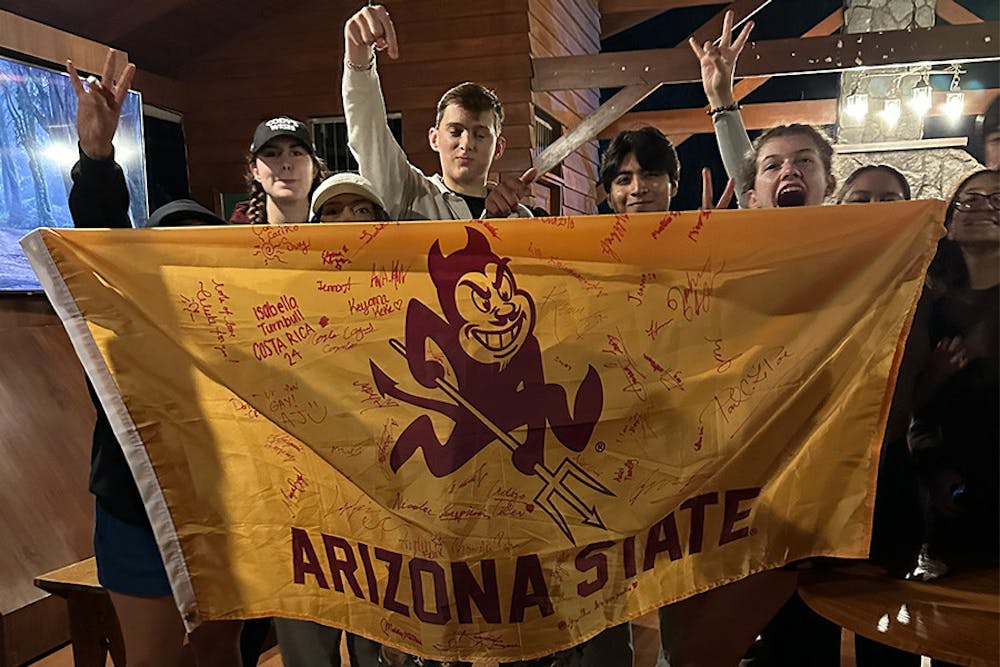
Studying abroad is a step many students look forward to taking in their college career. University programs provide students with the opportunity to gain a head start on international learning.
The Early Start Global Accelerator in Costa Rica is a unique program offered to first-year students after their first semester.
The program is offered to students in the Early Start program through the College of Liberal Arts and Sciences. 150 students are selected from the program on a first-come, first-served basis.
Spots are given to students across the College's divisions: humanities, social sciences, and natural sciences.
Held in Monteverde, Costa Rica, the program is taught at the Council on International Education Exchange's Costa Rica Monteverde Center. The Center is set on nearly 150 acres of land where students are housed and take their required classes.
The program is split into two sessions during winter break. The first session takes place Dec. 12-20, 2026, and the second Jan. 2-10, 2027.
Zachary Shaffer, co-director of the program and assistant teaching professor with the School of Life Sciences, wrote in a statement that Costa Rica is a wonderful setting for the program.
"It is a stable democracy with a nationwide commitment to protecting biodiversity and living sustainably," Shaffer wrote. "The actual CIEE campus we stay at is remarkable — it is basically situated in the middle of a tropical rainforest."
Participating students earn three credits for the study abroad by attending required prerequisite meetings and completing the course in Costa Rica.
Shaffer wrote that the program formally asks students to inform themselves on the culture, history and biodiversity in Costa Rica.
"Informally, I would say that we hope they will grow emotionally and intellectually — that this will make them curious to see more of the world and to continue exploring and learning," Shaffer wrote.
The program is funded through the partnership between the Global Education Office, the College of Liberal Arts and Sciences, and CIEE, free of charge for students. In 2024, ASU was selected to receive $1 million in matching grants to establish new study abroad programs through CIEE.
Jessica Early, a faculty lead for the program and English professor, helps to support students as they learn about new cultures and use writing as inquiry throughout the experience.
"As someone who teaches English and secondary literacy, I'm especially interested in helping students understand how writing and communication shape the way we experience the world," Early wrote in a statement. "I work hard to find ways for students to use writing to conduct research, observe and explore, to reflect, and to think about and plan for their future lives."
The nine-day itinerary includes a variety of activities students can participate in between classes. The activities include cooking and dance classes, hikes and zip lining.
Early wrote that the program is intentionally designed to integrate classroom learning and field experiences.
"Students might begin by discussing a concept in class and then immediately see it applied through hikes in the cloud forest, visits to local sustainable farms, conversations with community leaders, and other sustainability-focused activities such as birding and a water quality lab," Early wrote.
Applications for the program opened July 15 and are due on Aug. 12.
The Early Start Global Accelerator Program in Costa Rica is one of the many study abroad opportunities the University offers. Students can choose from over 300 programs at any time in their college career.
GEO marketing manager Lindsay Lohr wrote in a statement that there are other study abroad opportunities for first-year students, including the Barrett Global Honors Flex and Engineering in the Tropics program.
"These programs are designed for first-year students and offer lower division credit, that allow students to make connections, grow their confidence and find a sense of belonging at ASU earlier on," Lohr wrote.
READ MORE: How Sun Devils can go global: A guide to understanding study abroad programs
Regardless of when students decide to take their learning out of the country, opportunities are available for unique experiences.
"It is important for students to study abroad as it develops students personally, professionally, and academically," Lohr wrote. "It pushes students' comfort zones and gives them the chance to think on their feet and learn that they can do things that they originally thought were scary."
Edited by Alan Deutschendorf, Natalia Jarrett and Claire Bixby
Reach the reporter at dbell39@asu.edu and follow @dhemibell on X.
Like The State Press on Facebook and follow @statepress on X.
Dhemi Bell is a reporter on the community and culture desk and is in her second semester at The State Press.


