"Name five songs."
"I liked their music before they blew up."
"Fake fan!"
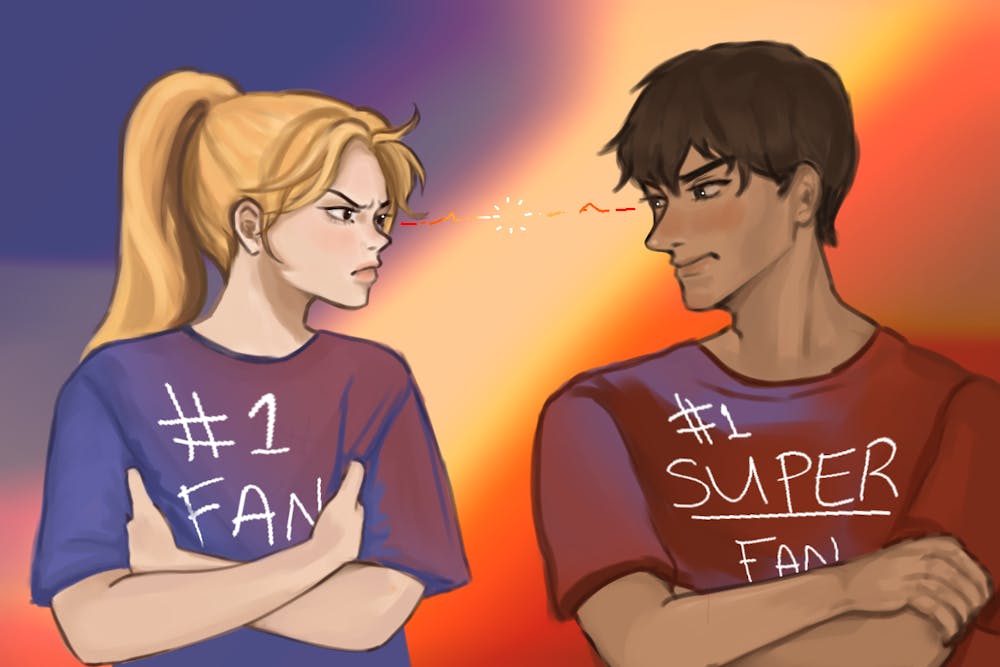
These comprise some of the all-too-familiar lines present in comment sections and social media posts. The internet age is defined by a constant "niche-off," everyone having to prove themselves as the better fan. Whether for music, books, film, TV — or really any form of entertainment — we're losing sight of how to simply enjoy things.
We've turned fandom into a competition.
Passion is no longer about liking something — it's about battling it out for the title of being a fan. It's not enough to just enjoy an artist, you need to know their entire discography. You can't just say you like a movie, it needs to be in your Letterboxd top four with a witty review to go along with it.
You need to defend your taste in just about everything, or risk being called out on social media for "not belonging."
And if someone else happens to like the same things as you? We question if they like it as much.
At some point, we stopped asking ourselves whether we actually enjoy something and started to focus more on what our likes and dislikes say about us. Social media has made our taste public, turning songs, movies, books and more into pieces of personal identity.
Spotify Wrapped, concert clips, Letterboxd ratings and our TikTok reposts allow us to constantly display what media we take in. In fact, so many of us — myself included — are guilty of this: spamming our Instagram stories with curated playlists, carefully selected candids and pictures timed just right to capture the title screen at the movie theater.
READ MORE: State Press, Wrapped: Reporters' Spotify Wrapped rankings, 2025
There's of course nothing wrong with sharing your interests — it's what makes us who we are. The only crime here is not being able to comfortably consume media anymore.
There's now a weird hierarchy of what we consider to be "valid" taste. The more niche your favorite movies are, the more interesting you seem. The earlier you discover a band, the more respected you are within the fanbase.
Meanwhile, enjoying something popular dismisses you as being "basic."
But maybe being basic isn't such a bad thing. Eliminating this fear of how we're perceived could allow us to just enjoy things again.
There's nothing inherently more meaningful about discovering a good song before everyone else. Preferring a blockbuster over an indie production doesn't make you any less sophisticated. Reading fantasy over classic literature doesn't make you any less of a reader. And there's nothing embarrassing about admitting your favorite song is a lead single rather than a deep cut.
The problem is we want two things at once: to feel like we belong, but also to feel like we stand out. We want to find common ground with friends, but we also want these interests to feel exclusive to us.
Social media makes this contradiction hard to ignore. By seeing what content people like, it's easier to find people we relate to, comparing our tastes becomes easier and the need to differentiate ourselves grows more prominent.
At a big school like ASU, this feeling of wanting to be socially accepted yet distinctive can feel especially noticeable. With tens of thousands of students around us, there's definitely no lack of opportunities to find people who like the same things as you.
READ MORE: Creating campus connections: A guide to meeting new people at ASU
But at the same time, the size of the campus can make these interests feel like a natural way to distinguish ourselves. The song by a small artist you stumbled across on TikTok, the black-and-white film you reviewed on Letterboxd or the book you bought in a local shop all seem to become ways to set yourself apart while remaining interesting to those around you.
But liking something doesn't have to make us different. If anything, finding someone who likes the same artist or movie style should make it easier to connect — not give you someone else to compete against in this battle of individuality.
College is a time for self discovery, to figure out what makes us who we are, and there's no need to fake being unique to accomplish this.
Being a fan of something shouldn't require you to prove what you listen to on your way to class or what movie you choose to watch at the end of a long day. We don't need to turn something meant to be a form of self-expression into a hierarchy.
It's OK to like cheesy movies without calling them camp. Fans of a singer can exist even if they only know their biggest hits.
Let's stop proving what we love and start actually enjoying it.
Editor's note: The opinions presented in this column are the author's and do not imply any endorsement from The State Press or its editors.
Edited by Sam Troester, Carsten Oyer, Senna James and Sophia Keeling.
Reach the reporter at evwestfa@asu.edu and follow @ellwestfall on X.
Like The State Press on Facebook and follow @statepress on X.
Ellie Westfall is a Reporter for The Echo at The State Press. This is her first semester working with The State Press, and she is in her second year at ASU with a double major in Journalism and Political Science.