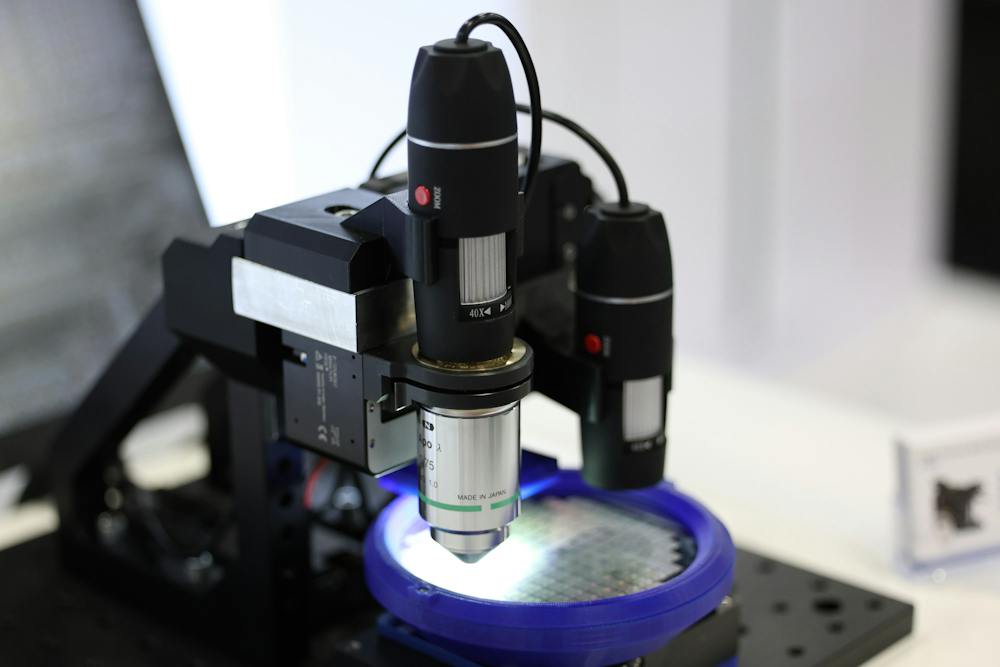
Sens. Ruben Gallego and Mark Kelly, alongside Reps. Greg Stanton and Yassamin Ansari, have secured a $2,062,000 federally funded grant for ASU to lead an initiative on water reuse for semiconductors, a booming industry for the state.
The project will test new methods of water recycling for semiconductor production at ASU's MacroTechnology Works, aiming to improve water conservation in semiconductor fabrication plants.
A semiconductor acts as a conductor or insulator of electricity that is essential to creating computers and other electronic devices, according to IBM.
In a press release, Gallego stated the grant will enable sustainability improvements and benefits for Arizona.
"Making Arizona's semiconductor manufacturing industry even more water efficient will allow us to continue to create good-paying jobs and protect our state's water supply," Gallego stated. "Thanks to this project, Arizona will continue to lead the nation in community-beneficial innovation."
In the press release, Kelly emphasized the importance of this grant to Arizona and to America, as well as the ways Arizona is prepared to tackle water management and chip production.
"This investment builds on that leadership by developing water reuse technology, creating good-paying jobs, strengthening American manufacturing, and protecting our water supply," Kelly stated. "It's a win for Arizona."
Matthew Marinella, a professor in the School of Electrical, Computer and Energy Engineering, said water serves an important purpose in semiconductor manufacturing.
Marinella said the water is used to carefully clean transistors, which are utilized in circuits and microchips. A transistor is the basic unit of electronics, he said.
"Bits of metal atoms can ruin these transistors that they're trying to make, and so they go to great lengths to make sure everything's clean, and they do all these process steps," Marinella said.
Between each step, Marinella said there is "almost always some kind of cleaning with water."
He said recycling the water for the same cleaning process is a risk that large semiconductor fabrication plants do not take, so the grant will allow ASU's plants to test out the technology first.
"The idea behind that grant is that we can try it out, work out the kinks," Marinella said.
Noah Shoup, a junior studying mechanical engineering and the president of the Sun Devil Semiconductor Club, said the grant could lead to greater semiconductor industry involvement with ASU.
"We already have a lot, but the industry is growing like crazy here," Shoup said. "I would love to see more students able to land full-time careers at some of these companies through the research that they've done with this grant."
Shoup also said as Arizona runs low on water, legislative involvement and water allocation for semiconductor manufacturing is important to the future of the field.
READ MORE: Cuts to Colorado River water supply sparks discussion of solutions among ASU experts
Darin Korn, a senior studying electrical engineering and the current vice president of technical operations at the Sun Devil Semiconductor Club, also said the grant can help shift some of the negative perspectives on semiconductor fabrication plants.
"The public might see and understand the importance of semiconductors, but they don't want it taking all their water, they don't want it polluting the environment, no one wants that, right?" Korn said. "A nice advantage of this research is that it makes semiconductors maybe more appealing to those who are very water conscious."
Korn also echoed the importance of water conservation in the field.
"Being able to reuse water to ensure that this industry can stay afloat and keep prospering and growing is very important," Korn said. "We don't want the reason this industry is not able to grow as much to be just a lack of water."
Edited by Mia Sweador, Carsten Oyer and Sophia Keeling.
Reach the reporter at ealong5@asu.edu.
Like The State Press on Facebook and follow @statepress on X.