Seven members of ASU's hockey team called for members of their coaching staff to be placed on administrative leave, including head coach Greg Powers, in a letter sent to ASU President Michael Crow by a lawyer on the athletes' behalf.
The players pointed out discrepancies in Senior Vice President James Rund's review of the Aug. 20 incident involving player Matthew Mayich. Reportedly, Mayich has "no chance of recovery" after a team workout conducted by Tim Ziesel, Army special forces veteran, left him hospitalized.
A letter released today by Timothy Casey, a lawyer at Schmitt Schneck Even & Williams, P.C., signed by seven anonymous members of ASU's hockey team, disputed the findings in Rund's review into Mayich's collapse.
"We are submitting this report anonymously because we fear retaliation from the coaching staff," the letter stated. "The head coach and his assistant coaches were all on the field on August 20, all remain in their positions, and together they decide our playing time, scholarship levels, and roster status. No one has separated us from them since that morning."
READ MORE: ASU hockey to play 2026-27 season despite Matthew Mayich's condition
The letter addressed the players' perspective, a direct comparison of Rund's report to the players' experience, issues identified by their lawyer and established failures during the workout.
ASU's published timeline briefly explains what the workout consisted of between 7:10-8:06 a.m. The players' letter added context to how much the team struggled to complete the workout.
According to the letter, early in the session, two players vomited and Ziesel asked one of them whether he was "throwing up or just taking a break."
The letter states at around 7:40-7:50 a.m., players were given their only water break by Powers. During that break, Ziesel said, "Oh yeah, I forgot, you guys need water," and added that he did not have any during combat.
Only the first finishers of the drill were allowed water, which consisted of eight players, the letter said. Everyone else continued to the next task without a water break, including Mayich.
"Ziesel left before the final event," the letter stated. "The medicine-ball relays in which Matthew collapsed were run with no one supervising but ASU’s own coaches and athletic trainer."
Throughout the drills, players noticed Mayich becoming disoriented before his collapse around 8:23 a.m., the letter stated. After Mayich fell to the ground, he was laid down, then held upright with squirt bottles spraying him and towels put on him.
Water was held to his mouth, but he spat it out, and he remained in the sun for several minutes until he became unresponsive, the letter stated. Mayich was then carried to shade, where he was again held upright and warm water ran over him from a garden hose. About 17 minutes after his initial collapse, Mayich was taken to the hospital.
The letter also includes a section describing the events directly after Mayich fell, stating he was "unintelligible and non-responsive" and that "his lips were gray."
According to the letter, staff did not appear to be properly trained in identifying or treating heat stroke.
"The athletic trainer, for example, sat Matthew upright twice, which is contrary to medical protocols, as understood by our counsel," the letter said. "Nothing effectively cooled him from his collapse at about 8:23 until EMS arrived at about 8:40."
The players stated they were not allowed to leave formation in order to drink water; Mayich did not get water at any point during the workout, and rest periods consisted of holding a plank or standing in the sun.
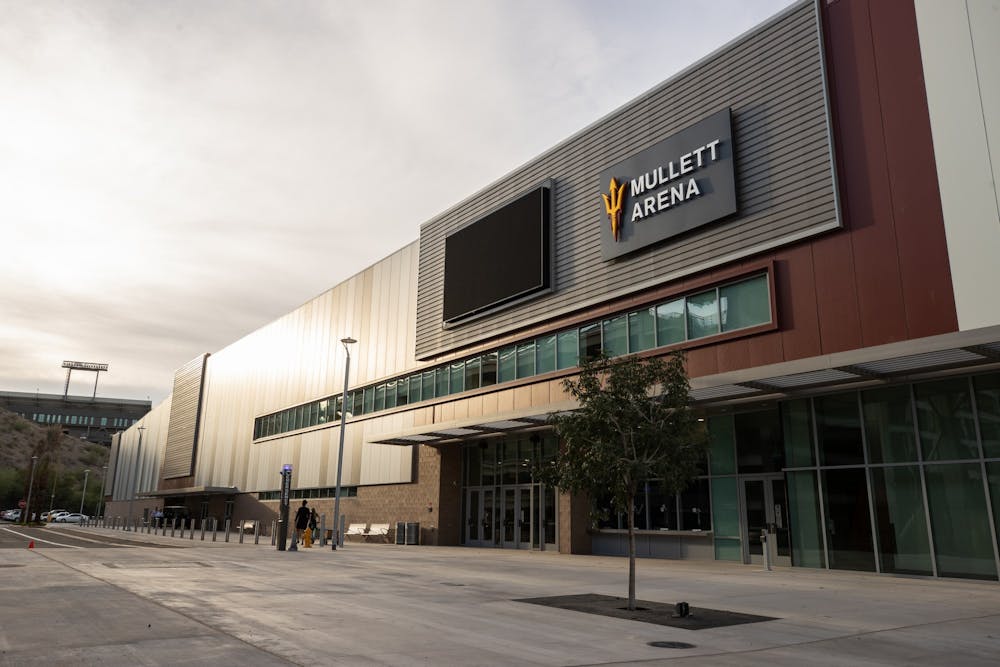
According to the letter, there is a cold tub in Mullett Arena, but it was not used to assist Mayich.
After the collapse, Powers told the team that Mayich's condition was "just a little heat stroke" and "heat exhaustion," which was something he had seen "a million times," the letter stated.
The letter compared the findings in Rund's review with what happened on Aug. 20 from the players' perspective. It expanded on inconsistencies the team noted, including sections of questions that were not addressed in the initial report. A question asked within the letter was whether or not Ziesel held first-aid, CPR and AED certifications.
The players' counsel also analyzed ASU's outside consultant policy with the actions pertaining to Ziesel, ASU's heat policy requirements with the records of Aug. 20 and ways in which the requirements were not met. This includes the players' lack of acclimatization to the heat.
In the letter, the Aug. 20 workout was compared with the workouts Mayich participated in during his first eight days in the Valley. It expanded on field conditions, supervision and emergency response, national standards, police interviews and the administrative review, as well as coaching staff roles not defined in Rund's review.
Players listed questions for seven different staffing positions, including the hockey coaching staff, within the University. Nine separate failures were noted in connection with Mayich's situation.
Ultimately, the letter ended with eight requests and 19 questions from the players to ASU, with one of the requests being to place all staff responsible for approving, conducting and supervising the session on administrative leave.
"Name an interim coaching staff for the period of the investigation if the facts set out in this report, together with what the investigation finds, indicate that step is appropriate," the letter stated. "An interim staff would allow the investigation to be completed, and the players to be heard, without asking players to put their scholarships, roster positions, and playing time at risk in order to be heard. It is not fair to require that."
When asked for a comment on the players' letter, a University spokesperson said ASU has nothing to add.
The University published a letter Rund sent to Crow on Sept. 21 with findings from the University's internal report on the Aug. 20 incident.
The review included information about the circumstances that led to Mayich's hospitalization following the team workout, with the stated focus being "fact finding" and a goal of improving student-athlete well-being.
According to Rund's report, 20 individuals were interviewed either as part of his review or by the ASU Police Department.
Rund's review lists the University's practices and procedures for outdoor activities with student-athletes, a brief timeline from the beginning of the workout to Mayich's collapse and includes three data points of the wet-bulb globe temperature measurement on the day of the workout.
A WBGT measurement takes into account air temperature, humidity, wind speed and solar radiation to give a comprehensive picture of the environmental impacts on a person, said Samantha Scarneo-Miller, a professor at Old Dominion University with the School of Rehabilitation Sciences.
"If you're outside in the blazing sun with no cloud cover at all, that is also going to be a way that we are getting more heat gain and then also inhibiting our heat dissipation methods as well," Miller said.
The letter addresses a 2021 study by ASU researchers that explains that the track at Sun Angel Stadium, on average, is significantly higher than WBGT estimated from local weather stations.
"People are afraid to speak out," Leonard Aragon, the lawyer representing Mayich's family, said. "These guys had to go through a lawyer to protect themselves."
Aragon said Rund's report was mainly designed to protect ASU.
"It tells me that this is just designed to protect ASU, not designed to get to the bottom of what happened and the truth and to have accountability here," Aragon said.
Once completed, ASU PD's investigation will be provided to the Maricopa County Attorney's Office for independent review, according to Rund's letter.
Edited by Natalia Rodriguez, Alan Deutschendorf III, Senna James and Kate Gore.
Reach the reporter at aswift10@asu.edu and apruiz@asu.edu and follow @alexswiftsports and @andiruiz2405 on X.
Like The State Press on Facebook and follow @statepress on X.
Andi Ruiz is a politics editor at The State Press. She was formerly a lead politics reporter and anchor at The Cut Network. This is her second semester at The State Press and is committed to bringing credible and accurate information to the ASU community.