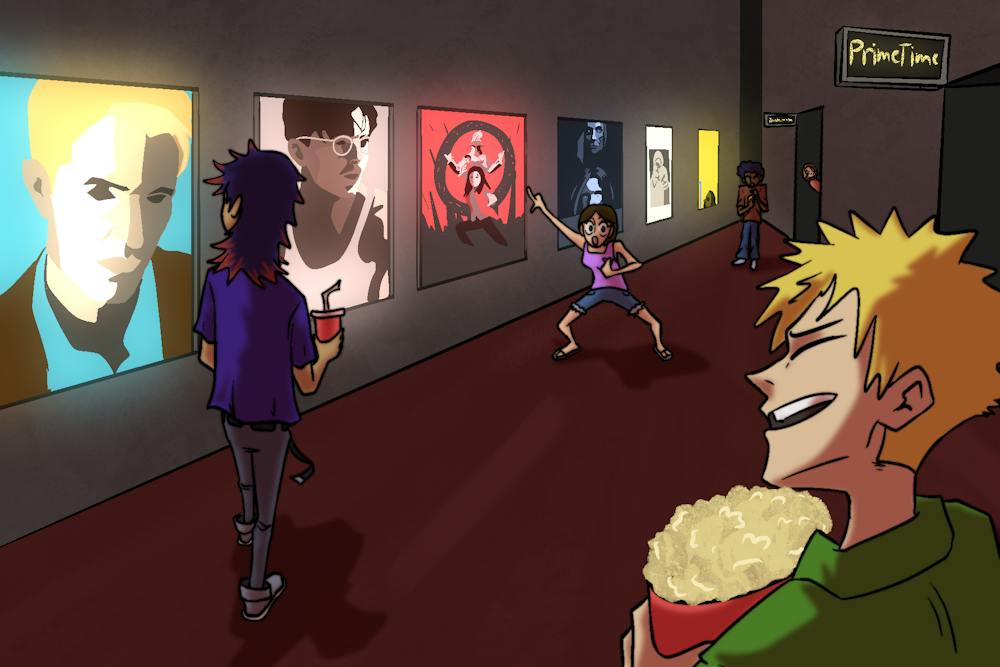
Iconic superheroes, much-awaited sequels and timeless franchises tend to dominate the box office. But some moviegoers prefer an alternative film experience.
Distribution companies such as A24 and NEON have brought visibility to independent film and allowed smaller projects to break into the mainstream, seen in recent films such as "Primetime" and "Anora."
Highlighting hidden talents in filmmaking, these movies tend to be thought-provoking with an unconventional, often artistic style.
READ MORE: Review: 'Primetime' artistically explores the uncomfortable line between TV and truth
For Isabel Teran, a sophomore studying film, media production and cinematography, indie movies allow directors to center a film around the heavy messages they're exploring. By contrast, Teran found larger productions to soften those themes for a general audience.
"Indie movies are really raw and direct, whereas big budget movies, you kind of have to read in between the lines," Teran said.
She said production companies often favor what gains traction and profit.
"You're gonna pitch (studios) a movie that they know people will go watch…versus an unknown actor with a kind of complex storyline," Teran said.
While classic, predictable movie formulas can make a film easier to sell to large-name studios, the unknown offers a draw in its own right.
For Luke Chamberlain, a freshman studying film and media production, the mystery and ambiguity seen in independent films are massive appeals.
"You don't know exactly what you're getting yourself into," Chamberlain said.
Chamberlain mentioned "Obsession," an indie horror film that became one of the biggest hits of 2026.
"That was a big indie hit of this past year, and I think that what drew people in was the new actors, the new faces, the new director," Chamberlain said. "No one knew who Curry Barker was."
"Obsession" was made on a budget under $1 million. As of August 2026, it has earned $520 million worldwide — making it one of the most profitable films in cinema's history.
For Chamberlain, that unexpected rise to success is why audiences need to support smaller films.
"That's how the big stuff comes to be big," Chamberlain said. "They have to start with a small idea and then work their way up."
Even household names in the world of film started small.
"Jon Favreau made 'Iron Man,' not thinking it was going to go anywhere, but people gave it a shot," Chamberlain said. "Now you see 'Avengers: Doomsday' is coming out later this year, and it's one of the most anticipated movies of the year."
However, a film's importance is not always measured by the recognition it receives.
For some film students, the value of underground productions can be seen much earlier: in the creative freedom, experimental style and opportunities they provide for those beginning in the field.
Gavin Bost, a freshman studying film, media production and directing, said independent, lesser-known directors are often working under comparable conditions to himself and his peers.
"A lot of the times the directors are kind of at a similar situation to me and other film students," Bost said. "They are people with not a lot of money, they're kind of on a time crunch, they're filming a lot without permits and doing tactics that we use."
READ MORE: Director's cut: A look behind student film production
That smaller scale adds a personal edge to filmmaking.
In Bost's eyes, indie films, constrained by smaller budgets, can take that disadvantage and harness it to make a product that is more grounded and lifelike.
"Obviously, big budget films have the opportunity to do really insane, crazy things, but they can also have the opportunity to break the sort of boundary, and you're aware that you're watching a movie," Bost said. "Whereas low-budget films can really seem like you're living with those characters, that you're in it with them."
A better budget doesn't always equal a better result.
"If you give an underground or indie film a chance, it really could be on par, if not better than those million-dollar movies," Teran said.
Edited by Sam Troester, Emilio Alvarado and Sophia Keeling.
Reach the reporter at evwestfa@asu.edu and follow @ellwestfall on X.
Like The State Press on Facebook and follow @statepress on X.
Ellie Westfall is a Reporter for The Echo at The State Press. This is her first semester working with The State Press, and she is in her second year at ASU with a double major in Journalism and Political Science.