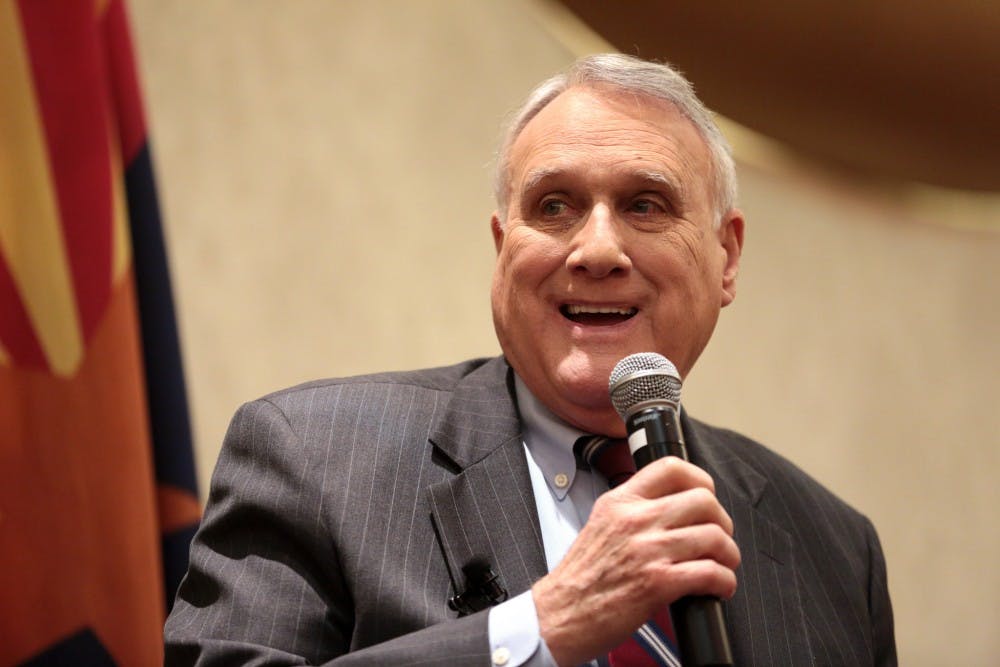
Jon Kyl, former U.S. senator and namesake of the Kyl Center for Water Policy at ASU's Morrison Institute for Public Policy, died on Sept. 17 at the age of 84.
A statement from his family said he died due to complications from a neurological disease. Kyl announced his dementia diagnosis in December 2025. Subsequently, he stepped away from public life.
Throughout his life, Kyl held many titles, including U.S. senator, representative and attorney. He also co-taught a class at the School of Civic and Economic Thought and Leadership.
"A true statesman and public servant, Jon was dedicated to representing Arizonans and advancing the interests and reputation of the state he loved dearly," ASU President Michael Crow stated in a Facebook post.
Grady Gammage Jr., a senior research fellow at the Kyl Center for Water Policy and a lawyer, worked alongside Kyl long before the center was established in 2014.
He joined the law firm back in the 1970s as a young associate under the firm's partner, Kyl, who taught him just as much as three years of law school did, Gammage said.
"He was almost always smarter than the people he was dealing with, but he never felt a need to intimidate or be overbearing," Gammage said.
Arizona's Groundwater Management Act of 1980 was one of the grand projects Kyl took part in during his time in law, he said.
"With some notable exceptions, perhaps no single event has proved more significant to Arizona's water future than the Groundwater Management Act of 1980," according to the Arizona Department of Water Resources website.
The law provided a long-term sense of water certainty for the fast-growing state, requiring new development in vulnerable areas to prove it had access to a 100-year water supply before building.
"Dozens of people claim to have been in the room when the Groundwater Management Act was written," Gammage said. "Most of the people who claim that were not in the room when it was written — Jon Kyl was."
After a successful career in law, the transition to politics was natural to Kyl, as his father was a congressman, he said.
Kyl was elected to the first of four terms in the U.S. House of Representatives in 1986 and later served three terms in the Senate.
In 2000, Kyl first introduced the Arizona Water Settlements Act, which became the largest water settlement agreement in Arizona's history when it was signed into law in 2004.
In a 2012 floor speech, Republican Sen. Mitch McConnell said Kyl worked behind the scenes for 15 years to get the settlement passed.
The settlement resulted in the Gila River Indian Community and the Tohono O'odham Nation receiving permanent water allocations, ending a longtime battle.
Gammage was part of a group with Richard Morrison, co-founder of the Morrison Institute, that conceptualized a water-focused center. He said they all felt it should be named after Kyl, who was well-known and a "legendary figure" in Arizona water policy.
Kyl was a modest person and had to be talked into being the namesake, Gammage said. He did not like to take credit or be flashy.
Sarah Porter, director of the Kyl Center for Water Policy, said Kyl was humble about the center carrying his name and avoided saying the title out loud.
"He would always say the water center, which I thought was pretty lovely, that he had that humility," Porter said.
The main purpose of the Kyl Center is promoting research and dialogue on "sound water stewardship," according to its website.
Porter said it was Kyl's vision: the center should produce a nonpartisan and neutral expert analysis to ensure well-informed policy decisions.
She said Kyl cared about making a complex issue like water policy easier to understand for Arizonans so that more people could become engaged in it.
"He wanted the center to be a particularly respected voice in explaining water issues to the public and to elected officials," Gammage Jr. said. "I think it's done that, and I think he was pleased with that."
In his late 70s, Kyl still read complex research drafts with more than a hundred citations that the center shared with him and responded with extremely detailed feedback, Porter said.
Kyl's presence at ASU was not limited to water policy.
He also co-taught a course on American civic and public affairs with professor Sean Beienburg in the School of Civic and Economic Thought and Leadership.
The course focused on major debates in American politics: free speech, the health of national institutions whether the Constitution is still effective and America's role in the world.
Beienburg said Kyl never leaned on his title in the classroom and would never mention he was a senator unless it was actually relevant.
Kyl often assigned materials he personally disagreed with, wanting students to see competing arguments, he said.
"He really was one of the finest statesmen in American history," Beienburg said. "And a genuinely good person."
Edited by Dhemi Bell, Emilio Alvarado, Senna James and Carsten Oyer.
Reach the reporter at dkovalen@asu.edu.
Like The State Press on Facebook and follow @statepress on X.
Diana Nychyporuk is a Podcast Reporter at The State Press. She previously worked as a reporter for the Community & Culture desk. Diana is pursuing a degree in Journalism with a minor in Political Science.