This story has been translated. Read the Spanish version here.
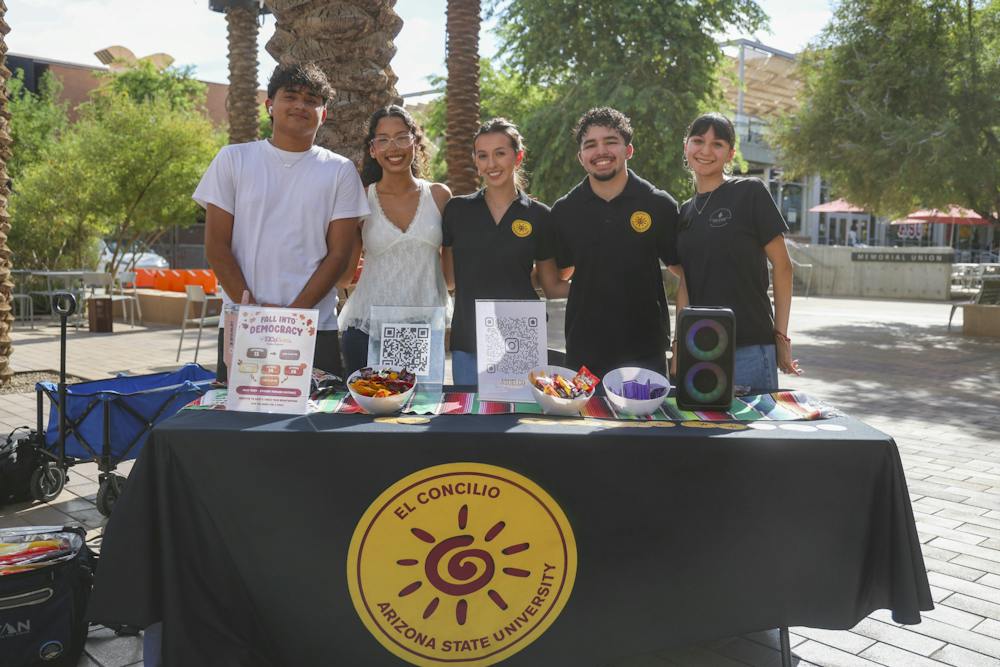
As the 2026 midterm elections approach, students from El Concilio — a nonpartisan organization that unites Latinx clubs — reflect on what motivates Hispanic and Latino students to vote, and whether their voices and concerns are represented in Arizona politics.
El Concilio launched a civic engagement campaign to help students check their voter registration status and help them register if they are not already.
José Luis Avila III, El Concilio's co-director of advocacy and a sophomore studying economics, said what really motivated El Concilio to launch ElCo Votes was the 2024 election and what he views as the disproportionate impact of immigration policies on Hispanics and Latinos.
Avila explained that El Concilio seeks to boost political participation starting on campus with students and their own peers.
"We have no reason to not talk to our friends and get them at least and make sure they're registered to vote, so we can create that bottom-up initiative," Avila said.
According to Avila, El Concilio is a space where students can feel heard and seen, and where they are also invited to get civically involved.
"We are here, we see you, we are feeling the concerns you have, we feel the emotional aspect of it too," Avila said. "Let's do something about it because we should."
Beyond simply hosting events and voting registrations, Avila explained that in addition to making students feel heard and represented, El Concilio seeks to leverage the midterm elections to foster their civic participation.
READ MORE: Sun Devils ramp up voter registration efforts ahead of midterm elections
Avila said what motivates many Latino students to vote is their families, especially those with mixed immigration status who are affected by immigration policies.
At the same time, he explained that one reason students sometimes do not participate in elections is the feeling that their vote will not have a real impact, which can lead to frustration and discouragement regarding the political process.
El Concilio seeks to overcome these barriers through student outreach events and activities that use shared stories and experiences to encourage other students to register and participate.
Avila said that what he would like students to understand about their political and civic participation is that, even if they feel their vote doesn't count, it can represent the voices of their families, friends and others who cannot vote.
"Voting is a privilege, and there are a lot of people, there are lots of individuals in our state and in the country who are just seeking to have that privilege and want to do something with it," Avila said.
Neida Romero Montes, a senior studying economics and political science, said that her participation in ElCo changed her perspective on politics by showing her the impact that Latino student involvement can have.
For her, ElCo is more than just an organization; it is a community.
"It's about bringing Latinos together, no matter what major, no matter what year," Romero Montes said. "Latinos crave community, and they crave seeing someone in higher education doing similar things as them."
Romero Montes said that having organizations like ElCo helps connect Latino students with politics through other young people their own age, while also helping them understand issues that affect their lives, such as education and immigration.
"When you see a fellow student, I feel like you connect with them more, and you're more willing to understand and be like, 'okay, you're right, I should care about this,'" Romero Montes said.
She hopes ElCo will raise greater awareness regarding Latino voter participation, as she considers this group demotivated by years of hearing political promises without seeing concrete changes.
"Your voice does matter, and if it didn't matter, people wouldn't be trying so hard to keep you away from voting," Romero Montes said.
Jonathan Martinez, a senior studying political science, said that what students initially seek when they arrive at ElCo is community and identity.
Something he learned during his participation in ElCo was the value of finding a sense of unity, family and community by recognizing that he was not alone as a Latino.
Martinez said being surrounded by other Latino students creates a space of trust that makes it easier to talk about politics, learn new information and participate civically.
After turning 18, Martinez began voting, motivated by the desire to stay informed and represent not only his own voice but also that of his family and community.
"I'm first generation, so me having a voice also allows them to have a voice as well," Martinez said. "So I'm voting for me, my family and anybody that's also impacted by these politics within my community."
Jazmine Garcia Chavarria, a junior studying political science and business law, noted that in addition to immigration, rising prices have become an increasingly prominent political concern among students.
She also mentioned that many students do not realize how local and state elections can directly affect their college lives, especially regarding the races and decisions listed at the bottom of the ballot.
For Garcia Chavarria, the lack of dialogue between elected officials and students can lead to a loss of motivation among young people who have been actively involved in their communities.
"Sometimes I do feel a little unmotivated to continue because I'm like, well, no one's really listening to me, and I'm super active in my community," Garcia Chavarria said.
Edited by Natalia Rodríguez, Alan Deutschendorf III and Senna James
Reach the reporter at lmrome12@asu.edu.
Like The State Press on Facebook and follow @statepress on X.
Lairam Romero is a reporter for La Prensa at The State Press. She has worked previously with Blaze News, Blaze Radio, (NAHJ) National Association of Hispanic Journalists, and the NAHJ bilingual magazine VOCES. This is her first semester with The State Press as a Journalism and Mass Communication major in her second year.