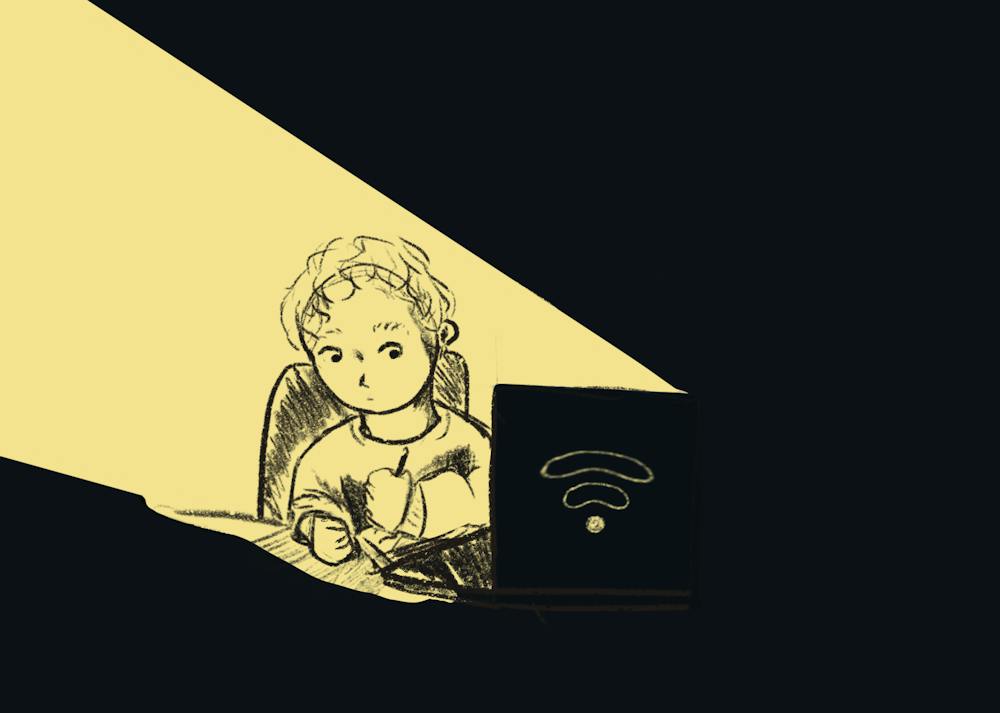
Social media creates a space for people to affirm their beliefs to the point where a parasocial personal attachment is formed to larger-than-life creators, sometimes even influencing their political thought.
A parasocial relationship is a one-sided connection an individual has with another person or fictional character they've never met. Viewers have long had to navigate the ups and downs of an online connection, but as political spending on these creators go up, authenticity becomes murky.
"Having these beliefs, especially at 14 and just starting high school, was really a fringe idea," Olivia Duncan said. "I was really big in online spaces, especially with feminism and being an ally toward LGBTQ+ communities."
Duncan, a recent ASU alumna and expected graduate student at the Thunderbird School of Global Management, grew up in the United Arab Emirates at a time when her area was more religious and conservative than herself.
She started engaging with platforms like YouTube and Tumblr when she was 10. Through her preferred online spaces, she found comfort in creators who she knew felt similar to her about social issues, but certain influencers are now taking advantage of this trust.
The New York Times published an article in August that found several creators were being quietly paid by political campaigns to speak in favor of a candidate.
In a study by the University of Essex that examined these relationships, it found the majority of participants admitted to having a strong parasocial relationship and 36% of them fostered that connection with a YouTuber.
Brianna Zichettella, a PhD candidate for communication and media at the University of Michigan, said these relationships are not positive or negative, but dependent on the viewers' perspective.
She studies these relationships, and even puts them at the center of her research for her dissertation. A parasocial connection can create a level of trust between the viewer and their preferred creator, Zichettella said, giving the creator the illusion of being a credible source of information.
"As we have this more diffuse connection," Zichettella said. "We also have connection online and to online communities."
These relationships platform on authenticity, Zichettella said. This works for political commentators like Hasan Piker, who speaks under the context of being an individual rather than an organization.
"There's a lot of institutions that are dealing with this loss of institutional trust, and unless there's a way to actually try to mitigate that, I think you're going to keep seeing people turning to these individual, charismatic sources," Zichettella said.
Ashley Santoro, a recent ASU graduate, said they don't like how creators can manufacture their political opinions and resonates with people who genuinely care about a cause.
Jacksepticeye and Markiplier were content creators Santoro liked and even connected with, especially after Markiplier opened up about the death of his step-father.
"That happened right after I had lost my father, and the way that he talked about it in his video was very relatable, and it hit home for me," Santoro said. "It felt nice in a way where it's like someone actually understands what I'm going through because none of my friends had experienced that, and it was a very fresh loss for me."
Jacksepticeye reinforced Santoro's own beliefs in being politically active after he openly discussed social issues and promoted charitable causes, but Santoro said they have chronic fatigue, and it can be difficult to go out to events or political gatherings.
"It definitely has inspired me to want to do more because they're really good about highlighting ways that people can get involved even when they have a limited capacity," Santoro said.
But they also have had their own breakup with a content creator.
Santoro said they experienced this with longtime YouTuber Tobuscus, otherwise known as Toby Turner, who started posting videos more centered on alt-right views and anti-immigration.
"The whole idea behind a parasocial connection is that you perceive this person as more authentic." Zichettella said. "I'd argue you feel like you know them. So if it turns out you don't really know them, if that's enough of a shock to the system, it could lead to parasocial breakup."
Beyond breakups because of political views, scandals and controversies can also impact a viewer's relationship with a creator.
Duncan started engaging with the internet during the "edgy" era of YouTube content creation.
"Ben Shapiro was really popular," Duncan said. "There were a lot of compilations on YouTube called 'Social Justice Warrior cringe compilations,' and it was really a big time to be edgy."
But those creators didn't appeal to Duncan. She was more engaged with content from a group known as SuperMega, who previously worked for Markiplier's video editing team. While they are not political commentators, she found comfort in what she saw as familiar ground.
"Listening to their podcast, and Ryan (Magee) recounting that he was arrested at the anti-Trump rally, I was like, 'OK, this is what I want to keep consuming,'" she said.
But in 2023, allegations surfaced about the channel's team, and it left Duncan unsure if she wanted to know about the personal lives of these creators she'd been a fan of for so long. Still, she said she continues to watch them to this day.
"It was like breaking the fourth wall," she said.
Edited by Andi Ruiz, Emilio Alvarado and Senna James.
Reach the reporter at gheadle@asu.edu and @George_Headley7 on X.
Like The State Press on Facebook and follow @statepress on X.
George Headley was a managing editor at The State Press and is a graduate student at the Walter Cronkite School for Journalism and Mass Communication. He has previously worked as the politics desk editor and as a community and culture reporter. He has formerly worked with other organizations, such as KJZZ, the Reynolds Center for Business Journalism, and the Howard Center for Investigative Journalism.