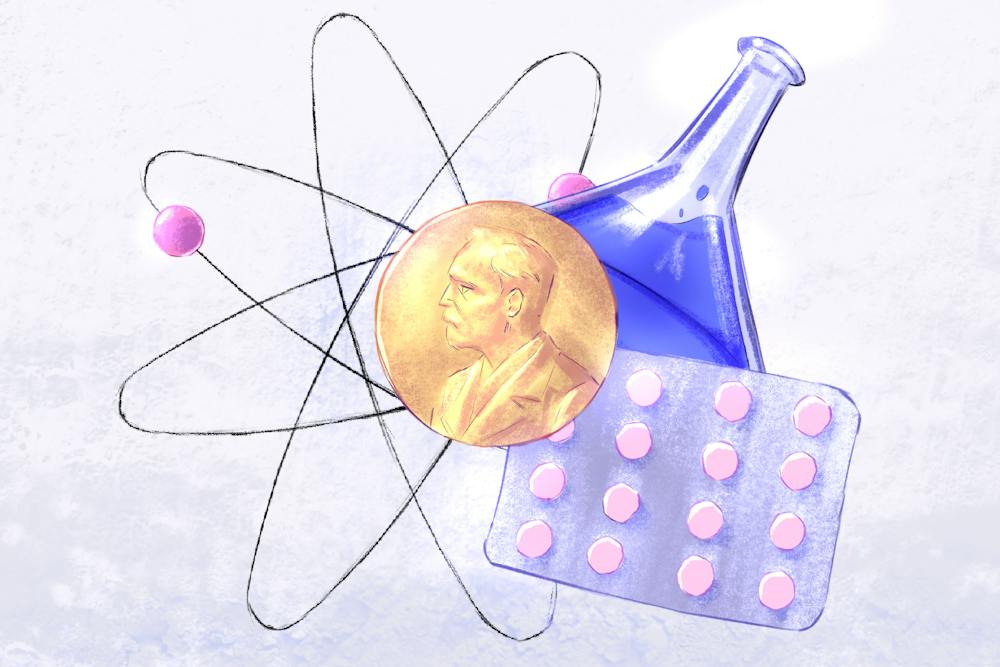
The 2026 Nobel Prizes in medicine, physics and chemistry were announced last week.
ASU researchers who study ion channels, neutrinos and molecular science explained what the brand-new laureates discovered and why it matters.
Switching neurons on with light
Three scientists won the Nobel Prize in Physiology or Medicine for their discoveries on light-gated ion channels and optogenetics.
The Nobel Assembly named Karl Deisseroth, a professor of bioengineering, psychiatry and behavioral sciences at Stanford University, Peter Hegemann, a professor of experimental biophysics at Humboldt University of Berlin and Georg Nagel, a professor of molecular plant physiology at the University of Würzburg, as winners of the category.
Ion channels are proteins that can let charged particles, such as sodium, in and out of cells, which is how nerve cells carry electrical signals, said Oliver Beckstein, a professor in the department of physics at ASU who studies membrane proteins.
An ion channel is like a door that can be opened up, Beckstein said. Most open with a "key," such as a change in voltage or a chemical.
The protein helped explain biological questions like how algae is able to swim, Beckstein said. Channelrhodopsins, one type of ion channel found in algae, open with light.
Deisseroth put the protein into a rat nerve cell such that a blue light would activate the neuron, according to the Nobel Assembly.
"One of the main advantages is that optogenetics can be used to modulate neural circuitry in very specific ways," M. Foster Olive, a psychology professor who heads ASU's Addiction Neuroscience Laboratory, said in a written statement.
Optogenetics lets researchers activate and inhibit specific types of neurons in a targeted way, Olive stated.
He stated one caveat is that neurons have to be equipped with light-activated proteins found in other species, often utilizing genetic technologies like genetically modified viruses.
"Also optogenetics involves specialized hardware such as fiberoptics and LED light sources, which is another limitation," Olive stated.
A telescope made of Antarctic ice
Francis Halzen, a Belgian physicist at the University of Wisconsin-Madison, won the Nobel Prize in Physics, the first solo prize in the category since 1992. He was awarded for the IceCube Neutrino Observatory and its discovery of high-energy neutrinos from space, according to the Nobel Assembly.
Frank Wilczek, a professor of physics at ASU and the 2004 physics Nobel laureate, called IceCube "a very ingenious kind of detector."
The collaboration includes more than 450 people from around the world, and the Nobel can go to no more than three.
Neutrinos are elementary particles nicknamed "ghost particles" because they do not interact with light and can pass through an entire planet, said Cecilia Lunardini, an ASU physics professor who specializes in neutrinos.
She said it's not exactly true that the neutrinos don't interact. In a big enough space, such as a cubic kilometer of ice, neutrinos can hit atoms and produce light if given enough time.
The observatory consists of more than 5,000 sensors frozen into a cubic kilometer of ice, watching for faint flashes of light, according to the Royal Swedish Academy of Sciences.
"IceCube is like a big animal with hundreds and hundreds of big eyes," Lunardini said.
Because neutrinos travel from exploding stars and some black holes, they "give you a direct window into the extreme and therefore fundamental and interesting astrophysical processes," Wilczek said.
"As a theorist, my role consists of making predictions for what IceCube could possibly observe," Lunardini said.
She said she hopes IceCube will soon detect a supernova, a star that collapses and explodes, near our galaxy.
"Nature has to be generous," Lunardini said. "I'm hoping that there will be (a supernova) eventually, and then it will be a big neutrino feast."
Molecules with handedness
Henri B. Kagan, a French chemist at Université Paris-Sud, and Kenso Soai, a Japanese chemist at Tokyo University of Science, won the chemistry prize "for the discovery of non-linear effects and autocatalysis in asymmetric organic synthesis," according to the Royal Swedish Academy of Sciences.
Kagan and Soai's work deals in chirality, the chemical principle that allows molecules to exist in two mirror variants, according to the Royal Swedish Academy of Sciences. Most biological chemistry is homochiral, with only one variant of an amino acid appearing in cells and the other being rarely seen in nature, and the two scientists demonstrated how that happens.
"Our right and left hands have a similar property: they are mirror images of each other, yet cannot be made to match exactly," Mario Galante, an assistant research scientist in ASU's School of Molecular Sciences, said in a written statement.
The principle is important for understanding DNA and proteins, Galante said.
"Chirality also influences the efficacy and toxicity of drugs and is increasingly revealing unexpected links between molecular handedness, magnetism, and chemical reactions," Galante stated.
Edited by Andi Ruiz, Carsten Oyer and Senna James.
Reach the reporter at lycifuen@asu.edu
Like The State Press on Facebook and follow @statepress on X.
Lidia Cifuentes Santander is a Sci-Tech reporter for The State Press. She is a physics doctoral student at ASU. This is her first semester with The State Press.