The Three Corners Satellite, designed and constructed entirely by students, will be leaving ASU today to be tested and prepared for launch on a NASA space shuttle.
The satellite, known as 3CS, was built mostly by undergraduates from ASU, University of Colorado at Boulder and New Mexico State University. It was designed to take pictures of Earth with three-dimensional imaging and software that will allow the students to communicate to different parts of the satellite.
The satellite will first leave for a Phoenix facility to test its resilience to harsh elements like extreme heat and cold.
Then it will be transported Thursday to the Air Force Research Center in Albuquerque, N.M., to make sure it functions. Once there, it will be fitted to a platform and prepared for launch, scheduled no later than summer 2003.
There are three identical parts of the satellite to be attached together. The pieces carry the name of each university mascot: Sparky, Ralphie and Petey.
ASU worked on the structure of the satellite, electrical systems, micropropulsion, power and solar cells.
Radio communication was made possible by NMU, and Boulder did the end-to-end data system (EED). EED is the main computer system software that allows the three parts to communicate with one another, said David Woffinden, an ASU electrical engineering senior.
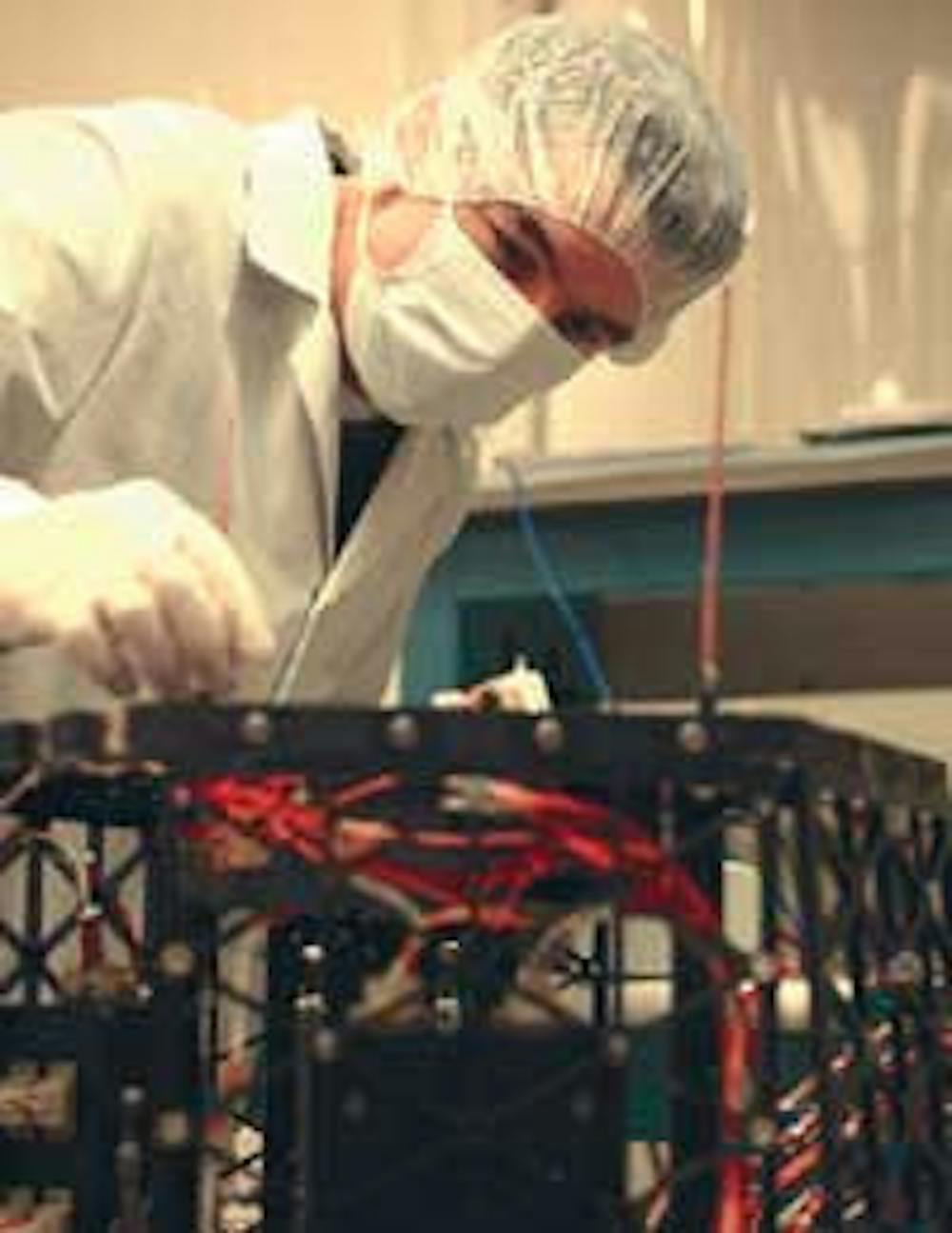
Woffinden came into the program with no experience and is now part of the electrical power system team, where he connects wires to parts of the satellite.
NASA and grants funded the project, which was proposed in 1999.
ASU has been designated as the lead university in the project since it first submitted the proposal for the satellite to the AFRC. This also means that the students have taken on most of the work, said Lisa Tidwell, an aerospace engineering senior.
Tidwell has been working with the program for four and a half years and saw the 2000 launch of ASUSAT 1, ASU's first student-operated and designed satellite to orbit Earth.
"Right now, we have 25 students here actively working on the satellite," Tidwell said. "And since the project started, we have had over 200 students involved. The students were the ones who decided everything including the mission and what to put on it."
Tidwell said the satellite was a low-cost mission. Students also included many parts that have never before been tried in space, such as parts from $50 digital cameras and batteries. Once the satellite is in space, students will be able to see how well these parts work and determine whether to use them in the future.
Reach the reporter at stinavee@asu.edu.