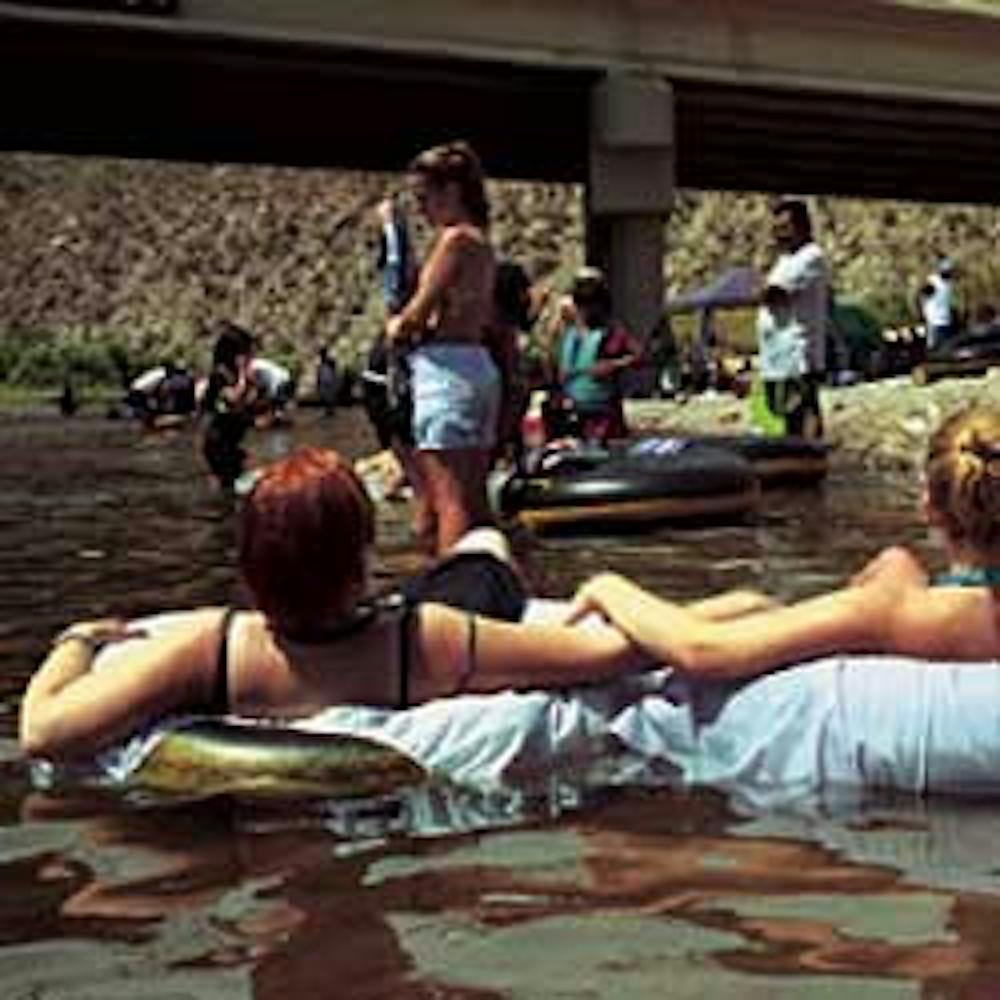
Click here to see a photo slideshow of a day at the Salt River.
Summer tends to be drag around the ASU campus. A big chunk of students decide to go home and live with mom and dad during the hot season, which leaves the few students who stayed in Tempe for the summer with nothing much better to do than watch the grass grow (which doesn't really happen here anyway.)
Escaping the summer heat of Arizona can be tough, but in northeast Mesa lies the Salt River, a lazy, slow-moving river that is actually quite a marvel considering it lies in the middle of the desert. In comparison to other vacation "hot spots" around Arizona, tubing the Salt River provides ASU students with a cheaper and more convenient way to get their parties on.
Computer science engineering junior David Jackson saw the river as relief from his ongoing summer physics class.
"The river seemed like a nice place to go and relax and get a tan on a day off," Jackson said. "It was a vacation away from reality."
Tubing the river takes anywhere from two to five hours, with the average trip taking about three hours. If you throw in the wait in line for a tube and the bus ride to and from the tubing drop-offs, four hours seems to be the average stay at the river. The drive from ASU takes about 45 minutes one-way.
A trip down the Salt River begins before the car even leaves the driveway. It is no secret that a lot of people migrate to the river to drink, and having a designated driver is imperative for everyone's safety. Another safety issue is the sun, which gives a person one heck of a sunburn during an afternoon's float. Even with a high SPF sunscreen, some floaters still can't avoid the damage of the sun.
"The sun takes a lot out of you," Jackson said. "You don't realize what it can do until you sit in it for over three hours."
Once at the river, the only place to rent a tube is through Salt River Tubing and Recreation, right off of Power Road. The $12 rental fee includes a tube as well as a bus ride to and from the river drop-off points.
Henry Breault started the company in 1979 while on a Labor Day vacation from Wisconsin. According to his wife, Lynda, Henry saw a newscast about the river during his trip and saw future success in its location.
"It looked disorganized," said Lynda, who acts as the company's director of marketing. "Henry saw a lot of potential for the river."
Salt River Tubing and Recreation only operates part of the year, from the beginning of May until the end of June. According to Lynda, an average weekend day during the summer draws about 3,000 to 4,000 tubers. The busiest day of the year is Memorial Day, when nearly 6,000 people float the river.
A day on the river
It may be over 100 degrees outside, but the 65-degree water of the Salt River still brings on a shiver for a lot of tubers.
Many groups tie their tubes together, something discouraged by the tubing company and National Forest Service for safety reasons. But in reality, there is no other way to journey the river and stay together - not to mention keeping your ice chest close by. The result is a series of floating clusters along the river, with friends sitting in a circle and hanging out, just as they might at someone's apartment.
The start of the trip is fairly laid back. Most people use the first part of the trip as a chance to sit back and take in the surroundings, as well as a beer. The flow of the river continuously bumps one group into another, allowing floaters to make new friends along the way.
"I just like kicking back and looking at all the people," said communications junior Keith Sherman. "It's fun to do people watching."
But where there are ASU students, alcohol and a body of water, irresponsible fun always seems to lurk close by.
And sure enough, it's not even an hour into the trip when students decide to use their knowledge gained from Geology 101 and jump off of the rock faces into the river. Each leap into the water solicits "oohs" and "aahs" from on-lookers, mainly to see if the guy who just did a triple lutz into the river actually emerges.
"It's the most petrifying thing to jump off, knowing people have died doing the same thing," Sherman said.
Uhh, so why do it?
"I don't know why I did it, but it's one hell of an adrenaline rush," he said.
Eventually the diving gets tiring to watch, and the tubers search for forms of other amusement. And it doesn't take a genius to realize that college students sporting bathing suits on a sweltering day provides plenty of eye candy.
With all of the pretty people on the river trying to gain more attention than the person next to them, nudity is not an unusual sight on the river. The objective of many on the trip is to both see and to be seen.
"There are a bunch of gorgeous girls, and once they grab your attention, it's hard to look away," said physics sophomore Eric Duncan.
And as innocent as they try to be, girls get in a fair share of gazing, as well.
"I love watching the boys try to be tough," computer science engineering junior Jackie Shue said. "I think all they care about is impressing girls."
The few patches of mini rapids offer occasional excitement and keep the inebriated tubers on their toes. But the flow of the river is generally slow, causing some people to induce a wilder ride by flipping their friends off their tubes. The water level can get low on parts of the river as well, forcing some bodily contortion to avoid any buttocks from scraping the bottom of the river.
The water level of the Salt River is completely controlled by SRP, with rainfall having little influence, contrary to what most people believe.
Saguaro Lake is the feeding source of the Salt River, with all water going through the Stewart Mountain Dam before it reaches the recreational part of the river. SRP controls the water flow based on agricultural needs, which means a rainy day could actually lower the level of the Salt River since less water would be needed by farmers.
Despite the distractions, a day in the sun and continual drinking finally catches up with most floaters by the end of a hot day. When the ride finally ends, worn-out tubers labor up a small hill to meet the buses at the pick-up point for a ride back. Unlike the bus ride to the river, this ride is quiet, as most barely have the energy to stay awake.
The dirty truth
While visitors to the Salt River may take home fond memories, they leave behind hoards of trash both in and around the river. Most groups bring along coolers of food and beverages and many neglect to throw away their trash, despite being issued garbage bags by Salt River Recreation.
Pete Libby, of the Mesa Ranger Station for the Tonto National Forest, said there is no excuse for littering along the river.
"It is inexcusable that mature human beings will leave garbage behind and call it a good time," Libby said. "It is irresponsible to take things to the river you're not going to take back."
According to Breault, steps taken by Salt River Recreation have reduced littering by 90 percent. Litter along the river has been reduced from 65 tons of trash in 1997 to 42 tons in 2001.
The fine for littering along the river $150; a second offense costs $250. Both the National Forest Service and Salt River Recreation have crews to clean up along the river.
Nonetheless, Libby said he has not seen much change during his 31 years with the Forest Service.
"I haven't seen a great improvement with litter," Libby said. "Less garbage would not be my observation."
The Salt River Recreation District is "doing their part," he said. "But stopping litter is like trying to stop speeding on a freeway."
When fun turns dangerous
Considering the large number of college kids who drink on the river, law officers are hard to find. The only ones in sight are on horseback along the side of the river.
Even underage drinkers don't flinch once they realize the swimming capability of a horse with a cop on its back.
But no one gets away as easily on the way back home. The Lake Patrol division of the Maricopa County Sheriff's Department closely monitors Bush Highway for anyone leaving the river intoxicated.
"The task force along Bush Highway looks for erratic driving and then investigates for alcohol," Sgt. J.J. Tuttle of the Sheriff's Department said.
In May and June there were 71 DUI arrests along Bush Highway.
According to Tuttle, the Sheriff's Department's biggest concern is drunken driving, as no officers actually patrol on the water itself. But the Sheriff's Department does have both medical and search teams along the river, with an additional 18 to 20 officers working on weekends and holidays.
Since 1998, 19 people have drowned on the river, with the most in any one year coming in 2001. Three have drowned so far this year, two of whom fell victim to the river over the Fourth of July holiday. The first victim, a 13-year-old boy, was reported missing on the holiday, and his body was found four days later, 100 yards downstream from where he was last seen. The second victim was an adult male who drowned two days later on July 6.
But Breault insists that tubing is safe.
"No tubers have ever drowned," she said. "Most of the victims have been fully-clothed individuals dragged down, not tubers."
Sgt. Clark Chapman of the Lake Patrol worked along the Salt River for three years and agreed that tubers are generally safer.
"The majority of the time in the three years that I was up there, the drownings did not involve tubing," he said. "They involve people at the recreation area on the shoreline."
Reach Andrew Bernick at dojersmang@aol.com.