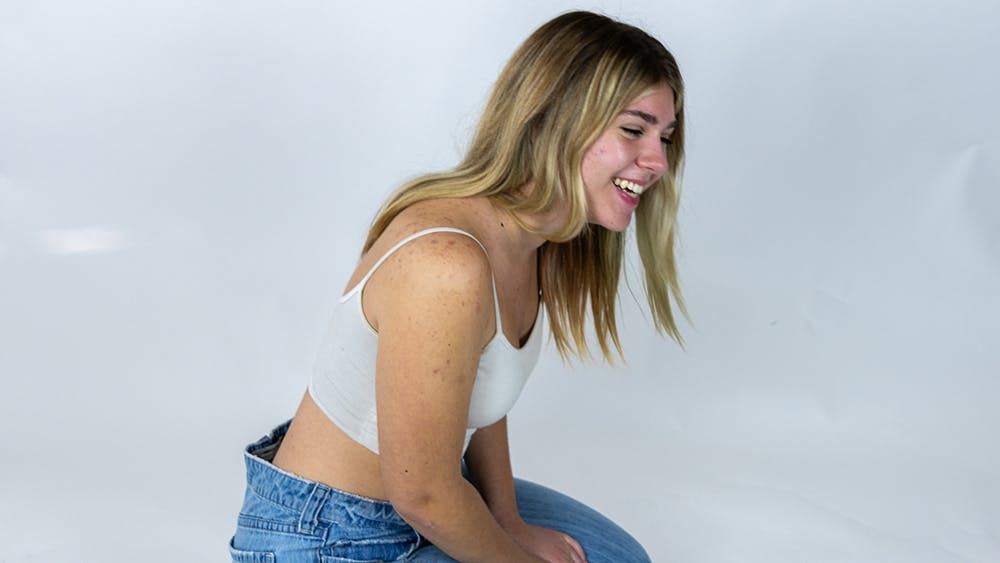
I’ve always had acne.
Bright, angry red pimples that dot my face, shoulders and back, emerging at the most inconvenient times. They first appeared when I was 14 and have stuck ever since.
I used to stand in front of the mirror, picking at my face until it was bloody and raw. I reached for every serum and medication on the shelves, but nothing ever worked.
When I got to high school, acne seemed life or death. In the eyes of judgmental prepubescent teenagers, having pimples was social suicide.
Freshman year, I started wearing a jacket over every outfit — even in Arizona’s triple-digit summers — because I was so embarrassed by my skin’s texture. At the mall, I passed on sleeveless tops, no matter how much I wished I could wear them. I even refused to change in the locker room with the rest of my dance classmates because I just wanted to hide my acne.
Being a dancer was especially difficult because you’re expected to carry yourself with confidence on stage, even if you’d rather shrink. I once had to wear a sleeveless, backless costume that put my acne on display in front of an audience. I cried every day leading up to the performance, riddled with anxiety about being examined on stage.
I felt naked. Every time I stepped out of the house with my acne out, I could almost hear my peers’ perceptions and their judgments. My fellow dancers looked like models in their costumes, while I was zit-covered and awkward. It made me feel like there was something inherently wrong with me because my skin wasn’t glass.
It became nothing short of an obsession with self-loathing.
Sophomore year, I begged my mom to take me to a dermatologist, though their prescriptions never ended up working. Sitting in the sterile room, I let the technician inspect my acne. I waited, feeling uncomfortable and embarrassed, wanting to disappear. “Do you wash your face regularly?” she asked, her tone not quite condescendingly, but not necessarily kindly either. Of course I washed my face. I washed my face three times a day. I exfoliated. I moisturized. I did everything right, so why was I still breaking out?
“There are a lot of people that think if you don’t wash your face, you’ll get acne,” Colin Mailman, a freshman studying mechanical engineering, said. “That might be true for some people, but bacteria on your face is only one factor of acne.”
Mailman’s experience is similar to mine, trying various skincare routines with no success. He said people view acne as something that needs to be “treated,” even though the treatments we try don’t always work.
“It can be hormones, just your skin type, the materials that you wear or you sleep in, like your pillowcase,” he said.
The source of acne is different for everyone, and how it affects people is truly a gamble; some people are blessed with naturally clear skin, and some people are more sensitive. Unfortunately, there’s no one secret to getting rid of it.
The American Academy of Dermatology Association reported that common habits for those with acne — like wearing makeup or squeezing breakouts — can have an opposite effect, only worsening the symptoms. They also found that obsessive face-washing can actually irritate the skin more, as well as constantly trying new treatments. If only someone had told me that earlier.
“It is definitely treated as a threat to human happiness, instead of just what it is,” Mailman said.
When I felt insecure, my mom would tell me my acne was normal, like it is for all teenagers during puberty, saying that I would grow out of it.
Key word: teenagers.
When you’re raised to believe your acne will go away with age, it’s paradoxical when you finally become an adult and realize it still isn’t budging. With my adolescent years behind me, I’ve become even more aware of the fact that I’m not the perfectly put-together college girl I thought I would be by now.
The beauty of authenticity
The only thing that has helped me overcome my acne anxiety is seeing other people with theirs on display. Which may sound harsh, but when I see others’ acne, I don’t judge or look down on them. I admire how their skin, even with its blemishes, looks so normal, because that’s all I ever wanted.
“They’re proud enough to not cover it up and just be their confident self around people ... That is very beautiful,” Hershey Gopinath, a freshman studying medical studies, said. She also found beauty in others’ acne at a young age.
“When I was around 11, I saw it on all my cousins, and I was like, ‘Acne is cool. I want acne,’” she said.
Maybe positivity is the antidote, because the more I look around me, the more I find beauty in imperfection. If I think it looks good on other people, why can’t my acne look good too? It’s a constant battle for me, but as I’ve grown up, I’ve realized that, first of all, nobody really cares about your pimples in college, and second of all, if they do, they’re weird.
The only person who really cares is you, which is why I’ve had to learn how to love my acne, because I’m the one who’s stuck with it.
It’s a roadmap of where I’ve been in life and a collage of my adolescence, which I’m lucky enough to carry on my skin, reminding me I’m not an insecure little girl anymore. It’s a sign of my growth; something I once covered up, but I now let be. There is beauty in allowing people to see your flaws.
“I’ve never seen anyone with dark circles as bad as mine before,” Gopinath said. “I feel like this is what makes my face look like my face.”
I feel like I’m losing the progress I made when I look around campus and see people with clear skin. Every now and then, my acne stands out in photos and I get uncomfortable. The urge to hide it comes creeping back in moments of insecurity.
“As humans, we’re very hard on ourselves, but not on others,” Gopinath said. “That sort of standard that we set ourselves to plays a very crucial factor.”
The very ideals we preach about others are almost impossible to keep up in practice. Gopinath said people tend to hold themselves to a high — or even impossible — standard, while being unconditionally accepting toward others.
I blame social media for the internal pressure living inside all of us.
Influencer University
It’s easy to exclaim that “acne is beautiful!” and “I’m not insecure anymore!” until you have the option to smooth out your skin with a filter. Which feels great, until you turn Snapchat off and look in the mirror, only to be met with reality and disappointment.
When you’re a young person bombarded by perfectly airbrushed “baddies” on social media, you’re going to look at yourself and wonder what went wrong. That’s the loophole I fell into at the ripe age of 15; It’s almost irreparably damaging to your psyche. I still feel the repercussions all these years later, despite trying to remove myself from attachments to beauty standards.
“Other people should know that just because you don’t look like somebody online, it doesn’t mean that you aren’t beautiful and that you aren’t your own unique person,” Braeden Culling, a freshman studying architecture, said.
We sat on the floor of his dorm together, creating an intimate space where we felt free to talk about the harsh realities of being at an “influencer school.” Culling explained that ASU’s open secret is that everyone is constantly competing with each other, even if nobody wants to admit it.
“I know a lot of my friends, especially when we’re out walking around campus, we will see someone who we find attractive, and for a split second, we kind of want to be them. On the surface, they have it all,” he said.
A desirable body type, blonde hair, and, of course, glistening skin are just some of the beauty standards Culling sees most predominantly at ASU. Influencer culture pressures us to post ourselves at our best and hide ourselves at our worst — even though a person’s “best” is often manufactured.
READ MORE: 'Wait it out'
“It just becomes a festival in which we beat down on ourselves and we refuse to see the beauty that we have and the different cultures that we bring to the University,” Culling said.
The truth is, everyone has something wrong with their skin. Yes, I see your eye bags, your acne scars and your discoloration. But I don’t think there’s anything wrong with that. No amount of foundation or filters can change the fact that we’re all human.
“I feel like people, even just individual content creators, owe to society their imperfections,” Mailman said. “It’s so dangerous to have children with developing minds be on social media and then witness everything that they’re not right now and are supposed to grow into.”
We’re primed from a young age to expect beauty to come with age. But here I am as an adult, and I’m far from perfect. I still break out every month, as embarrassing as it is to admit. Even if nobody wants to talk about these imperfections, they’re not going away... at least not for me.
In my 20s, I might still have acne. Because of my genetics, that’s just how I am. I’m stuck with this skin.
I don’t love my acne all the time, but I know that it tells the story of who I am. Every scar, every pimple and every wrinkle holds the essence of me, all wrapped up in a body that’s uniquely mine.
Letting others see my acne was pivotal in developing my self-confidence, a way of finally letting the world see me for who I am. On a good day, I don’t even look twice at the new pimple on my face — OK, so maybe I’m not jumping up and down about it, but that’s something at least.
To be human is to be imperfect. We should all remember that more often.
Edited by Leah Mesquita, Natalia Jarrett and Abigail Wilt. This story is part of The Purity Issue, which was released on December 3, 2025. See the entire publication here.
Reach the reporter at ajanusee@asu.edu and follow @lexijanusee on X
Like State Press Magazine on Facebook, follow @statepressmag on X and Instagram and read our releases on Issuu.
Lexi Janusee is a senior reporter at The State Press. She is a sophomore studying Journalism with a minor in Theatre. This is her third semester with The State Press, working previously as a full-time Echo reporter.