COULD YOU TAKE a swing at this man?
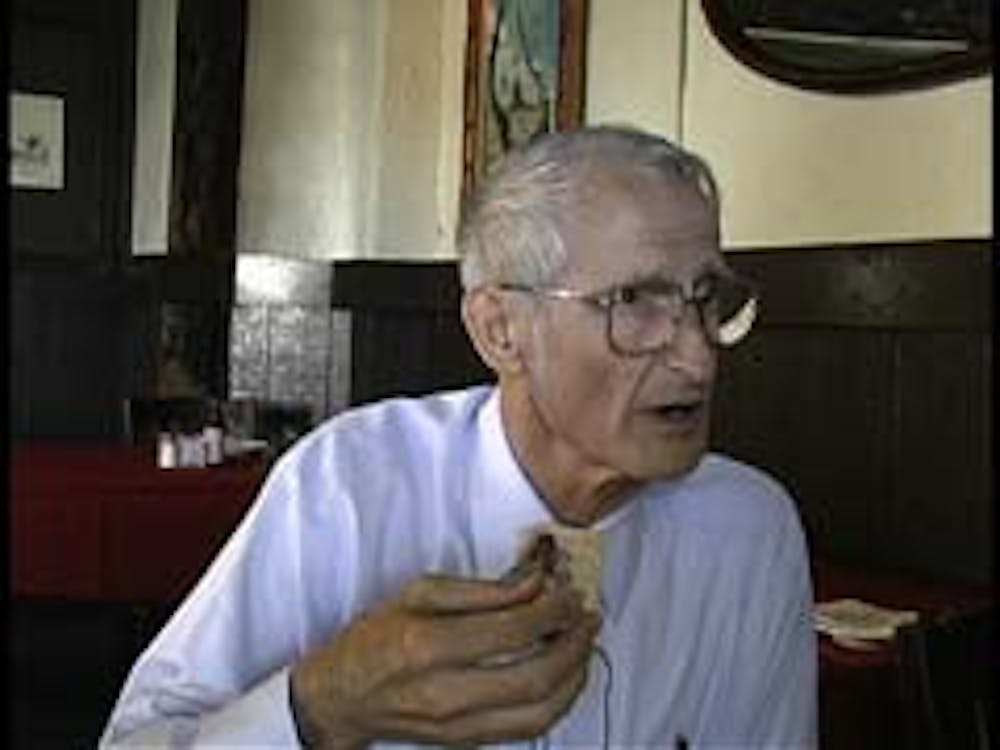
Leland Fairbanks walks with a slight hunch and has probably lost an inch or two from his peak height. His blondish-gray hair has thinned a bit, but likely receded as far back as a 71-year-old's will this late in life. He wears big glasses, not so much in thickness, but in mass. For a lunch date at a Mill Avenue restaurant, he fashions a gaudy bronze bolo tie that looks as if it's being used to keep his baggy pastel blue shirt fastened around his neck and from flying off his frail body.
He was a family physician for 45 years and probably saved a few lives before retiring several years ago. Throughout the decades, he has been honored with dozens of merits and medals, and showered with gratitude and praise for his service to public health. He has never lived like a wealthy doctor who has his own practice. He lives in a modest home with his wife of 49 years, Eunice.
In many ways, Fairbanks is the ideal granddad, a man you'd treasure advice from and gladly help cross the street.
But if you own a bar in Tempe, Leland Fairbanks is a pain in the ass.
THE GOOD DOCTOR likes catch phrases, however cliché or repetitive they may be.
| Click here to watch a Quicktime of Dr. Fairbanks speaking about his first experience with an emphysema patient.Click here to watch a Quicktime of Dr. Fairbanks speaking about the harassment he received the day after the smoking ban passed.Watch an SDTV-Channel 2 special report about Josef Watson's interview with Dr. Leland Fairbanks at noon Aug. 30 - Sept. 2. |
In a span of less than an hour at Monti's La Casa Vieja Restaurant on the north end of Mill Avenue, Fairbanks offers up close to a half-dozen of those doozies, including, "The cigarette smoke is like a toxic waste dump," and "Bar owners think the smell of smoke is the smell of money." More than three months have gone by, and Fairbanks is still churning out the hits that helped to narrowly pass Proposition 200, the city's supposed smoking ban that outlaws lighting up in any enclosed public place in Tempe.
He orders a chicken salad sandwich on white bread with an ambiguous side of vegetables from the waiter who wonders why this old man is being interviewed.
"They've got some good, healthy food here, too," says Fairbanks, noting the smoke-free air in which we sit. The sunlight catches an angle of his bolo tie just right, and the ACAS (Arizonans Concerned About Smoking) logo blinds me for a second.
He takes a sip from his glass of pink lemonade and tries to convey the mission of his crusade.
It began in the mid-1950s when a green Midwesterner treated merchant marines at a New Orleans hospital.
"One of the first patients I had was a man dying of emphysema," says Fairbanks, a native Minnesotan. "He would smoke, choke up, he couldn't breathe. [The nurses] would bring the oxygen in for treatments and they would hold his cigarette for him so he wouldn't drop it and burn the bed and the hospital down. Then, he'd need his next cigarette again after he had the oxygen.
"And I talked to this man, and he started to cry. He said, 'It doesn't make any sense at all. I'm gonna leave my children without a father, my wife without a husband. It's a foolish thing. I'm embarrassed by what I'm doing, but I'm so addicted that I can't quit.'"
It's a new millennium, and Fairbanks still appears emotional about that event in his life. It shaped his future and led to national recognition. In the late 1980s, he along with then-Surgeon General C. Everett Coop, fought against smoking in hospitals, a ban that is only logical today. He helped outlaw smoking in Mesa in 1996. And in January, realizing that too many smokers like the merchant marine who played cards in smoky New Orleans bars couldn't quit on their own, he circulated a petition throughout Tempe to get a smoking ban on the May 21 ballot.
"The ban will help more people to quit than spending millions on pamphlets that don't work."
ON MAY 22, Fairbanks woke up to find a sign adorned with a swastika leaning against the front of his house. In the previous months, he had become used to that sort of thing. Swastikas were painted on his street sign. The phone rang late at night and early in the morning, waking him up to the silence of dead air on the other end of the line.
When he began gathering signatures in January, he says business owners and others in the community warned him he would likely have his life threatened.
"My family has been fearful for my safety," he says.
Few publicly supported Prop 200. Mayor Neil Giuliano never chose a side. And those in opposition, says Fairbanks, were just plain mean. McDuffy's owner Roger Egan and Mill Avenue Beer Company owner Jerry Piorkowski bashed not just the ban, but Fairbanks himself, he says. Proponents of the Stop 200 campaign even labeled Fairbanks as the "Taliban Health Czar," and others called him a Nazi.
Much of it has subsided. But many Tempe business owners, especially on Mill Avenue, still hold a grudge.
"We're talking about [the owners'] livelihood," says Eric Emmerts, the vice president of public relations for the Tempe Chamber of Commerce, which steadfastly opposed Proposition 200. "Of course, I'm not saying that people should be threatening Dr. Fairbanks' life. But when you threaten someone's livelihood, I can understand some of the hostility."
The summer months are always the worst time of the year for Tempe businesses, says Emmerts. And a drop-off in revenue from last year at this time – largely due to an economic slowdown and the effects of Sept. 11, he says – was expected.
The chamber has been tracking what's been happening to local businesses, mainly restaurants and bars. In June, says Emmerts, restaurants took a 22 percent hit from last year's numbers. Bars fared even worse, anywhere from a 20- to 40-percent drop, which he says is largely attributed to the smoking ban.
"Some restaurants are doing better," says Emmerts, adding that an exact trend couldn't be established during the summer months. "But the bars are still hurting."
Fairbanks feels the bar owners' pain. He says he nearly felt it across his face several weeks after the ban went into effect.
"I might actually have some hazard bringing it up and I don't want to say which bar I went to," says Fairbanks nervously. "But I had a meeting one time to look in on the compliance of the ordinance. This bar was full of people watching [a preseason Arizona] Cardinals [football] game. It was such a sight! A full bar of people and no smoke!"
The bar owner noticed who Fairbanks was, rushed around the bar and ordered Fairbanks to leave.
"He said, 'Get outta here! I won't answer any of your questions and I want you outta here!'" recalls Fairbanks. "I think a lot of the people there were ready to punch me in the nose."
FRED MAKAPUGAY QUIT smoking just before his 31st birthday. That was Aug. 19. This year. About a week and a half ago.
"Now, I'm just eating everything in sight," says Makapugay, the owner of Café Boba, an eclectic tea and coffeehouse on Mill Avenue that opened in November. "Luckily, I don't have a lot of time to think about it because I'm bouncing around all over the place trying to keep busy at work."
A former athlete, Makapugay says he never thought he would have been a smoker. In fact, he didn't start until he was 28, after he gave up racing jet skis and moved to San Francisco from his native Thailand.
"The people I met there and hung out with were kind of party animals, and I'm sure that influenced me," says Makapugay. "And I even learned to really enjoy smoking. It's a very relaxing thing when you're not doing anything."
But Makapugay is trying to get back into shape and become healthier, in general.
The ban, he says defiantly, had nothing to with it.
"It's my personal choice and it's everybody's right to smoke or not to smoke. No law or amendment to any law could reverse that."
Makapugay thwarts Fairbanks' theory that the ordinance will help people quit smoking. Like many who worked to stop Proposition 200, Makapugay likens Fairbanks to a tyrant, forcing his will on the people, telling them what's good for them. The ideology is far from what Makapugay says he expected from Arizona when he first arrived.
"It's like abortion to me, personally. You can't force someone to stop smoking and you can't force people to go against their will. I really thought that something like this couldn't happen in Arizona. I kind of looked at it as this, sort of, last frontier."
But it did happen in Arizona – barely. Nearly 20,000 ballots were cast in the May 21 election in Tempe, which included a run-off election for city council. Prop 200 won out by fewer than 1,000 votes – 10,345 (52 percent) to 9,381 (48 percent), according to the city clerk's office.
The vote happened less than two weeks after spring convocation at ASU, and that, coupled with "the politics of this town," had everything to do with Prop 200's passage, Makapugay believes.
"I hate to use the word, but I do think it was one big conspiracy to get this thing passed," says Makapugay, who did not vote on the proposition because he is a Glendale resident. "If the students would have been here, there's no way it would have gone through."
Fairbanks disagrees and says the Smoke-Free Tempe committee had nothing to do with the date of the election. City officials, he says, told him the proposition had to be decided upon that date, unless he wanted to pay $110,000 for a special election.
As for ASU students overwhelmingly going against the ban, Fairbanks says, "There are those who argue that the student vote would have gone against us, but I have a hard time believing that. They may party at ASU, but educated people know the hazards of smoking. Smoking bans have worked in other college towns across the country – at the University of Colorado in Boulder, at Oregon and Oregon State. Smoke-free bars have thrived at Stanford and Harvard.
"Educated people are smart enough to know it's not a good choice."
DOS GRINGOS ON University Drive could flourish under the new ban. Most of the bar's patrons, a base made up almost entirely of ASU students, are found on the outside patio where the ordinance doesn't have jurisdiction. Tempe officials expect more patio license requests from local bars and restaurants as the temperature drops down from the scorching summer heat.
On the Friday night before the first day of fall classes, Gina Pezcotti, a broadcast communications major, is enjoying a smoke with her friends on the Dos Gringos patio. While she admits she is smoking less because of the ordinance, she is rather miffed by its ideology.
"I think that it is so stupid. It's absolutely ridiculous," says Pezcotti, 21. "If you smoke, you're still going to go outside to do it.
"Yes, I'm smoking less, but it pisses me off."
Others at Dos Gringos must be so upset that they decide to deliberately defy the ban. In Dos Gringos' small inside bar, about a half-dozen smokers can be seen lighting up underneath a new No Smoking sign. And no one asks them to stop. A Dos Gringos employee says the bar has adopted "a sort of 'Don't ask, don't tell' policy."
An individual who violates the ordinance, Tempe City Code 22-43A, faces a first-time warning, followed by a $50 fine for the second offense and a $75 fine for all offenses thereafter. For bars and other businesses that allow the violation (TCC 22-43B), a second offense results in a $100 fine, and a $500 penalty for the third.
Dos Gringos wasn't the only bar in violation that Friday night. At Palapa Cantina, just behind Fat Tuesday's off Mill Avenue, George Emerson stumbles in somewhat drunk, a lit cigarette dangling from his mouth. But the bartender doesn't ask him to extinguish the smoke. Instead, he pushes an ashtray – one of about a dozen lying in wait – closer to Emerson's weaving hand.
"Yeah, I heard something about this ban," says Emerson, 22, a student at Rockhurst College in Kansas City, Mo., in town visiting friends. "But no one seems to mind."
That includes Tempe Police, says one Mill Avenue bar owner who did not want to be identified. The owner says that Tempe Police are on the side of the businesses, and statistics provided by the department may indicate just that.
Since the ban went into effect May 31, Tempe Police have responded to 101 complaints regarding the smoking ban, as either someone had lit up or refused to stop smoking inside an establishment, or a bar employee was allowing smoking, according to Tempe Police Sgt. Dan Masters.
Of those complaints, no citations were issued.
As for Mill Avenue, specifically, 11 bars in Tempe have received formal warnings for allowing customers to smoke inside. None of those warnings were issued to Mill Avenue establishments.
"It certainly concerns us. We're still in the process of educating our officers," says Masters. "But I think that whether we [the officers] agree with [the ordinance] or not is irrelevant. The onus falls on the police officers to carry out the enforcement."
DAVID WARING SAYS he won't comment on his employees purposely allowing smoking inside his bar. But the Palapa co-owner tries to justify their actions, nonetheless.
"This whole smoking ban creates an unfair competitive advantage," says Waring, 34. "Drinking and smoking go hand in hand. If I want to drink, why not go to Sugar Daddy's in Scottsdale, or some other place in Chandler?
"I don't have a problem with a smoking ban unless it's city-specific. They need to do something statewide. Then, we all just adjust our lifestyle."
Makapugay says he wouldn't root for bans in other cities, but as a businessman with a new café struggling to get ahead, the bottom line is all that matters.
"It's a sad thing to see, all across the West Coast. There isn't a place for smokers any longer. But the number one thing for the businesses right now is for us to be able to earn a living."
Fairbanks has already begun the process of leveling the playing field. Next on his agenda is a similar ban in Scottsdale, which, he says, Mayor Mary Manross has already endorsed. Chandler would follow, where Mayor Boyd Dunn has organized a task force on the issue.
After conquering the Valley, Fairbanks says he will take a proposal to the State Legislature, which he says has ignored him for 15 years.
The victories, he says, have far outweighed the backlash. The same day he met me for lunch on Mill Avenue, Fairbanks was awarded a lifetime achievement award, in part because of his latest win in Tempe. After all the years of taking the heat, Fairbanks says he still knows when his work is appreciated.
"You know, I think I've gotten more appreciation than I deserve," he says. "After all this is done, nobody will really hold that much of a grudge. These days, they'll at least shake my hand while they call me a 'Taliban Health Czar.'
"And that's about all you can ask for."
Reach the reporter at josef.watson@asu.edu.