Swipe left. Swipe right. Pause, scroll, read, swipe left again. It's a tedious and oftentimes unnerving routine — yet I keep going back.
My presence on dating apps began as a game. Who will I match with? How many likes did I get? For a long time, chasing these questions was pretty entertaining; however, at some point the swiping, liking and futile conversations made these apps feel like a chore.
This fatigue is common among many of my peers, and as a result, these apps have started to lose their grip on college students around the country. Through this opening in the market, a new kind of online dating platform has emerged — Ditto.
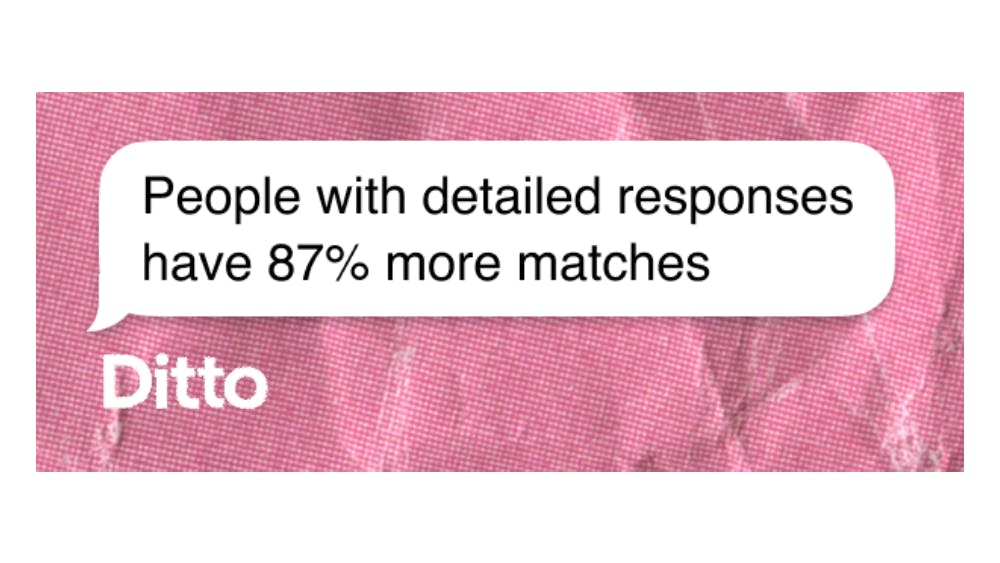
I, admittedly, was an immediate skeptic. But my hesitations were not based on any of the typical issues you may find with dating apps. With Ditto, there is no swiping or liking, or even really any talking. This platform relies entirely on artificial intelligence and intricate algorithms to find you a "perfect match."
The introduction of an application like this on ASU's campus led me to question what kind of role AI can play in the future of online dating and the overall impact technology has on interpersonal connections within college campuses.
Head over heels?
The new platform's unique interface initially caught my eye. To join the program, users send a text message through a link on the Ditto website. The entirety of the matchmaking process is conducted through your phone's messaging app.
By texting the number, users open a conversation with an AI chatbot that sends them a link to fill out basic information. The first tier of questions centers the user and their type on paper, with basic "get to know you" questions about background, interests, dating goals, and ideal physical and emotional attributes in a partner.
Users are then given several options: receive the quickest possible match, a decent fit, an intentional match (where most preferences fit) or to "wait for the one," with all boxes checked.
Every prompt in this questionnaire is optional, including adding photos of yourself. Because of this, I began to wonder how the program would be able to sift through discrepancies between profiles.
By asking what facial features a user likes, but not asking questions about the user's own features, the AI behind the platform is presumably responsible for analyzing physical and emotional attributes for potential matches.
For example, when users are prompted to describe the ideal "vibe" of their partner, and enter something along the lines of "granola" or "indie," it is solely up to AI to discern what or who falls under those styles or ways of life. Why should users trust Ditto to make those kinds of categorical decisions?
Later on, users are able to answer a second tier of questions. This "in-depth" section asks what green or red flags users look for, what activities they'd prefer on a first date, and what their political and religious beliefs are.
This line of questioning (while also voluntary), raises even more questions about the optional nature of the platform's surveying and how matches are created if certain information is omitted.
The final step in the profile creation process is the "ideal look" section. In this tier, users upload photos of their celebrity crushes and other figures who have the "look" of their ideal partner.
Once the profile is complete, all users have to do is sit back and wait for Wednesday to roll around when Ditto sends them their match for the week. Once they receive a match, they are provided with some photos and basic information about the person and their interests.
Ditto then sends a link to a calendar where users can enter their availability for a date, planned by Ditto. The planning of this date seemingly takes into account the general interests of both matches, starting with a "main event" and providing a supplemental list of different activities to do as the date progresses.
At this point, users still do not have any contact with their match, and could only know their first name and what they look like (if they provided photos). It is only once both parties confirm availability for a date that Ditto reveals their phone numbers and users are able to contact their match.
Although I refrained from continuing the experience up to this point, I was generally disappointed in the platform as a whole. Since joining the app, I have received three matches, with curated date ideas for each. My first option was a coffee date at a local cafe, and the supplemental ideas included vinyl store browsing or dinner and a movie. While very cute ideas, I couldn't help but feel underwhelmed by the simplicity of them. For a platform that prides itself on intricate connections and unique experience, with the scope of AI at its helm, the series of ideas it shelled out were pretty lackluster — and this feeling permeated throughout most of my time on the platform.
AI in matchmaking
Ditto, developed by two University of California, Berkeley dropouts, launched in 2025. Creators Allen Wang and Eric Liu rolled out the platform for students at San Jose State University, UC Berkeley and University of California, San Diego students, as an alternative dating program for easier connections.
Through provocative marketing on UC campuses, student mixer events and a persistent online presence, Ditto has entered scattered conversations among college students wondering: What is this?
Many of their advertisements have not ailed this curiosity, but they have certainly succeeded in garnering public attention. Flyers on the University of California, Santa Barbara campuses read, "Matthew cheated on me. Here's proof," as onlookers were prompted to open an attached QR code that led them straight to the Ditto website.
Other ads made references to the "Hang the DJ" episode of the TV show "Black Mirror," which follows a couple who rebelled against an AI system that pairs people together for a limited time.
The platform has since expanded across the country, debuting at ASU in March as part of a 2026 expansion, according to Business Insider.
Earlier this year, Ditto launched a collaboration with popular anonymous student platform Yik Yak, giving students the opportunity to find platonic or romantic matches based on a 30-question survey. Over the course of three weeks, students across the country opted into the experience.
The introduction of an AI-forward platform like Ditto on college campuses has sparked thoughts on the encroachment of AI in everyday life and the depth of the role it can play in fostering human connection.
"I don't know what a computer could tell me about someone that I couldn't figure out on a first date," Piper Kvanvig, a senior studying communications, said when asked whether there is a place for AI in the realm of online dating.
Some of the most popular dating apps among college students are Tinder and Hinge, both platforms with wildly different interfaces and approaches to connections than that of Ditto.
What sets Ditto apart from these apps is not only its interface, but also how it bypasses communication barriers that often hinder connections on alternative platforms. Users don't have to speak to their match at all, leading up to their first scheduled date, and they don't even have the option to until both parties have confirmed their availability for the preplanned outing.
This incredibly unique matching process is the essential basis of the platform's creation. Wang stated in an X post from 2025 that he and his co-founder developed Ditto to "kill Tinder with AI."
Ditto intends to accomplish this through the elimination of swiping, scrolling and communication in the matchmaking process. Competing platforms are almost all based on user-driven engagement — the more you swipe, the more visibility you have and the more matches you get.
The first obstacle that Ditto aims to hurdle is the first date. For many online daters, it can be difficult to get the relationship from the screen to an in-person meeting. According to Liesel Sharabi, an associate professor at the Hugh Downs School of Human Communication, "There's the process leading up to meeting, where people flake, and they ghost and dates drop off. And that can be really frustrating for people."
For Ditto users, this issue is largely solved. The program itself curates the date for you, and the day and time can be agreed upon without a single word between either party.
"There's not an algorithm out there that's able to just immediately identify your ideal partner," Sharabi said. "Otherwise, the market would be cornered, everybody would use that app. But with AI, I think there's a lot of possibility."
Sharabi has conducted research on communication technologies and their impacts on relationship development in modern romance. "The big question is how this kind of technology can be used as an introduction service (and) how it can introduce people so that they can go on to have successful face-to-face dates and face-to-face relationships," Sharabi said.
In examining how the emergence of this technology in online dating reflects trends in younger generations, Sharabi highlighted a growing attitude among Gen Z in their dating aspirations – striving for authenticity and quality connection.
While acknowledging the ever-lingering presence of hookup culture, especially among college students, Sharabi noted an increasing interest in relationships and genuine connections within this demographic. "You see apps like Hinge and some of these other platforms that are more centered around relationships," she said. "That's another way that Gen Z and young people have started to kind of shift the culture a bit."
Campus consensus
A major concern for online dating among college students is discerning the intentions of potential matches. Although many apps offer users a space to make their aspirations clear, there is still space for misunderstanding and crossed signals.
"It's very hard to distinguish what that person wants until after something happens, and with Hinge, or literally any dating app, you can put what you're actually looking for, and maybe some people are not honest on that part, but it just definitely gives you some type of range of what that person may want. And you don't have to go through all those hoops," Madeleine Hazzard, a sophomore studying nursing, said.
Kvanvig expressed similar thoughts, highlighting how overwhelming presence on these apps can be. "It's also important to know what you're wanting out of it when you go into it, just because it is so vast (and) the decision fatigue factor of trying to do online dating is kind of crazy," she said.
Ditto's interface takes a similar approach to its competitors in this regard, having one section for users to express what they are looking for, with the option to select multiple answers.
Hazzard also expressed initial hesitance toward being active on dating apps. "(But) once I got comfortable with the app, texting people (and) went on a few dates, I definitely felt a little more comfortable. But some of those dates have gone pretty bad, or just not comfortable enough for me to keep going," she said.
Cassandra Cotton, an assistant professor at the Sanford School, touched on a significant finding in her research, in that many younger people have grown to treat dating apps like games, or something to mindlessly scroll through at the end of a long day.
According to Cotton, the gamification of online dating reflects a greater detachment among young people.
“A lot of people were telling us stories (where) they would reach out to someone, and then the texting back and forth would just be endless, like it would never lead to a real, in-person connection," she said. "(It) makes it easier to emotionally detach, because you don't necessarily know if it will go anywhere."
Cotton began collecting data on relationship aspirations among young people, primarily ASU students, in February 2025. With the help of over 25 sociology capstone students, she has overseen in-depth interviews centering around the concerns, ambitions and trends that come with dating.
According to Cotton, online dating can feel like work for many young people, and large amounts of time spent curating profiles has the potential to give way to fatigue and feelings of inauthenticity.
"Some of the apps ask lots of detailed questions, and so they spend a lot of time making an answer, testing it out with their friends, getting someone to take the perfect photo of them. And so it ends up being a lot of time investment," she said.
Ditto's interface certainly addresses many of these concerns and mindsets when it comes to online dating. By removing the user-engagement aspect of dating apps, users no longer have the responsibility of sifting through hundreds of profiles, and this kind of emotional detachment is less of an issue.
However, because users are unable to speak with their matches until further along the process, there is space for a different kind of detachment, where the match only exists as a photo and an AI summary, and not a person you can build a connection with.
Another point of contention among students on these apps is the paywalls behind certain features or extensions. Hazzard commented on this issue, saying, "Because the goal is to try to find someone, I don't think we should have to pay to have these extra things."
On Tinder and Hinge, users have the option to purchase tiered subscriptions that give them access to view the profiles that "like" them, offer increased customization of their profiles and the profiles that they see, provide unlimited "likes" and more. On the other end, Ditto's platform is currently free, which is a definite appeal for college students and supports a mission that solely prioritizes making connections (over profit), although Wang and Liu are considering future monetization possibilities, according to Forbes.
On campus, algorithms reflect the varied desires students have in their romantic connections, as well as a general culture that is popular among students. According to Kvanvig, "(Dating apps) definitely feed into the hookup culture, because it (provides) easy, (accessibility) to people who also want to hook up."
Sharabi also noted the role dating apps and their algorithms play in the expansion of dating pools, "Algorithms are being used to sort, filter and narrow down your pool, so your romantic prospects are dependent on non-human judgment. For that reason, they're really significant, and something that people don't often think a whole lot about."
Ditto's approach to online dating alleviates many prominent concerns among college students, while also leaving many questions unanswered. While there is certainly space for improvement within the internet dating realm, it remains unclear the extent to which an AI-first platform will meet these needs.
Edited by Leah Mesquita, Natalia Jarrett and Abigail Wilt. This story is part of The Best of ASU, which was released on April 29, 2026. See the entire publication here.
Reach the reporter at kwalls6@asu.edu
Like State Press Magazine on Facebook, follow @statepressmag on X and Instagram and read our releases on Issuu.
Keyanee Walls is a magazine reporter at The State Press. She is a second year student at ASU’s Walter Cronkite School.