DOHA, Qatar - "Jessica Lynch," said the commando in full battle gear, taking off his helmet. "We are United States soldiers, and we are here to protect you and take you home."
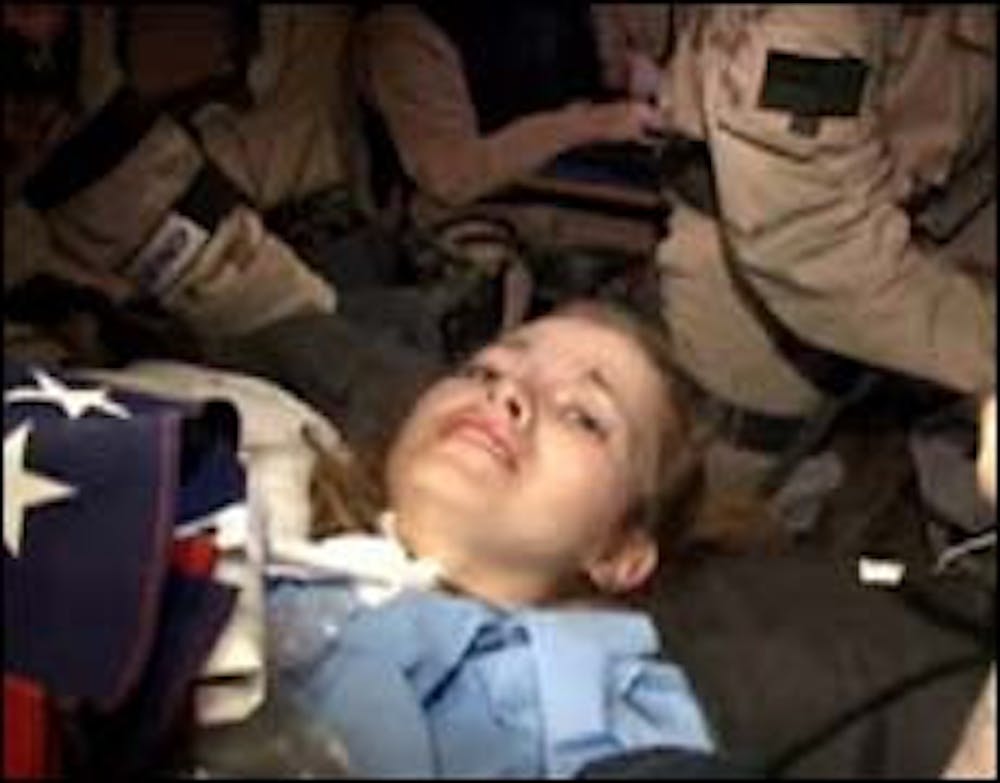
"I'm an American soldier too," replied the 19-year-old Army private, lowering a bedsheet she had pulled over her head and peering up at one of the men who would whisk her out of captivity at Saddam Hospital and out of Iraq.
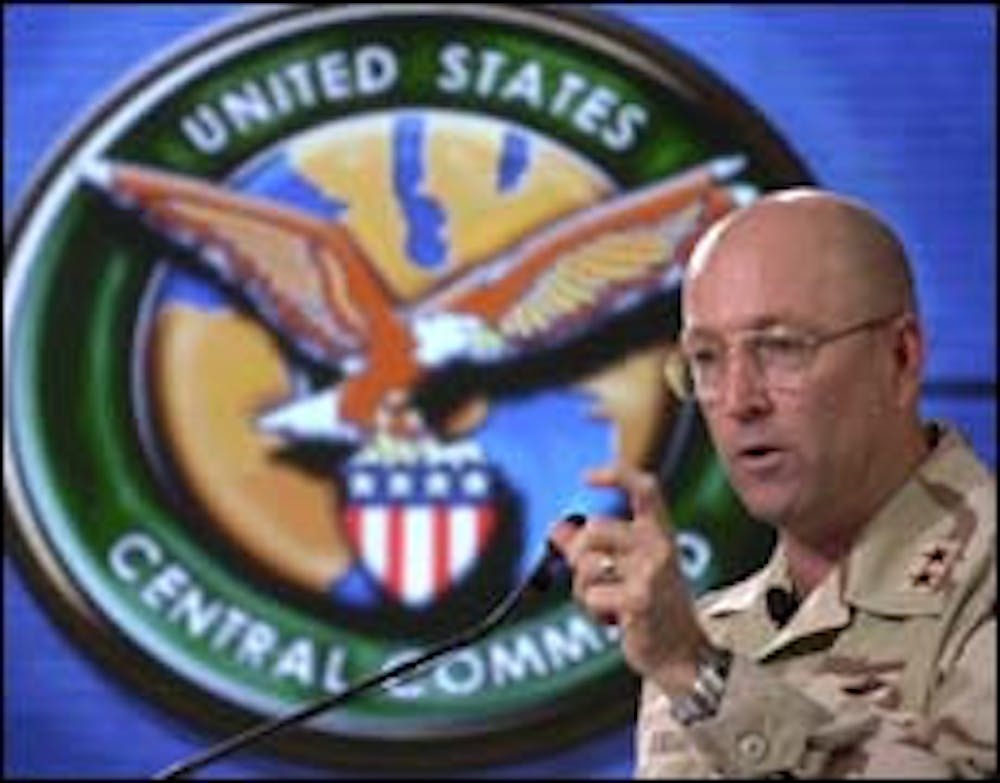
The details of the dramatic rescue of PFC Lynch, who was badly injured and is recovering at military hospital in Germany, were recounted for the first time Saturday by a senior U.S. Central Command official.
In a daring, deep night raid Tuesday, Lynch was spirited out of the Iraqi town of Nasariyah, where she and her comrades in the 3rd Army Infantry's 507th Maintenance Company had been ambushed a week earlier.
U.S. Air Force Major Gen. Gene Renuart, Centcom's director of operations, said that the raid had been staged by a special task force of Navy Seals, Marine commandos, Air Force pilots and Army Rangers acting on intelligence tips from Iraqi civilians in the city.
Renuart said the Lynch's daring rescue began after military officials near Nasariyah received "indications from local contacts" that a U.S. soldier was being held hostage by Saddam Fedayeen guerrillas. The Washington Post reported this week that the tipster was an Iraqi attorney whose wife worked as a nurse at the hospital.
The raid began when a U.S. marine unit staged an attack on Nasariyah that was meant as a diversion for the Iraqi fighters guarding the hospital. The rescue team, wearing night vision goggles, was then flown by helicopter to the hospital, where they persuaded an Iraqi doctor to take them to Lynch's room.
Renuart said Lynch appeared "pretty scared" when the commandos found her. While being rushed to a helicopter, she reached up and grabbed the hand of the Army Ranger doctor and gripped it for the rest of the operation, he said.
"Please, don't let anybody leave me," Lynch told the doctor.
The commandos who rescued Lynch also recovered 11 bodies from the area around the hospital, and the Pentagon early Saturday confirmed that nine of them belonged to fallen U.S. soldiers. Eight of the nine died in the ambush on Lynch's maintenance unit, which took a wrong turn into hostile territory on March 23, the third day of the war.
The bodies were flown to Delaware for identification. The eight recovered dead soldiers in the ambush were identified as: Army Pfc. Lori Ann Piestewa, 23, a Hopi Indian from Tuba City, Ariz., and the first U.S. woman killed in combat in the war; Sgt. George E. Buggs, 31, of Barnwell, S.C.; Master Sgt. Robert J. Dowdy, 38, of Cleveland; Pvt. Ruben Estrella-Soto, 18, of El Paso, Texas; Spc. James M. Kiehl, 22, of Comfort, Texas; Chief Warrant Officer Johnny Villareal Mata, 35, of Amarillo, Texas; Pvt. Brandon U. Sloan, 19, of Cleveland; and Sgt. Donald R. Walters, 33, of Kansas City, Mo;
Renuart said that the Iraqi physician led the commandos to a burial site near the hospital, where he pointed out where the bodies of the other soldiers had been buried. The commandos had not brought along shovels, so they dug up the bodies "with their hands," Renuart said.
It was "a great testament to the will and desire of coalition forces to bring their own home," Renuart said.
A friend has been keeping Lynch company at the U.S. military's Landstuhl Regional Medical Center in Germany. Members of her West Virginia family were expected to arrive Saturday to see her for the first time since the terrifying ordeal.
The private has requested her favorite foods - turkey, steamed carrots and applesauce - for when she no longer needs to be fed intravenously.
Doctors in Germany said Friday that she had suffered a fractured right arm, two broken legs and a spinal injury. She quickly underwent surgery on her back after being flown to Germany earlier in the week.
A military doctor said Friday that Lynch had not been stabbed or shot. But the Associated Press reported Saturday that Lynch's mother, Deadra, said that doctors had found entry and exit wounds "consistent with low-velocity, small caliber rounds" of bullets.
Neither the military doctor in Germany nor Renuart, the Centcom official, could say if Lynch had sustained the wounds during the violent ambush on her unit's convoy or after she had been taken captive by Iraqi paramilitary forces.
The general said that the commandos also found a weapons cache at the hospital, and a sand-box model of Nasariyah on the floor in the basement on which the paramilitaries had marked out U.S. military positions with red and blue flags.
They had also marked out their own positions, which gave U.S. Special Forces "a bit of intelligence" to be used against the paramilitaries as well, Renuart said.
Renuart confirmed that one of Saddam Hussein's top henchmen, Ali Hassan al-Majid, alias "Chemical Ali," had been in the hospital in recent days, but that he was not there at the time of the raid.
On Saturday, U.S. officials said their warplanes had bombed al-Majid's house in Basra, although it could not be determined if he was there at the time.
© 2003, Chicago Tribune.
Visit the Chicago Tribune on the Internet at http://
www.chicago.tribune.com/
Distributed by Knight Ridder/Tribune Information Services.