SAN DIEGO - Positioning himself against the backdrop of American's military might, President Bush on Thursday declared the United States had prevailed in the war on Iraq but cautioned that dangerous work in the global war on terror lies ahead.
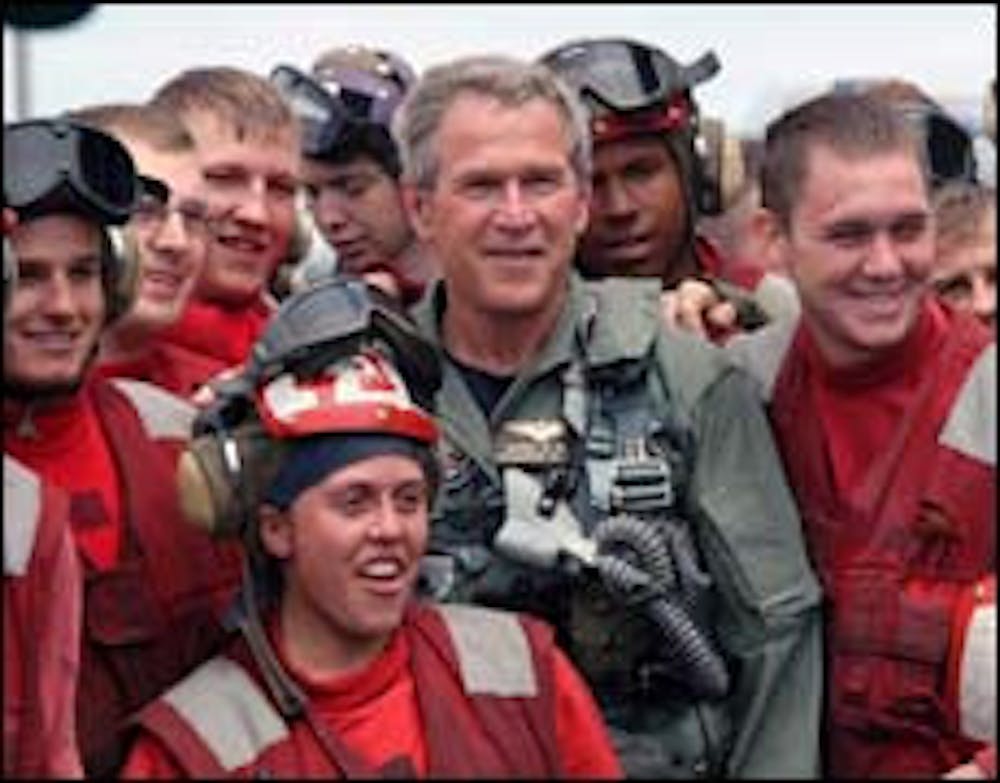
Surrounded by thousands of sailors, Marines and pilots aboard the nuclear aircraft carrier USS Abraham Lincoln, Bush asserted that U.S. victories in Iraq and Afghanistan had helped turn the tide in the fight against al-Qaida and others responsible for the terrorist attacks against New York and Washington on Sept. 11, 2001.
But even while he reveled in the progress of the war on terror, the president warned in his primetime address that U.S. troops would remain indefinitely in Iraq and Afghanistan as American forces pursue al-Qaida from Pakistan to the Philippines to the Horn of Africa.
"The war on terror is not over, yet it is not endless. We do not know the day of final victory, but we have seen the turning of the tide," Bush said from the flight deck of the Lincoln, as the ship steamed slowly for port in San Diego after completing a record 10-month deployment to Afghanistan and Iraq.
Bush spoke after seven U.S. soldiers were wounded in a grenade attack in the restive town of Fallujah west of Baghdad, the third clash with Iraqis there this week.
Seeking to underscore his leadership in the Iraq war and dramatize Republicans' claim on defense issues, Bush landed in a Navy jet on the carrier 30 miles out at sea as he tried to mark the end of a chapter in U.S. military conflict and refocus the nation's attention on domestic matters.
The president did not mention domestic policy in his 27-minute speech, but his aides have been busy laying the groundwork for a return to vigorous political activity on a number of fronts, particularly the ailing American economy that is expected to dominate his campaign for re-election next year.
Bush's aides have been cautioning for days that the president would not declare victory in Iraq, but rather would announce an end to "major combat operations" there. Yet, Bush appeared to go further, claiming victory in "the battle of Iraq," but not an end to U.S.-led military missions in Iraq and Afghanistan.
In Iraq, former President Saddam Hussein and his caches of chemical and biological weapons, the two main targets of the invasion, remain unaccounted for.
In Afghanistan, warlords continue to threaten the U.S.-backed government that replaced the Taliban regime 18 months ago and Osama bin Laden, the target of the campaign, remains at large.
The United States is just beginning the task of rebuilding both nations and, in Iraq, establishing a democratic government in a country that has known only dictatorial rule for decades.
But as he prepares to refocus his attention on re-election next year, Bush sought to create in the public's mind a clearly drawn end to combat and in the process grant him leeway to put aside duties as commander-in-chief.
In a move the White House and its army of supporters are describing as a "pivot," Bush will now shift emphasis from foreign affairs to the domestic issues, particularly the economy, that polls show are more of a concern to the voting public than a second terrorist attack.
Democrats assailed Bush's appearance on the aircraft carrier as a grand publicity stunt that exploited the U.S. military to boost Bush's political standing.
"Forty million Americans have no health care, 2 million jobs have been lost in two years, child poverty is increasing for the first time in a decade, states across the country are going bankrupt, seniors can't afford their prescription drugs, yet President Bush has time to ... spend taxpayer money flying out to an aircraft carrier for a stunt photo op?" opined David Sirota, spokesman for Democrats on the House Appropriations Committee.
In his address, Bush continued to link Iraq to al-Qaida, the terrorist network blamed for the Sept. 11, 2001, terrorist attacks, even while the administration acknowledges it has no evidence of Iraqi involvement in those attacks and such a link has been widely questioned in the intelligence community at home and abroad.
The president called Iraq "an ally of al-Qaida" and said, "the liberation of Iraq is a crucial advance in the campaign against terror."
"The battle of Iraq is one victory in a war on terror that began on Sept. 11, 2001, and still goes on," Bush said. "With those attacks, the terrorists and their supporters declared war on the United States. And war is what they got."
Bush also reiterated a new U.S. doctrine that targets not only terrorist organizations but any nation or leader the United States believes has aided or harbored terrorists.
Vice President Dick Cheney, speaking in Washington to the conservative Heritage Foundation, defended the administration's decision to look beyond those immediately responsible for the Sept. 11 attacks and target its policies at the much broader issue of terrorism.
"The president's made clear from the very beginning that this will be a long and a focused effort," Cheney said, "not only because the terrorists operate in the shadows, but because they also enjoy the backing and support of outlaw states."
Bush flew to the carrier aboard a Navy S-3B Viking jet, which for the event was dubbed "Navy One." The president, a member of the Texas Air National Guard during the Vietnam War, sat in the co-pilot's seat and said he took the controls for nearly a third of the 30-minute flight.
After landing, Bush, dressed in a green flight suit and carrying his helmet under his arm, said he "just steered it straight."
In a scene likely to be repeated in campaign ads, the president waded into the crowds of sailors aboard the carrier, posing for pictures and shouting out, "Good job."
Above the flight deck a massive banner proclaimed, "Mission Accomplished."
The White House said prior to Bush's trip that he would land on the ship more than 100 miles from shore and the distance was the reason that, unlike presidents before him, he had to take a plane rather than a helicopter.
But the Lincoln, which was christened in 1989 by then-Defense Secretary Cheney, was actually only 30 miles off the California coast when Bush arrived. Navy officials said they had to slow the ship so that no land would be in sight to mar the television pictures, further slowing the carrier's arrival, and the sailors' homecoming, so that Bush could spend the night aboard.
© 2003, Chicago Tribune.
Visit the Chicago Tribune on the Internet at http://www.chicago.tribune.com/
Distributed by Knight Ridder/Tribune Information Services.


