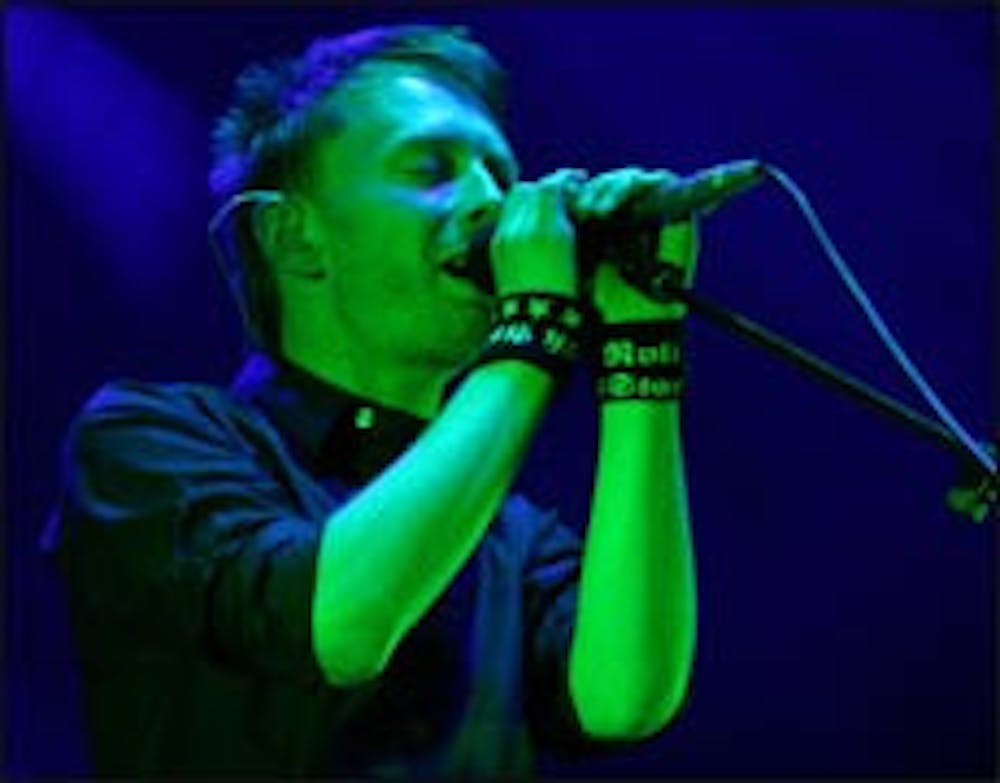
If there's one thing Radiohead has proven indisputably in its decade-long career, it's that the British quintet loves a challenge.
Two summers ago, it helped break in Hutchinson Field in Grant Park as a major concert venue for Chicago with an incandescent performance. The band and its state-of-the-art sound system and light show were a perfect complement for the city's spectacular skyline and Buckingham Fountain on a sultry August night, and the show was deemed an unqualified success by fans, critics, promoters and City Hall.
"It was, quite frankly, an unforgettable night in an unforgettable setting," singer Thom Yorke says. Undoubtedly, the smoothness of the Radiohead experience paved the way for last month's Shania Twain concert at the same site.
So when Radiohead plays more ordinary venues, it can't help but feel like a letdown for fans looking for another once-in-a-lifetime experience. But though the settings may be relatively mundane, the band comes to the States in top form musically, as recent bootleg recordings filtering over from Europe indicate.
Radiohead is at the leading edge of what once used to be known as progressive rock, a band that meshes psychedelic sound experiments and avant-garde electronic textures with rock guitars and the occasional singalong chorus. In the studio, they have become mood masters, sometimes challenging even their most ardent fans with intricate arrangements.
Paranoia and anxiety course through their sixth album, the recently released Hail to the Thief (Capitol), but there's also a sense of universal longing with which anyone, especially any parent, can identify. In songs such as "Sail to the Moon," "I Will" and "Wolf at the Door," Yorke sounds very much like a new father troubled by the sort of world he's bringing his child into (the singer and his partner, Rachel, have a 2-year-old son, Noah).
In a phone interview upon his arrival in North America to begin an extensive tour, Yorke gave some insights into the state of Radiohead's world.
Q. There was talk you'd reprise your Grant Park show of 2001 this summer in Chicago.
A. The first time was a great experience, and we were tempted to repeat it, because it had quite an effect on us, playing underneath that skyline. But there's nothing worse than just repeating something that you're really fond of. It was one of the highlights of that year for us, but we wanted to do something different this time. It wasn't a case of someone in Chicago telling us we couldn't do it.
Q. Instead you're playing an amphitheater in southern Wisconsin, which doesn't sound nearly as cool.
A. I'm viewing it like this: Facilities like that are useful for the lights and for the gear. The down sides are many. We were in a position that we tried very, very hard to play in different places on the last tour. And we had this thing that we didn't want any corporate advertising, no corporate boxes, and we wanted to stay as far clear of Clear Channel venues as we could. And we sat down before this tour and found we had a fairly unpleasant decision to make. We were basically told that if we had a problem with corporate advertising we couldn't play anywhere, simple as that. That's normally called blackmail. If we turned around and said, that's it, we quit, the people who suffer would be us and the people who really wanted to see us. The people we don't want to win would've won. We were damned either way.
Q. It's like Pearl Jam trying to buck Ticketmaster, which forced them off the road.
A. Exactly. You have to have a sense of humor about it, or you go crazy. People look at us like we're idiots anyway because we won't license our music for (commercial advertising). You work really hard on a piece of art, something you're really proud of, only to have it associated with something you're not proud of. People who love music have their own associations with that music, which are precious to them, and if they suddenly saw it representing something else, it's robbing them of the music in a way. The payback is never enough to justify that.
Q. But a lot of bands now say it's the only way to get their music heard, because radio is so constricted.
A. Those are usually the same people who don't tell you how much money they made off it. It's a load of cash. The outlets are choked off on radio, but those things never stay that way. Satellite radio, online streaming off the Internet: People will be able to steal the music back.
Q. Speaking of stealing, that's what the music industry calls file-sharing. How has access to your music on the Internet through these unauthorized channels helped or hindered Radiohead?
A. I hate to say it, but it sort of has helped, because people got to hear bits of our albums beforehand. And as we discussed, access to radio can be quite limited. So it was a nice way of spreading the word around. It may affect how many people buy CDs, but I don't know for sure. Personally I want to vomit when I hear the record company heads using file-sharing as an excuse for their slipping revenues, when to me the reason that revenue is slipping in the music business is because most of the stuff they're trying to sell you is (expletive)! And people don't want to buy it.
Q. Much of Hail to the Thief comes from the perspective of a new parent concerned about the kind of world he's bringing his child into. Are you more or less optimistic about the planet since your son's birth?
A. As I'm prone to depression, I'm very suspicious of my panic attacks and the way they make me feel about the future. It's a common delusion that depressed people have about how bad the world will be. But it's kind of difficult not to be. In England, we've been going through this heat wave, and I've been waking up every morning at 4 o'clock having panic attacks about it. People are dying of heat exhaustion. The problem is that the elite, whoever the hell they are, are deciding global policies on the environment, and they have no concept about the future at all, what the consequences will be. They're supposed to be answerable to the people who put them in power, but they're not, because the evidence is all around us. When we were making the record, I used to sit around thinking that it can't carry on like this. It just can't.
Q. That would explain the anxiety and paranoia in the music.
A. This isn't something that is with me all the time. I think about this as much as most parents do, I suppose. I just choose to put it all in the music, because I don't want to get locked up (laughs).
Q. The music is therapeutic?
A. It's the same sort of energy you get from being in a march or protest rally, when people get together and all feel the same way about something. And you can tell that they've been waiting months if not years to get out in the street and start shouting and screaming. That's the energy I get from music.
Q. A concert is a ritualized aspect of that.
A. It's also quite important. Getting together in large groups of people, whether it's a concert or football match, I used to not understand that. But now I'm getting my head around it, why it's important for people to do that. Also the other side of it is that a lot of people in a small area who feel the same way about something is a very powerful, dangerous and explosive situation. Which can be a good thing.
Q. Did you ever have that kind of transforming experience?
A. The first transforming experience I had wasn't at a show but at a rally. My first year of college in London I went to a rally against tuition fees, and it got really nasty. Police on horses charged on people, and heads got bashed and legs got broken. That was my first experience of the danger of a crowd. I don't believe in violence at all. You can be angry, but you don't have to be violent. If you're suddenly in a group of people that all feels the same way about something, where it's possible to have a meeting of the minds on something that is not discussed in the media or is part of the general consciousness day to day, it has a very big effect on you.
Q. How do you hope a Radiohead concertgoer will feel after one of your shows?
A. I think of music as a separate thing from what we've been discussing. The whole point of playing in a group of people like that is like having the best day of your life, something that is very enriching. You come out of it temporarily feeling that everything is in its right place - emphasis on temporarily.
©2003, Chicago Tribune.
Visit the Chicago Tribune on the Internet at http://www.chicago.tribune.com/
Distributed by Knight Ridder/Tribune Information Services.