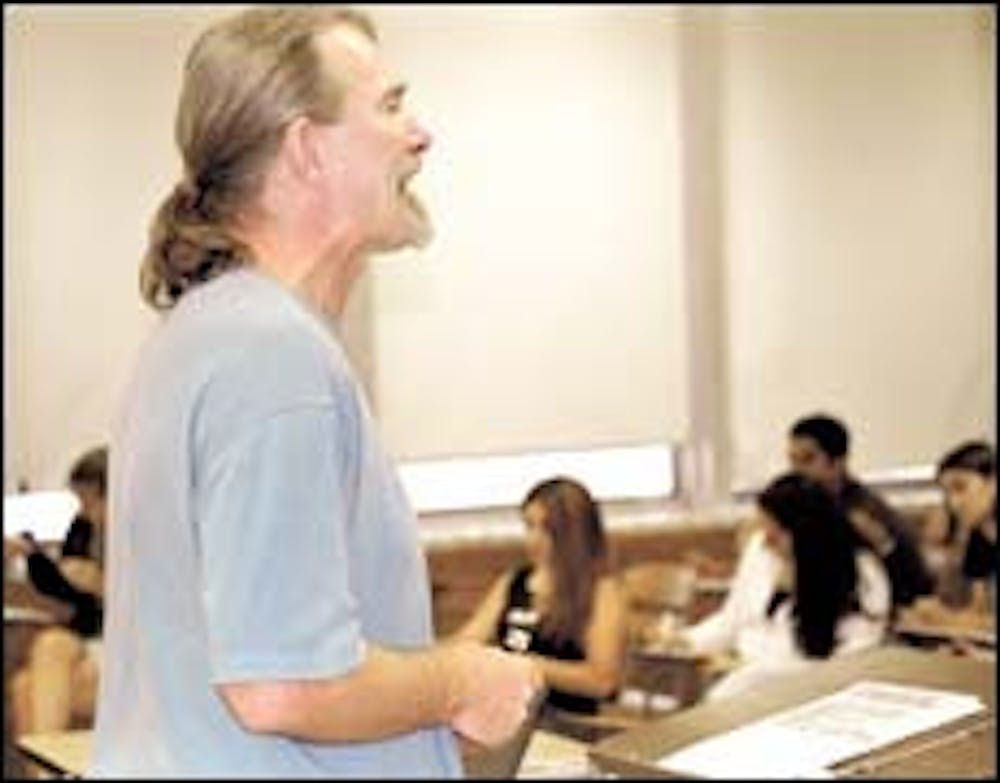
In an effort to make ASU seem a little smaller to incoming freshmen, the College of Liberal Arts and Sciences is piloting an integrated learning program.
About 120 freshmen are involved in the Learning Communities program this fall, although Dan Bivona, associate dean for academic programs, said he expects the enrollment to rise to 600 students within five years.
The students take a cluster of courses organized around a common topic.
"So far, student response has been positive," Bivona said. "Students seem to be very engaged in the subject matter. Not only have they been more attentive, but I've had no problem getting them to talk in class."
The students had the option of choosing between three themes: Human Disease and Society, Multicultural America: Race, Gender and Ethnicity, or War, Culture and Memory.
The clusters incorporate English, religious studies, history and political science, and are worth nine, 10 or 12 academic credits. The material covered relates to the main theme of the cluster.
Bivona, who teaches in the Human Disease and Society section of the program, said the concept has been proven successful in other universities around the country.
"We think it's the best way to introduce students to a multidisciplinary way of thinking," Bivona said.
"It's a fairly unique experience," said Kyle Longley, a history professor in the War, Culture and Memory discipline.
"Everything is completely related, whereas students wouldn't otherwise see that," he said. "I think that enhances the learning experience."
Class sizes in the program range from 50 students in a lecture class setting to 12 in small discussion groups.
Michael Winkelman, an anthropology professor in the Multicultural America area, said the classes under that topic help students understand interactions and relationships between cultural groups.
"The other courses reinforce and expand the material I've been trying to cover," he said. "It gives us a richer, integrated learning experience."
Jennifer Glantz, an undeclared freshman, said she had enjoyed the program so far.
"Sometimes I think we have more work, but I like the topics and it's interesting," she said.
Some freshmen chose to live in a section of Palo Verde West reserved for those students participating in the Learning Communities program.
Samantha Hoffman, an economics freshman in the program, said living in the residence hall was beneficial.
"You can always ask someone questions," she said, adding that she also liked the smaller class size.
Reach the reporter at katherine.j.krzys@asu.edu.