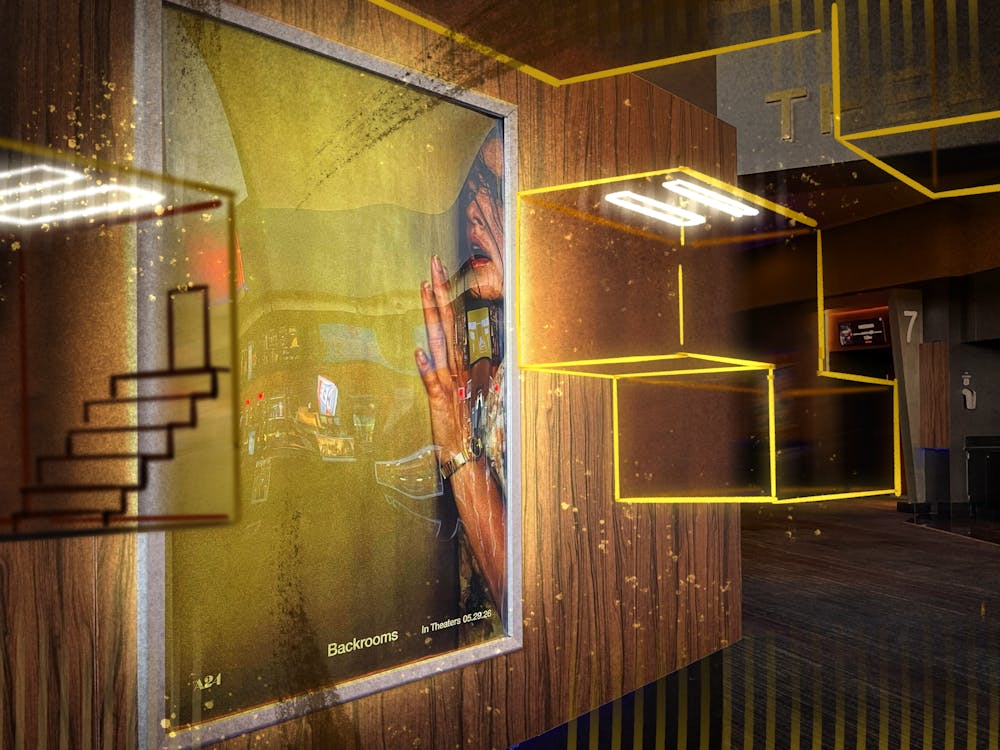
"Backrooms" is a beautiful surprise wrapped in a ball of suspense and discomfort, proving that any idea can make a great film, so long as it has the right team behind it.
Set to release Friday, Kane Parsons' breakout film "Backrooms" centers around Clark, a stressed-out manager of a furniture store played by Chiwetel Ejiofor, and his therapist Mary, played by Renate Reinsve.
The film follows Clark as he discovers the backrooms, an empty and endless space, with seemingly no other human inhabiting it. He attempts to prove the existence of the backrooms to Mary, but things don't go as planned.
The trailer looked incredibly promising; however, I grew up with cash-grab, backrooms-themed games that made the concept more of a meme, as opposed to an internet urban legend that could be the framework for a full-length movie.
I can say with utmost confidence that this film was far from a cash grab, but instead a movie with love and care poured into every inch of it.
First of all, the cinematography throughout the film is astounding. The film's use of tight shots and long moments of cinematic silence left the audience on the edge of their seats.
Many of the shots led the audience to believe something was around the corner, but the film used this to its advantage, taking its time to reveal the monster.
When Clark first entered the backrooms, it took over 10 minutes for another presence to show itself, and even then, the audience isn't shown the monster, just the damage it can cause.
This kept the tension alive and made the chase scenes incredibly satisfying with the kind of scares that leave the audience frightened and fulfilled.
Too many horror movies rush to the scares and don’t take the time to actually frighten the viewer. This was one of my biggest fears going into the movie.
What originally made the concept of the urban legend scary was its eerie and uncanny nature.
It wasn't the kind of fear that made a viewer jump, but instead left them with a pit in their stomach.
It was like walking around a dimly lit, empty parking lot in the middle of the night. There's nothing necessarily frightening about that, but it's what you don’t know that makes it scary.
One of the many highlights of this movie was the acting and the characters; both Ejiofor and Reinsve delivered exceptional performances that established the key differences in their characters' personalities.
Clark is expressive and takes up space in each frame he's in; he has an irritable and anxious energy that is clear whenever he's on screen.
Mary is quiet and makes herself small; the audience doesn't learn much about her until the latter half of the movie. But from her first scene, there is a clear and constant sense of discomfort in which she exists.
Through their first scene together, we see the night Clark’s wife kicked him out of his own home. Within minutes of this scene starting, we can see the persona Clark puts up crumble over itself to reveal a workaholic wannabe architect with deep anger issues.
The characterization of Clark is one of my favorite aspects of the film, as Clark’s personality is quickly defined and stays consistent throughout each scene.
There is never anything either character does that feels as though the plot demanded it. Both Mary and Clark have well-defined backgrounds and personalities that fuel their actions throughout the film.
I find it deeply ironic that a manager of a constantly empty furniture store and the daughter of a paranoid hoarder find themselves in the backrooms, which presents itself as an empty office space with furniture scattered throughout it.
Clark ends up losing his sanity in a more uncanny and horrifying version of the space he lost his marriage and dream in. Meanwhile, Mary finds a way to overcome her trauma in that same space that haunts her throughout the film.
Rating: ★ ★ ★ ★ ★
Edited by Dhemi Bell, Natalia Jarrett and Claire Bixby.
Reach the reporter at omoranwi@asu.edu.
Like The State Press on Facebook and follow @statepress on X.