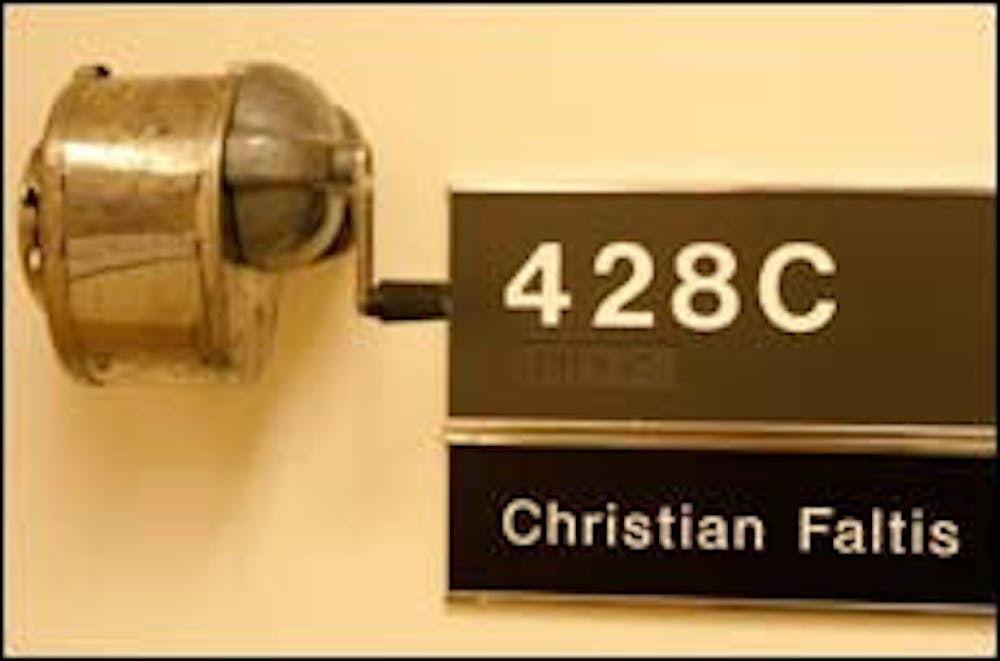
ASU education professor Christian Faltis' 2001 conviction and jail time for aggravated assault didn't cost him his job, but he has drawn the attention of an Arizona state legislator who wants to change the way felons are employed, or not employed, in state schools.
Faltis was released from state prison in August after he served time for aggravated assault in connection with a car accident that happened in 1999. Court documents showed that Faltis' blood alcohol content was over the legal limit at the time of the accident.
Rep. Andy Biggs (R-Gilbert) said the screening process for hiring state school employees has some holes.
"There are no policies," he said. "I'm filing legislation to help them correct that."
Stirring up the pot
Biggs said he favors a state university background check similar to the one used in the K-12 school system in Arizona.
He said the legislation he would propose would definitely affect future hires and might affect people already employed at state universities. The legislation would be pre-filed after Nov. 15 in anticipation of the upcoming general legislative session.
"Certainly individuals convicted of crimes of moral turpitude or violent crimes should not be teaching at a state university," he said.
Other felonies, he added, should be grounds for dismissal at the discretion of the university president.
Biggs said a friend brought Faltis' criminal history to his attention several months ago, prompting him to "stir up the pot a little bit.
"I'm not saying Dr. Faltis needs to be discharged, or not," he said. "I'm not sure I've decided if he's an asset or liability to the University. But it does raise a serious issue as to the vulnerability of the university system. People in those positions of authority ought to be of the highest caliber possible."
On the job
Faltis is one of two ASU professors who have been convicted of felonies in the past five years. One convicted murderer was also hired, in 1993, to teach criminal justice classes.
In each case, Deputy General Counsel Mary Stevens said ASU looked at the nature of the offense, the severity of the legal penalty and the correlation of the crime with the offender's job before deciding how to act.
"We try to separate criminal offense from employment conduct," she said. "The major factor is, does it relate to what they do at ASU?"
James Hamm was admitted to ASU's College of Law in 1993. In 1992, he had just finished serving 17 years in prison for murder. After graduation, he was hired to teach at ASU, but the offer was rescinded when local media publicized the hiring.
Plant biology professor Ralph Backhaus was sentenced earlier this year to 120 days in jail for his part in an ecstasy drug ring. ASU asked him to resign, presumably because his crime involved his job intimately and, Stevens said, "because of what was in his plea agreement."
Ill-fated trip
Faltis' case also ended in a plea agreement.
Faltis and his then-girlfriend Jennifer Tackman were driving to Puerto Peñasco, Sonora, Mexico on Interstate 8 in August 1999 when the vehicle they were in hit a pickup truck, then rolled over.
Tackman, who wasn't wearing her seat belt, was severely injured, and the occupant of the truck was slightly injured. Faltis sustained only superficial injuries.
According to court documents, Faltis had a blood alcohol level of .162, well over the legal limit at the time - .10. Faltis said he didn't remember driving, and at least one doctor reported that Tackman's injuries were "very consistent with her being the driver." Still, prosecutors said Faltis was behind the wheel.
After a jury conviction, the court found Faltis' lawyer, David Burnell Smith, to be "ineffective in his representation," and set aside the jury verdict.
Faltis, who declined to talk to The State Press about his "personal experience away from ASU," entered a plea agreement with the state in April 2001.
Faltis pleaded guilty to aggravated assault, a class four felony, in return for dismissal of a related charge of endangerment and the promise of a shorter prison sentence. He was suspended without pay from ASU, but he was not fired or asked to resign.
He was released on Aug. 21 after two years, three months and 14 days in state prison. Part of the condition of his release was that he couldn't drink alcohol at all.
Before his conviction, Faltis told the court he could regain his employment with ASU as a means to pay damages. In a letter to the judge hearing Faltis' case, David C. Berliner, then-Dean of the College of Education at ASU, wrote, "It is my hope that after serving his punishment, professor Faltis could take up academic employment with us once again."
ASU released a public statement, dated the day Faltis was released, that explained his continued employment.
It read in part, "After a lengthy review and consultation with prison officials and counselors, ASU has decided to return Dr. Faltis to ASU in probationary status for two years, before consideration for tenure. The University believes Dr. Faltis has paid his debt for his offense in a model way and that providing him this opportunity at this time is the fair and right decision."
Faltis is scheduled to teach a "sociolinguistic issues in bilingual education" class in spring 2004.
Reach the reporter at jesse.christopherson@asu.edu.