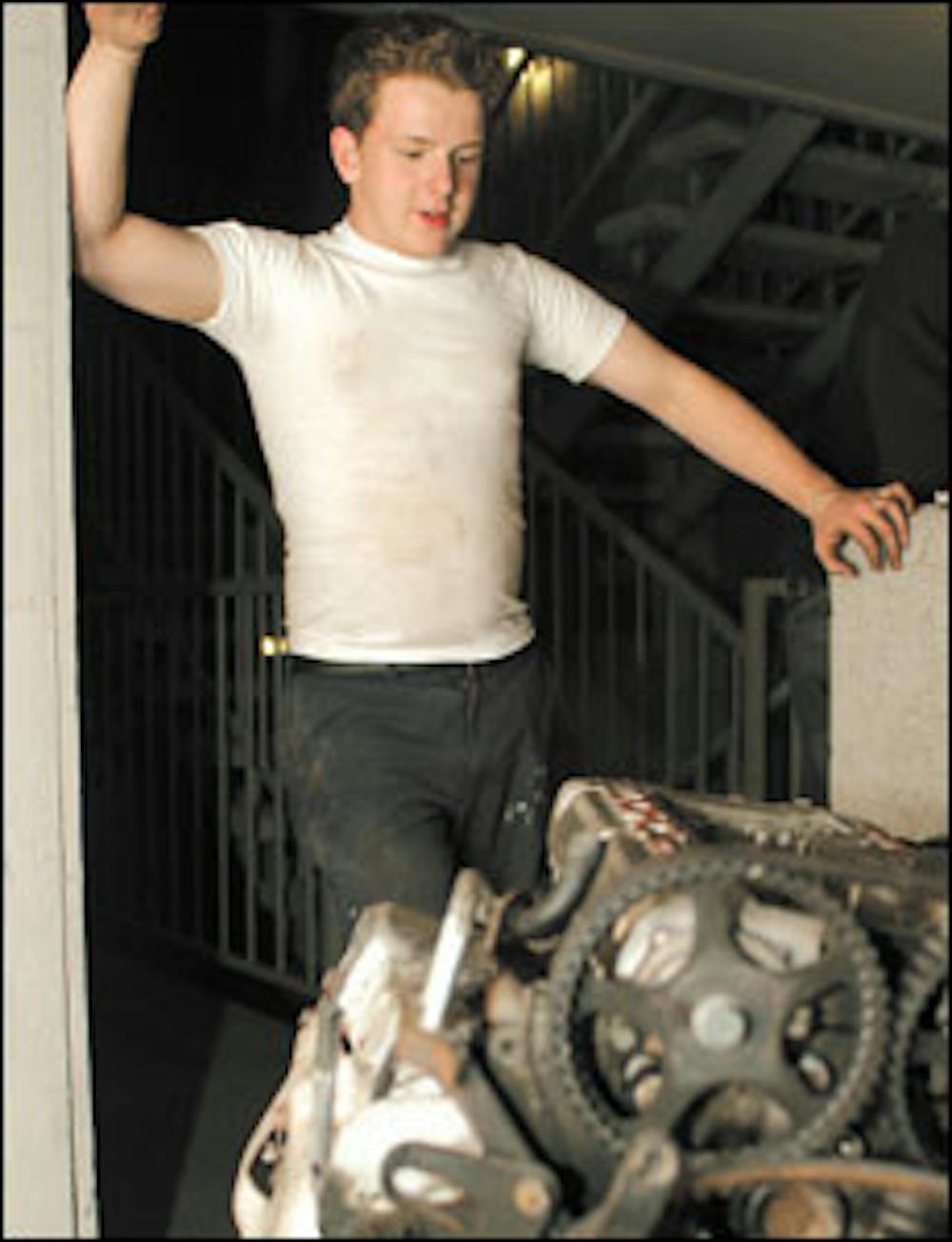
Dave Thomas, a Mesa street racer, said he has no intention of giving up his hobby after witnessing a drag racing accident.
He said that three recent Valley accidents, which either resulted in fatalities or serious injuries, were caused by stupid and careless racing practices.
"Whether they were racing or not, they were pretty stupid for running a red light," Thomas said about the accident he saw at Dobson and Broadway roads in Mesa.
Thomas' girlfriend, Danika Barela, an ASU psychology junior, helped people injured in the Feb. 6 drag racing incident.
She said that witnessing the crash is not going to stop her boyfriend from pursuing his pastime, but she said, "I think maybe it might've put it in perspective for him."
Thomas said he races on business parkways and frontage roads where there is no traffic and visibility is good. He added that he tries to race late at night when traffic is low.
"The problem is that there are no tracks in the East Valley," he said. "To race, you need to go to Phoenix International Raceway, which is all the way out in the West Valley."
Although PIR does not have an open track night, Firebird International Raceway does. It hosts "Street Drags," where for $17, thrill-seekers can bring their cars out to the track.
Officer Frank Valenzuela, a spokesman for the Arizona Department of Public Safety, said that racing is "starting to take place in more populated areas," because rural areas are harder to come by.
There are several types of racing that the department sees:
The race is organized at a fast-food joint or convenience store.
On the freeway, people will simply see who can get from one point to another the fastest.
Motorists will play games of cat and mouse both on freeways and main roadways.
Also, known racing locations are heavily patrolled, he said.
"It's an increased problem that we're seeing, simply because it's starting to involve more and more innocent commuters," Valenzuela said.
Valenzuela said that law enforcement receives tips on organized races from citizens and friends of racers. These tips are used to execute sting operations.
Valenzuela said he remembers the department dealing with four or five racing incidents in the last year that resulted in serious injury or death.
In Tempe there has not been a rise in racing, said Sgt. Dan Masters, a Tempe police spokesman. But Tempe wants to send the message that this kind of behavior will not be tolerated, he added.
"Valley-wide, there have been some high-profile incidents in the last month which has brought [the issue] to the forefront," Masters said.
Reach this reporter at timothy.taylor@asu.edu.