ASU and the Arizona Cardinals settled a $12-million lawsuit this week after almost four years of disputes regarding revenue from signs at Sun Devil Stadium.
Cardinals Vice President and General Counsel Michael Bidwill and ASU President Michael Crow held a press conference Monday to announce the approval of the settlement, and the conditions of a new partnership.
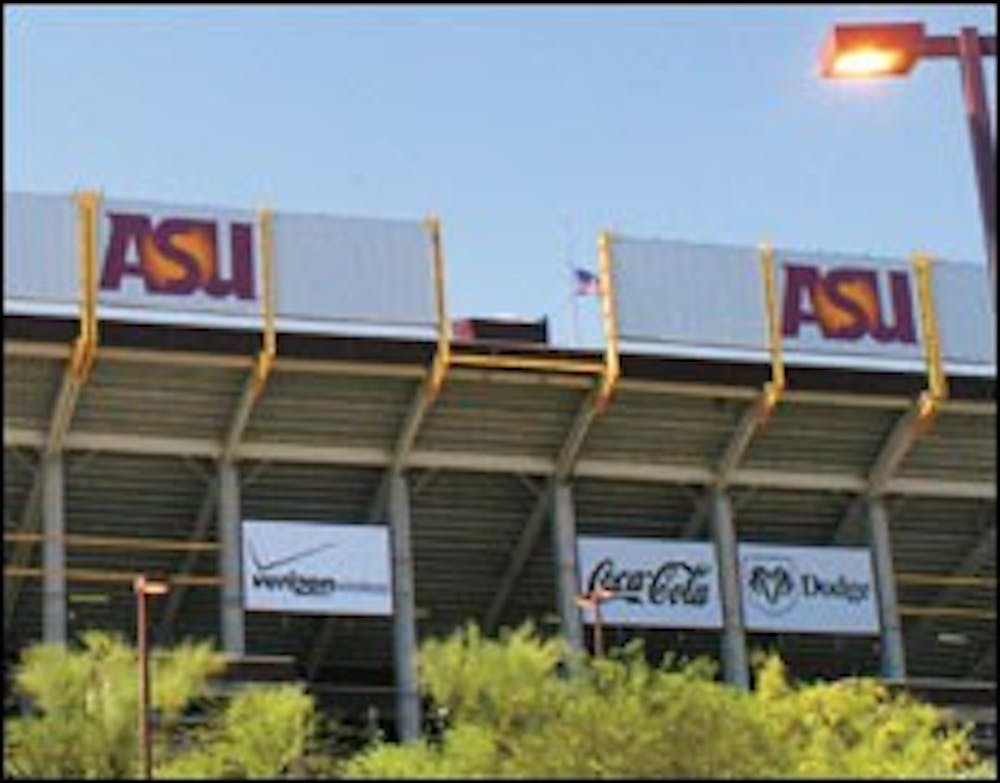
The basis of the disagreement was over advertising revenue. The Cardinals will now be allowed to sell and keep revenue from eight advertising panels in the stadium for each of the 2004 and 2005 seasons.
Each party will potentially gain $1.75 million over two years. The Cardinals will also retain all revenue for parking, minus $110,000 annually to ASU, and will get all the stadium profits from tickets, concessions and suites from all of their games.
The Arizona Board of Regents approved the deal at a Friday meeting in Flagstaff to end the dispute that threatened to "ruin the relationship between the institutions, " Crow said.
"ASU and the Cardinals are kicking off a new era of football in the Valley and Arizona. We've gotten over our differences and are moving forward," Crow said. "It's complex when you have a college team and a pro team working in the same environment -- you've got to be partners."
Bidwill vowed to work with ASU even after the Cardinals move into a new stadium in Glendale in 2006. Specifics of the deal are still evolving, but among the new partnerships, the Cardinals and ASU will work together to develop joint marketing ventures, aid internship programs for ASU students and support each other's programs.
Both agreed that it is "mutually beneficial" for the two institutions to get along.
"If all the kids thinking about football see fighting among the college and pro team, and it seems like all the issues are related to money and not the sport, we've got to resolve that so that isn't all they see," Crow said.
Bidwill agreed, saying, "Football is an important sport for this country. It teaches dedication, commitment and following the rules, and Phoenix has real potential to be a football powerhouse."
When the Cardinals came to Arizona in 1988, their original license with ASU stipulated that the Cardinals pay a fee based on ticket sales for access to the stadium, and ASU and the Cardinals would share concessions and parking revenue.
A1994 amendment to the license allowed the Cardinals to share the cost of adding improved auxiliary scoreboards and tri-vision signage panels in exchange for the right to market and retain the revenue from half of the new advertising signs.
ASU renovated the stadium in 1999 and installed new permanent sponsorship panels. The Cardinals claimed a right to approve of any new signage based on the 1994 amendment, but ASU disagreed, saying the amendment only applied to temporary signage.
In November 2000, the Cardinals -- only nine days after voters approved a publicly financed stadium in Glendale -- initiated a review under ABOR policies and alleged ASU violated the 1994 agreement.
An arbitrator sided with the Cardinals in 2002, agreeing they were financially damaged by the new advertising signs, whose revenue went solely to ASU.
The Arizona Republic reported Thursday that the ASU Athletic Department paid almost $500,000, mostly in legal fees, to avoid the potential $12-million suit, which would have equated more than one-third of its 2004-05 $30.4 million operating budget.
With the opening of the Glendale stadium for the 2006 season, the Cardinals will have their own facility for the first time in the franchise's 82-year history.
Reach the reporter at annemarie.moody@asu.edu