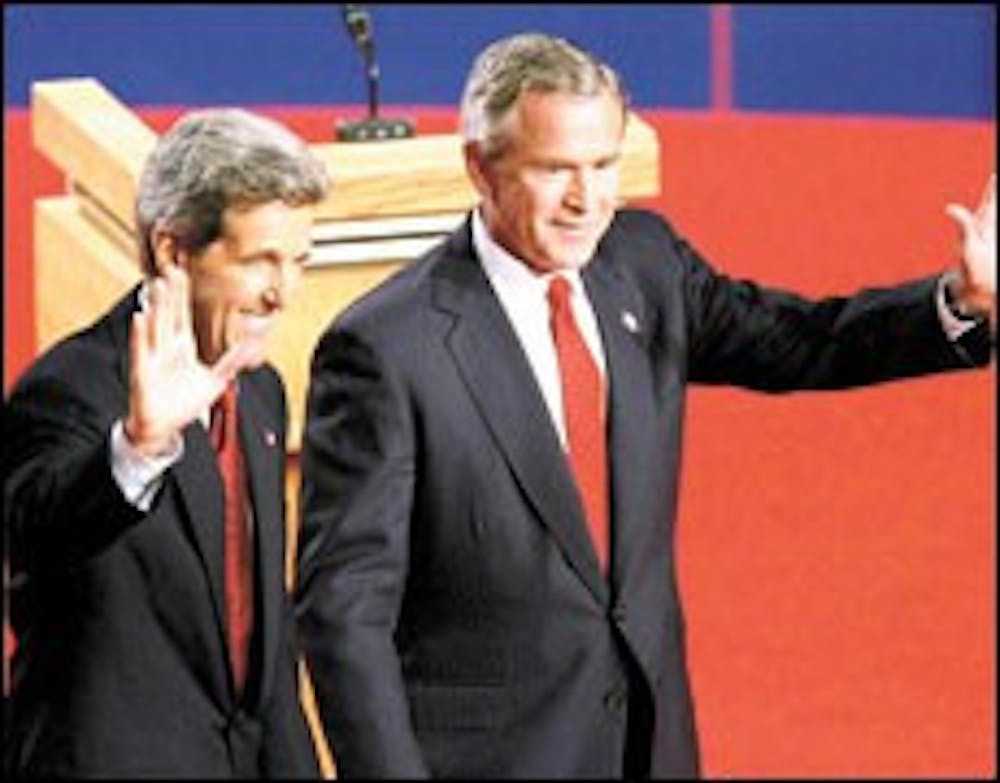
Democratic candidate Sen. John Kerry and President Bush faced off on plenty of issues -- from health care, jobs, tax cuts and education to Social Security, gay marriage and immigration -- during the final presidential debate, held at Grady Gammage Auditorium Wednesday night.
The evening began with ASU President Michael Crow and Commission on Presidential Debates representatives giving opening statements.
Debate moderator Bob Schieffer, host of "Face the Nation" on CBS, then welcomed the candidates, who began the familiar exchange of policy, politics and one-liners.
The most emotionally charged question of the night came when Schieffer asked the candidates if homosexuality was a choice.
Bush said he didn't know.
"I do know that we have a choice to make in America and that is to treat people with tolerance and respect and dignity," Bush said, noting that while he respects someone's rights, he said it shouldn't change our basic views on the sanctity of marriage.
Kerry said homosexuality is not a choice.
"The president and I share the belief that marriage is between a man and a woman," said Kerry. "But I also believe that because we are the United States of America, we're a country with a great, unbelievable Constitution, with rights that we afford people, that you can't discriminate in the workplace. You can't discriminate in the rights that you afford people."
Kerry accused Bush of turning his back on the health of Americans, rushing the country into war and costing millions of Americans their jobs from his failed policies.
Kerry cited numbers in Arizona -- 82,000 lost their health insurance under the current administration and 223,000 children have no health coverage. He said he has a plan that would give Americans the choice to sign up to the same health care plan that congressmen and senators have for themselves.
"The reason health care costs are getting higher, one of the principal reasons, is that this administration has stood in the way of common-sense efforts that would have reduced the costs," Kerry said.
Bush, in return, cited, on multiple occasions, Kerry's Senate record of voting 98 times to increase taxes and called Kerry's health care plan "an empty promise."
Bush said there are several factors that contribute to the increase in health care costs. He said most health care costs are covered by third parties, and consumers aren't involved in the decision-making process.
"It's one of the reasons I'm a strong believer in what they call health savings accounts," Bush said. "These are accounts that allow somebody to buy a low-premium, high-deductible catastrophic plan and couple it with tax-free savings."
Bush said his administration has increased funding for education and said only a "liberal senator from Massachusetts would say that a 49 percent increase in funding for education was not enough."
Schieffer asked the candidates what they would tell someone who has lost their job to a person overseas who's being paid a fraction of what the same job pays in the United States.
Bush said he would tell the person that in addition to continuing his policies to grow the economy and create jobs, his administration has funding in place to help Americans get an education.
"Here's some help for you to go to a community college," Bush said. "We've expanded trade adjustment assistance. We want to help pay for you to gain the skills necessary to fill the jobs of the 21st century."
Kerry said Bush has cut $1 million in job-training funding, as well as other federal education funding, such as Pell Grants for economically disadvantaged students, that would help make college more affordable.
On the Roe v. Wade landmark decision by the U.S. Supreme Court, which gives a woman the right to have an abortion, Kerry said he would not change the court's decision and would fight to protect it.
He said he would not appoint a judge to the Court that would "undo a constitutional right" such as the First or Fifth Amendments.
Bush didn't comment on the Roe v. Wade decision but said he will not use a "litmus test" in appointing judges to the Supreme Court.
On the issue of immigration, Bush said he views it as a security, economic and human rights issue.
Bush said he doesn't believe in amnesty.
"I don't think we ought to reward illegal behavior," Bush said. "There are plenty of people standing in line to become a citizen. And we ought not to crowd these people ahead of them in line."
Kerry said Bush broke his promise on immigration and that the borders are still unsafe.
Kerry said his plan on immigration would include cracking down on illegal hiring and creating a earned legalization program for people who have lived in the United States, worked here for many years and pay their taxes.
Reach the reporter at laosamoa.poasa@asu.edu