In February 1899, British writer Rudyard Kipling wrote a poem entitled "The White Man's Burden: The United States and the Philippine Islands." In it, Kipling urged the United States to take up the "burden" of empire, as had Britain and other European nations. An articulate advocate of imperialism, Kipling in our modern-day world would be a Fox News pundit.
Nevertheless, I do sympathize with him and other parts of the propaganda machine -- past and present. They are charged with the challenging task of injecting a moral element in the most immoral acts, at least in the minds of the voting public.
And it worked. A fast look at the recent presidential elections would serve as an example of how easy it is to manipulate the masses with the false sense of a grand mission. No one would dispute the legitimacy of actions that seek to spread democracy, fight terrorism and protect the homeland.
If you ask my friends Mohamed Hummus and Joe Six-pack, they would love it. Until one of their sons (or both their sons) died in Fallujah. That's when they would take a closer look at those actions.
White man's burden has a misleading racial tone to it. It's a multi-faceted crusade that takes different forms: Race is the non-spoken element of it. The fashionable alternative is the term "Western," coined by a cabal of Western triumphilists (aka neocons).
Politically, it justifies killing millions of innocent non-Western citizens, since they do not belong to "democratic" countries, thus threatening our own freedom and apple pies.
Religiously, it seeks to force non-Christians to accept "modernity" and "tolerance" due to the fact that only Westerners could speak of such values. Somehow, the Spanish Inquisition, Holocaust and the Crusades were just minor incidents.
The self-assigned task of bringing people into civilization is reflected everywhere from President Bush's rhetoric to regressive approaches to Christianity. Pockets of Western non-believers exist, yet as we saw on election night, they don't matter.
The underlying feeling is popularly supported and embraced. That feeling implies a sense of superiority spiced with arrogance and camouflaged with humility. It feeds the national conscience and inspires a cultural support system for that burden.
Once you think you are on top, it's hard to notice what's going on below. However, "below" has another type of burden that exists as a product of the first burden. It is what I like to call "Brown man's burden."
Once again, race or color is not the sole category here. You are included if you are white Arab, a yellow Asian or a black Brazilian. It is basically a burden generated as a consequence of the white man's burden.
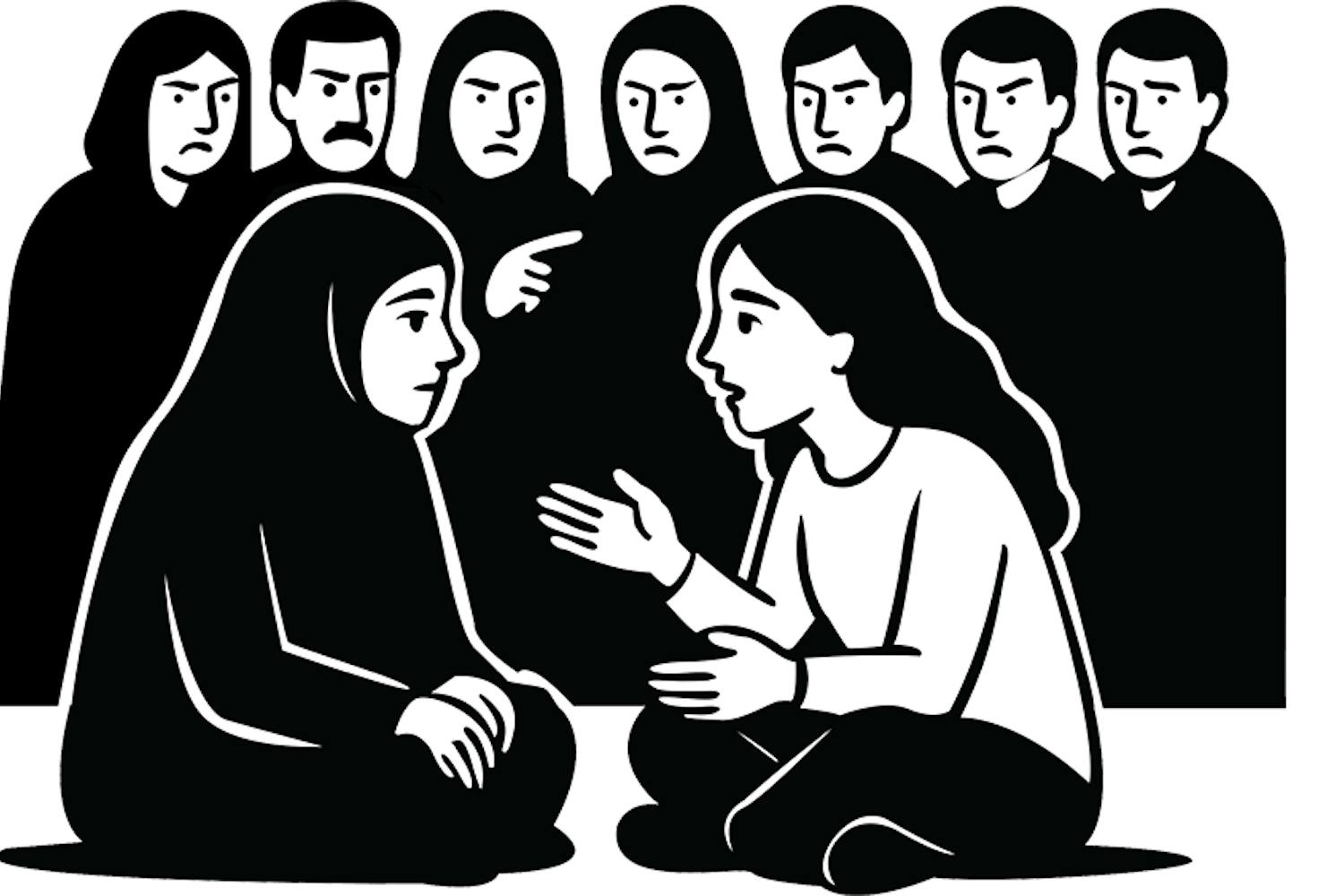
This burden is an interesting phenomenon. It makes you feel like you can't or don't do anything that's right, moral or accepted. As a result, you are prone to leave yourself in need of help and guidance, voluntarily or not. You sense it as a black man driving or a Muslim flying. If you are both black and Muslim, it's a double burden.
People perceive you as an illegal alien even though you were born here. Some treat you as a threat to democracy even though you immigrated from a Middle Eastern dictatorship. You are accused of "stealing" American jobs even though a U.S. firm hired you and sponsored you for a work visa. You are a challenge to cultural assimilation because you do not eat pork products.
The burden takes scarier proportions going beyond borders. Your life decreases in value, and sometimes it becomes worthless. During the Cold War, hundreds of millions of lives were lost. The two superpowers used Third World countries like they were a chess game.
Geopolitical gains and losses mattered more than the humans who perished in the countless number of civil, regional and international wars that took place. In the fight for democracy and freedom, citizens of other nations paid the ultimate price. They sacrificed their lives, presumably, to secure liberty for the "first world." It gives a new dimension to the word "dispensable."
Little has changed since the days of Kipling. The Middle East is rife with the opportunity to fulfill the vision of the imperialist poet. The lives of thousands of Iraqis become a cheap price to carry the white man's burden. No one bothered to secure their consent. But if Iraq is the "cradle of civilization," how exactly are we supposed to bring it into civilization?
Yaser Alamoodi is a political science and religious science senior. For any bones to pick, reach him at yaser.alamoodi@asu.edu.