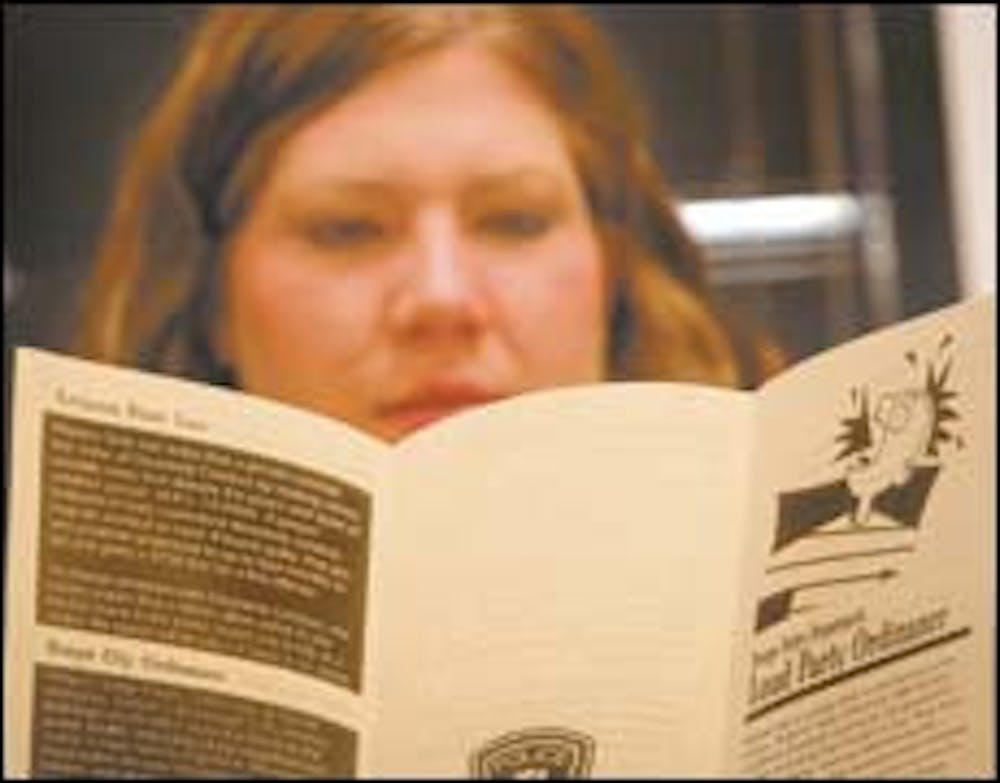
A handful of on-campus residents traded a night in front of the television at home to see Tempe's Party Patrol bust some of their fellow students.
"We figured we were going to be sitting in our dorm watching 'COPS' anyway," said Palo Verde Main resident and biology and society freshman Dave Klink, as he walked into "Party Smart 101," a program held in a Center Complex classroom by ASU and Tempe's student housing liaison, Jennifer Pregler.
Students in attendance also heard from a Tempe officer who has worked the Party Patrol and a defense attorney in the hour-long event about laws governing partying in Tempe and how they are enforced.
The group also saw a video documenting a bust by the Party Patrol.
Even a gathering with five guests can qualify as a party under the city of Tempe's party ordinance, the speakers stressed.
"Though you have the right to entertain," Pregler said, "your neighbors also have the right to peace and quiet."
The Party Patrol is made of one to four uniformed officers who volunteer to work overtime on Friday and Saturday nights during ASU's school year, said Sgt. Dan Masters, a Tempe police spokesman.
Masters said the Party Patrol officers are able to focus on party-related complaints because they work in addition to regularly scheduled officers.
"Their primary responsibility is to respond to complaints of loud parties and [related] calls," he said.
Masters said the patrol's effectiveness is reviewed periodically and could be scrapped if found to be unneeded.
But Tempe Officer Frank Aguilera said the patrol is likely "just a reality of life."
Aguilera, who has worked the Party Patrol, said officers generally attempt to clear out the party and give the host a formal notice that they have violated the ordinance.
"All I want is to get the party finito, get the people out and get you a notice," he said.
Hosts who receive a second notice within 90 days can receive a $250-$1,000 fine, and "on the third notice, your landlord will be fined also," Aguilera added.
Attorney Tamara Primera suggested cooperating with the police if contacted by the Party Patrol.
"I'm not telling you to confess," she said. "What I'm saying is to be polite and cooperate with the police."
Speakers also said party hosts can be liable for the later actions of their guests.
"You as the host of that party, as the provider of that alcohol, have a responsibility just like a bartender has a responsibility not to over-serve," Pregler said.
Pregler suggested students who host parties consider the dynamics of the community in which they live and communicate with neighbors. Partyers should also ask neighbors to call them -- and not the police -- with complaints, and stay sober so they can judge when guests have had too much to drink.
"It's the best way to protect your friends," she said.
She also said alternate transportation for guests should be available and limiting access to alcohol to those 21 and older would be a good idea.
Business freshman Ryan Delgadillo said he found the program "very informative since [I'm] going to be living off campus next year."
Monday's event was promoted primarily in campus residence halls. Pregler said she plans to hold similar events advertised to different audiences in the future.
"I think that all of our students need to be educated on these issues," she said.
Reach the reporter at brian.indrelunas@asu.edu.