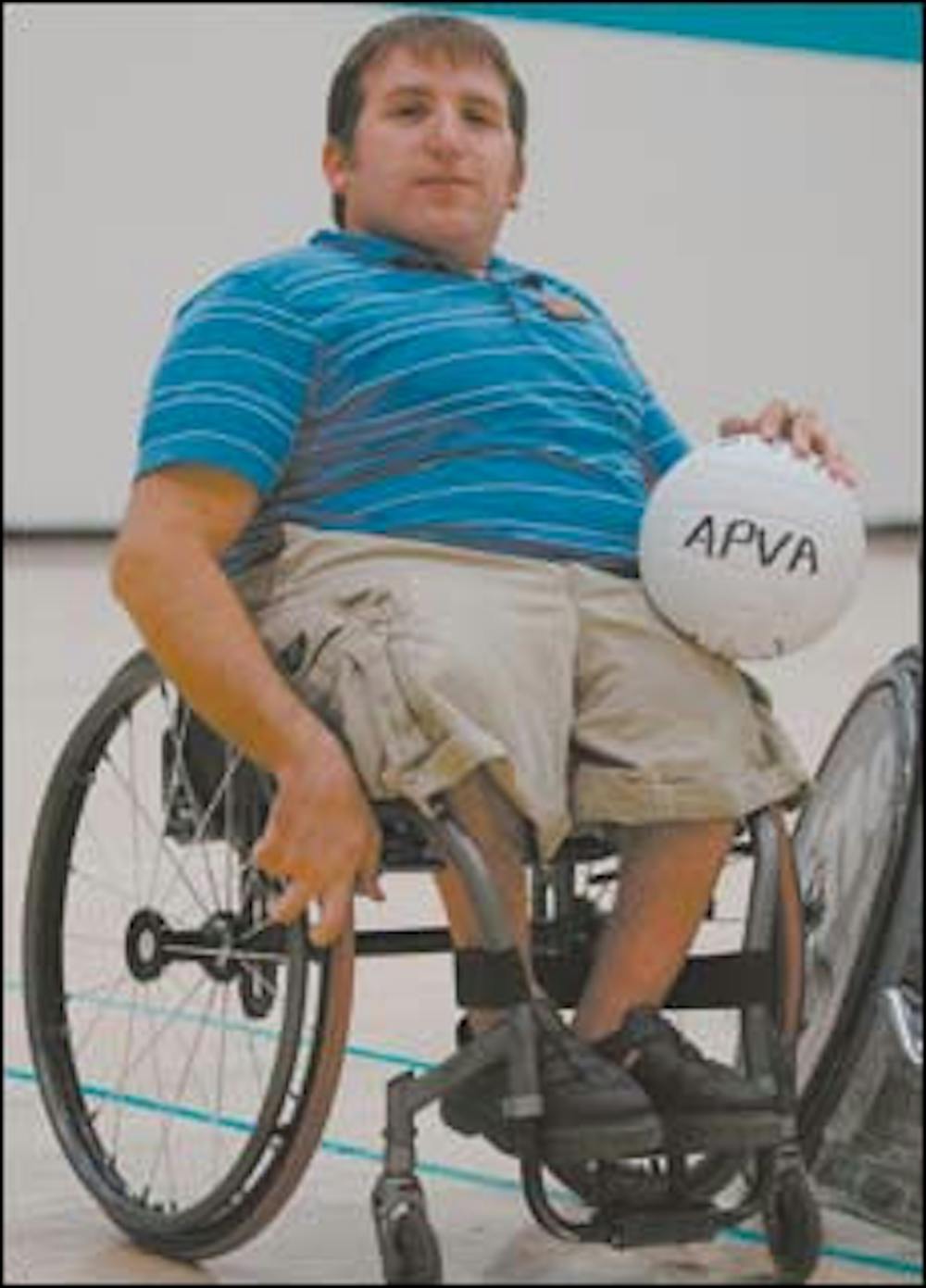
Positioning your wheelchair properly on the playing court is not a skill that most athletes encompass or, for that matter, need. However, thousands of quadriplegic athletes, such as Dan Ferreira, practice skills in wheelchair sports such as rugby and basketball on a daily basis.
Ferreira said that before he began to compete athletically, he felt sorry for himself and had low self-esteem.
"People dream about not being disabled again," Ferreira said. "But how realistic is that?"
Quad sports like basketball, track and field, and rugby gave him a new lease on life and a new motto: "If you want to be successful in life, you are going to do it by working hard."
Ferreira is the adaptive coordinator for sports and recreation, and the instructional club sports program at ASU.
He started the quadriplegic rugby program at ASU just under a year ago after running a successful quad rugby clinic with about 15 participants.
Quad rugby is a disability sport that has been increasing in popularity since it was invented in Canada during the late 1970s. The sport has recently received more recognition because of "Murderball," a documentary that was released in theaters in July.
Quad rugby is a mixture of basketball and hockey. The game is played on a basketball court with two goals marked by orange pylons set up at opposite ends of the court. The object of the game is to advance the ball toward the goal by passing or carrying the ball.
A single point is awarded when a player passes through the pylons with at least two wheels of their chair. A game consists of four eight-minute quarters.
The eligibility of players is determined by the severity of paralyses in both their upper and lower extremities, which they must have in order to play. Once they are cleared to play medically, their disability is assigned a number on a .5 to 3.5 scale, with 3.5 being the least impaired. This is to assure that there is an equal amount of physical ability on the court so neither team is at a disadvantage.
Most quad rugby players' disabilities are cervical spinal cord injuries. Disabilities include cerebral palsy and polio, amongst others. Ferreira, 30, was born with a genetic disability called Osteogenesis Imperfecta, which has kept him in a wheelchair since birth. He didn't begin to participate in quad athletics until he was 15.
Steve Lusby, a quad rugby veteran, currently coaches the Sun Devil quad rugby team that practices on Tuesdays and Saturdays at the SRC.
Lusby said the sport was about supporting one another.
"I just want to give guys like me some help to gain the same confidence and experience that I have received from quad rugby," he said.
Lusby, 46, has been involved in the sport for 15 years and won two national championships as a player for the Tampa Generals in Florida.
ASU's quad rugby program primarily focuses on the fundamental learning of the sport.
Lusby said he stays involved with the sport because he knows how much camaraderie he felt while playing quad rugby.
The Sun Devil quad rugby program, funded by the Arizona Chapter of Paralyzed Veterans of America, is part of the Adapted Sport and Recreation program that Ferreira coordinates at the Student Recreation Complex.
The program applies the concept of reasonable accommodation of all participants to ensure that all experiences are positive.
The program includes many recreational activities and different sports, and is open to the entire disabled community.
In the end, sports have helped Ferreira gain perspective.
"There are much worse diseases," he said.
Reach the reporter at branko.seretti@asu.edu.