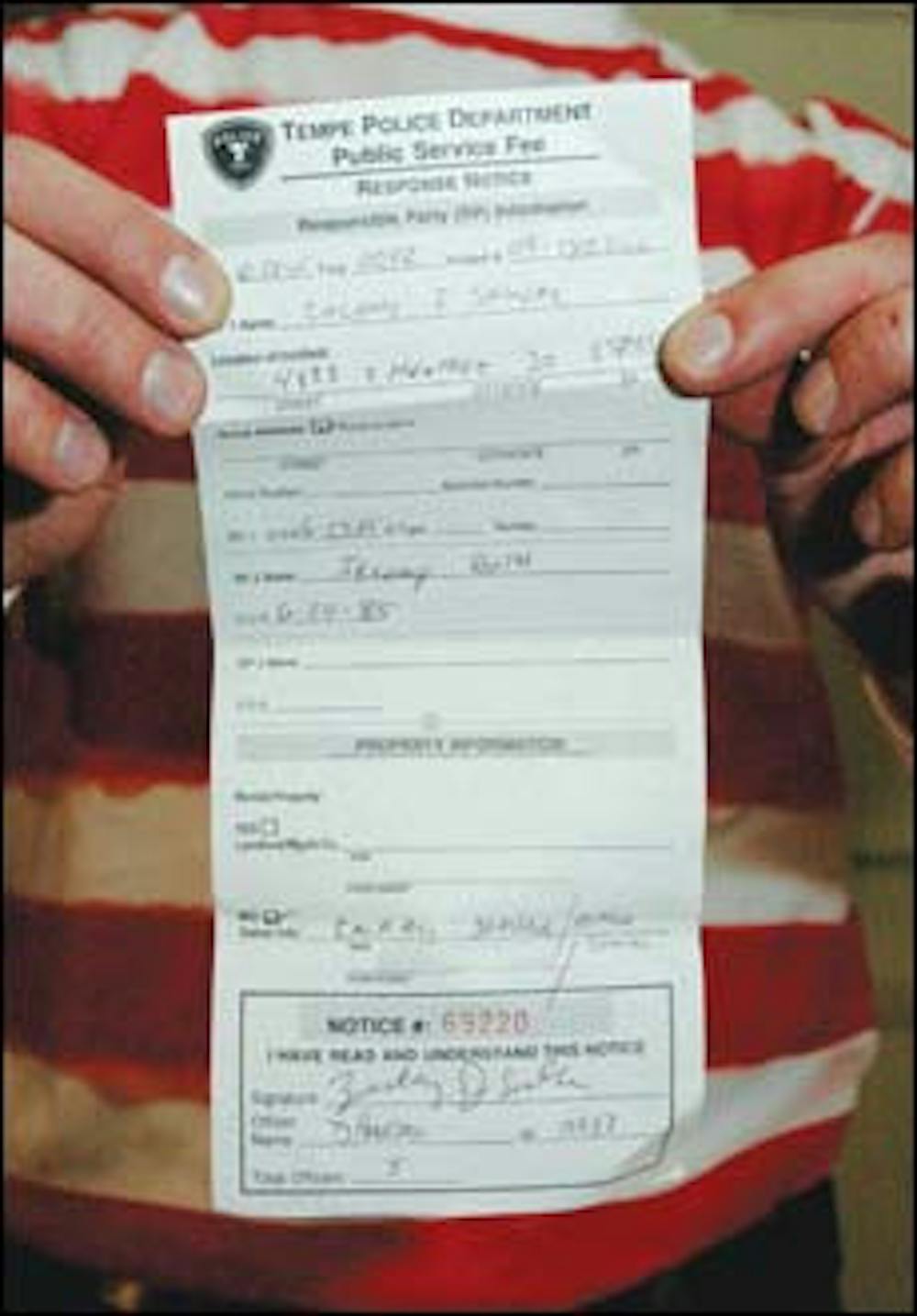
In its first two years, Tempe's loud-party ordinance has brought in more than $32,000 in fines, and officers have handed out more than 2,700 party notifications.
And within months, the city plans to start tracking down thousands more in unpaid party fines.
By January, the Tempe Police Department will begin handing off party ordinance fees that are 120 or more days overdue to Progressive Financial Services, one of Tempe's contracted collection agencies.
The city is currently working out software issues with Progressive, said Karen McNeil, a Tempe police management assistant.
She said in the past, Tempe police sent information on people with overdue fines to the city attorney.
But the 2003 revision of the city's party ordinance led to more fines being billed, and McNeil said the police department did not want to inundate the city attorney with overdue-fine cases.
Of the $82,000 in fines billed, only $32,310 have been paid, according to the department's latest counts.
The city sends notices to those with overdue fines monthly, McNeil added.
Ordinance's beginnings
The late-fine collection by Progressive will be the latest development in the history of the 2-year-old law.
Tempe City Council passed an amendment to its loud-party ordinance on Oct. 30, 2003, that drastically extended the period of time during which repeat offenders could be fined.
The city has had a party ordinance on the books since 1995, but the original
ordinance only allowed police to issue fines if they were called to the same location twice in a 12-hour period.
"The City Council and police officers who were working under that original ordinance felt it basically had no teeth," said Sgt. Dan Masters, Tempe police spokesman. "Theoretically, you could have a party at five on Friday night and get warned and have a party again Saturday night and get warned."
Masters said the department didn't have the tools to effectively address repeat offenders.
"We would find ourselves going back to the same houses dealing with the same problems, dealing with the same people," he said. "There was no reason for the people not to have a party because they knew our hands were tied."
The amended ordinance extended the period of time police were allowed to issue fines to repeat offenders to 90 days.
Reducing loud parties
Masters said the ordinance aims to reduce gatherings that disturb the peace, not all parties.
"We don't expect people not to have parties," he said. "I think that's part of any city and especially with the dynamic of being a college town ... but with having parties comes responsibility."
The number of party-related calls Tempe police fielded between January and September 2005 is down 9.5 percent from the same period last year, according to a department report.
And neighbors usually don't call just because there's a party next door, but rather because of "collateral issues," Masters added.
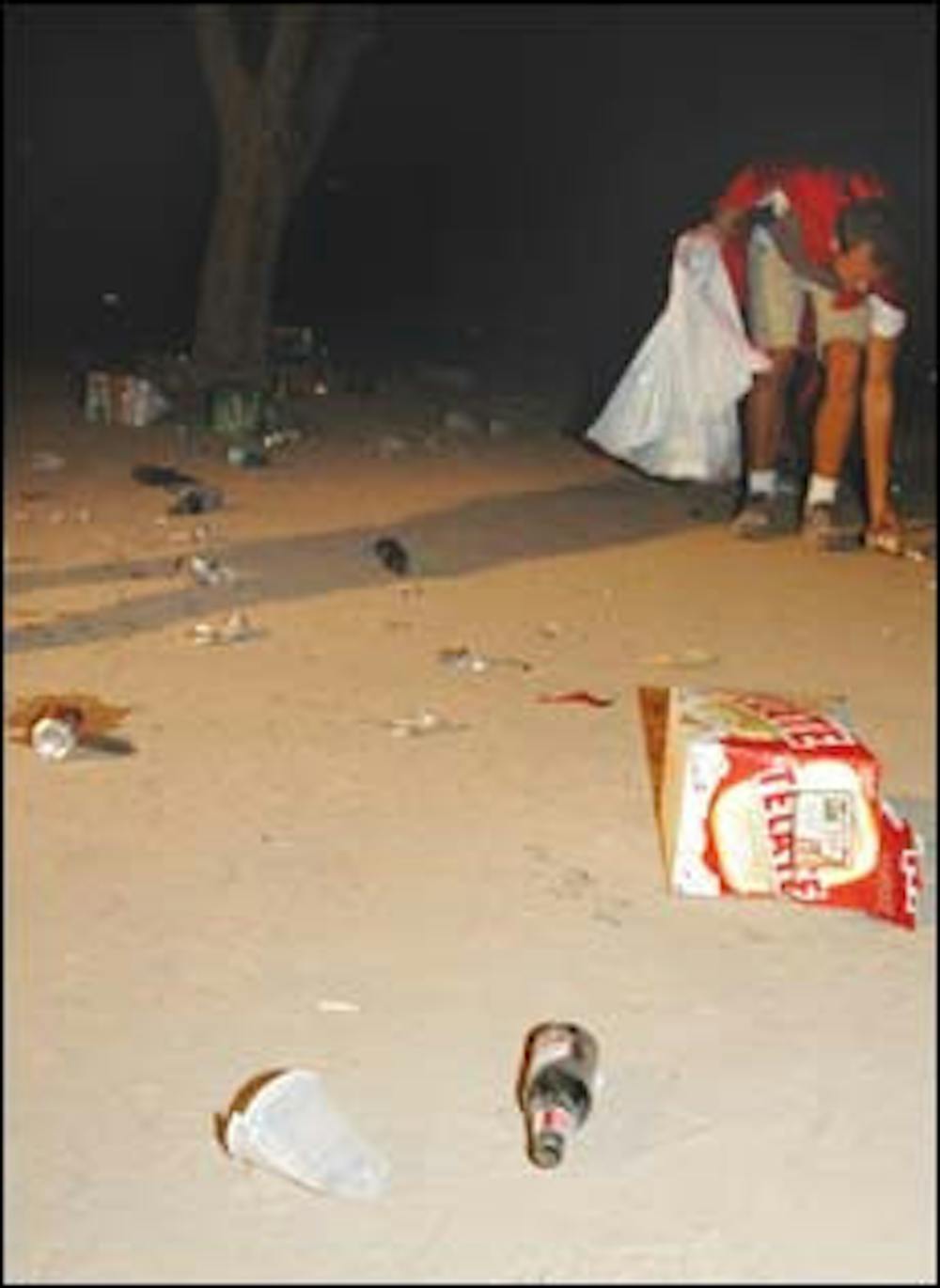
"It's the quality-of-life issues that people call us about," he said. "They complain that people are urinating in their yard, parking on the sidewalk, in their driveway, that there are beer cans or beer bottles strewn about.
"It's those things that end up, understandably, upsetting neighbors."
Those neighbors gave high marks to the party ordinance in a Tempe Police Department survey.
In the department's 2004 citizen survey, 59 percent of the 971 respondents said they thought the party-ordinance enforcement was effective in reducing loud parties. Fifty-four percent said they would like to see even more enforcement.
Fines cover police costs
Tempe's party fines are set by the City Council and are meant to cover the cost of officers and equipment used in the return visits.
The current fee structure ranges from $250 for a call requiring one or two officers to $1,000 for incidents that require more than six officers.
"[Tempe's] ordinary response is usually two officers, unless there's comments on the call," Masters said.
An exceptionally large party or a history of violence at a location might cause Tempe to send extra officers, he added.
UA partiers also fined
Tucson, home to UA, fines partiers more heavily over a longer time frame than Tempe.
Tucson's unruly-gathering law is part of its Neighborhood Preservation Ordinance, which largely collected existing neighborhood-related laws into one section of the city code.
The overall ordinance, passed in February 2003, was spurred by state legislation that allows neighborhood associations to claim victims' rights in certain crimes, said Sgt. Ramon Batista, a Tucson police spokesman.
But he added Tucson police have been enforcing the unruly-gathering section since about 2000.
"It started, as you can imagine, around the U of A ... in terms of where it was occurring most frequently," he said.
The first time Tucson police respond to an unruly gathering, the person responsible for the get-together is fined at least $100.
A large orange party notice is posted at the event's location, usually in the front window, to remain for 180 days. Removing or hiding the notice is punished by another $100 minimum fine.
Even after they were legally allowed to remove the notice, Batista said some offenders have left remnants of the sticker on their windows as "a badge of honor."
Tucson's ordinance requires those responsible for an unruly gathering to be fined at least $500 for the first return visit by police within the 180-day period, a minimum of $1,000 for the second return and at least $1,500 for third and later return calls.
"Our city-court judges, for the most part, stick to the minimum," Batista said. "I think they just leave that open in case they get those one or two cases where they need to go over [the minimum fine]."
Cities such as Los Angeles and Cincinnati -- which are home to two of ASU's peer institutions, UCLA and the University of Cincinnati -- also allow police to fine party organizers for the costs associated with a second visit to a disturbance. But those cities' codes more closely resemble Tempe's 1995 ordinance.
The Cincinnati Police Department's procedure manual only allows fines to be issued for return visits within eight hours of the original call. Los Angeles police only issue fines when they respond twice to the same incident.
Valley cities follow suit
Closer to ASU, Phoenix and Mesa adopted ordinances more along the lines of Tempe's this summer.
Phoenix revised its city code in May so police can fine those responsible for loud parties up to $1,000 for each repeat call to the same location within 60 days.
Shutting down large parties in Phoenix can be a costly task, said Sgt. Lauri Williams, a Phoenix police spokeswoman.
She said some loud-party calls have required the work of officers both on the ground and in the air.
Williams said Phoenix's ordinance was revised "in an effort to try to address those types of situations ... and then also trying to find someone to make responsible to make sure they're keeping control of the party."
Mesa added a party ordinance, modeled on the ordinances in Tempe and Phoenix, to its city code in July. It allows billing partiers for the costs of return calls within a 90-day period, but is not yet being enforced.
"We're just working out the fine details now, and hopefully we'll be in the enforcement stage in the next few months, if not sooner," said Sgt. Chuck Trapani, a Mesa police spokesman.
Mesa's ordinance also allows partiers to be held liable for up to $1,000 for each return visit, and Trapani said the amount billed would likely be determined on a case-by-case basis.
Party patrols
Tempe's ordinance complemented the police department's existing Party Patrol, a squad of up to four officers working overtime on weekend nights during ASU's school year. Because all regular shifts are already covered, the Party Patrol officers can focus primarily on party-related calls.
During the 2004-05 school year, Tempe's Party Patrol responded to nearly 17 percent of all party-related calls and handed out about 38 percent of the party notifications issued, according to a department report.
Tempe's Party Patrol was launched in August 2002.
Tallahassee, Fla., has staffed a similar patrol since 1994.
"Basically, it became a need we had -- especially during the fall during football season," said Sandra Harrison, alcohol compliance officer for the Tallahassee Police Department.
Tallahassee is home to 39,000-student Florida State University, as well as the smaller Florida A&M University and a community college.
"Back in the early 1990s, we were having an excessive amount of ... loud-music or loud-party calls, and they were obviously lowest on the priority list," Harrison said.
She said it would often take officers so long to be able to respond to party calls that neighbors would call back to complain or the calls' severity would increase.
Harrison said that until the past few years, Tallahassee police would rely primarily on giving verbal warnings to party organizers as well as the threat of filing a civil complaint against people who receive three warnings in a six-month period.
But she said the process to take civil action was complicated and the warnings often weren't effective.
"It got to the point where they didn't take the warning very seriously," Harrison said.
Now, she said, Tallahassee police focus more on making any applicable arrests than giving warnings at loud parties.
"If we see a party's out of control, the first time we go and shut it down," Harrison said.
Reach the reporter at brian.indrelunas@asu.edu.