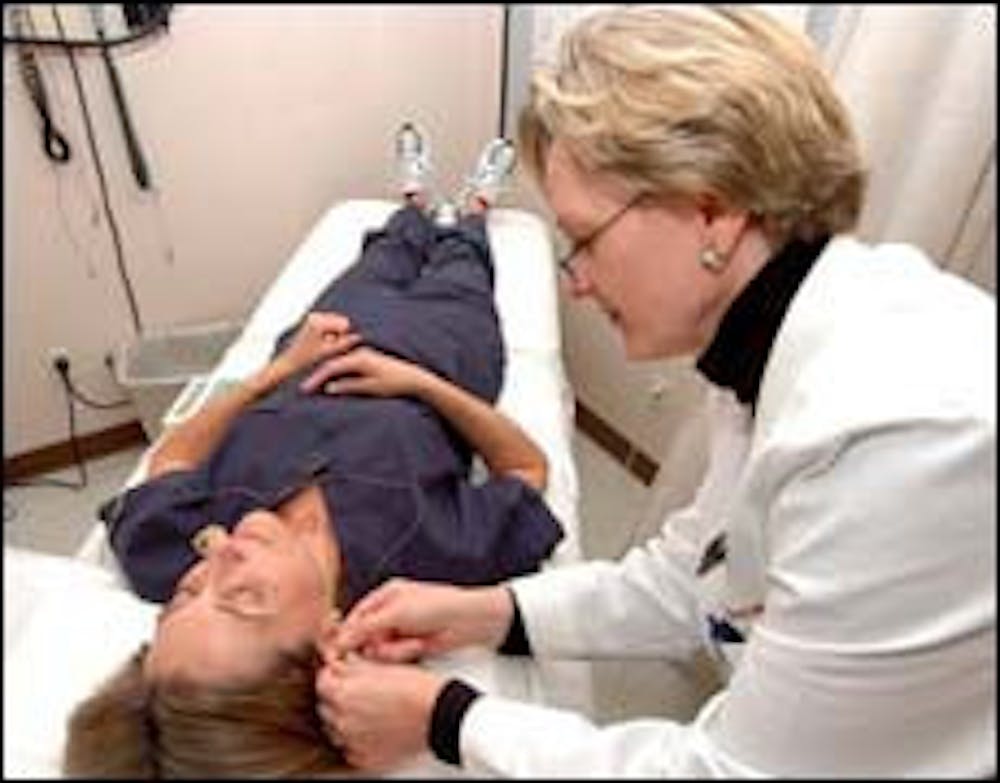
Students who want to unblock their "chi" can now visit the Campus Health Service for acupuncture therapy.
Dr. Stefanie Schroeder, chief of medical staff at the ASU Health and Wellness Center, has offered acupuncture clinics three days a week for treatment of a variety of health conditions since September.
Acupuncture can treat depression, migraines, muscular-skeletal pain, allergies, menstrual pain, asthma and flu symptoms by getting the patient's "chi" flowing, Schroeder said.
The "chi," she explained, is the life energy that flows through the patient's body. It's a spiritual force that can have biological expressions.
"It's what's making us tick," she said. "It's very closely related to blood, but not the same thing as blood."
Schroeder said she hopes students will use acupuncture to complement - not replace - their traditional Western medical therapies.
"To me, acupuncture is complementary medicine; it's not alternative medicine," she said. "Plus, there are certain conditions, like chronic pain or tennis elbow, that traditional Western medicine doesn't help very much."
One condition that may be best treated with acupuncture is what's referred to as "student syndrome" in traditional Chinese medicine, Schroeder said.
"We see a lot of students get sick a lot," she said. "They're tired and exhausted and depressed, but not to the point that they want to go see a counselor and get on medication."
Schroeder said she plans on researching acupuncture's effect on "student syndrome" during the semester.
In that research project, student volunteers with fatigue and depression would have their hormone levels measured before and after acupuncture therapy.
Schroeder said many of the student patients who have received acupuncture treatments since last semester have experienced positive results.
The hardest part for the patient, she said, is getting over any misconceptions about acupuncture or fear of needles.
"I'm afraid of needles," said Ashle Johnson-Brandstrom, a freshman architecture major. "But I know acupuncture is good for you and it releases anger. Maybe I would do it."
Unlike syringe needles that cut muscle fibers and can cause a lot of pain, acupuncture needles are non-cutting, causing minimal damage and little pain, Schroeder said.
The cost for a one-hour acupuncture session at ASU is $60 for the first treatment and $40 for each following treatment. Schroeder said most patients need less than 12 treatments.
Off-campus costs in Arizona typically range from $45 to $100 per session, depending on the practitioner.
Reach the reporter at annalyn.censky@asu.edu.


