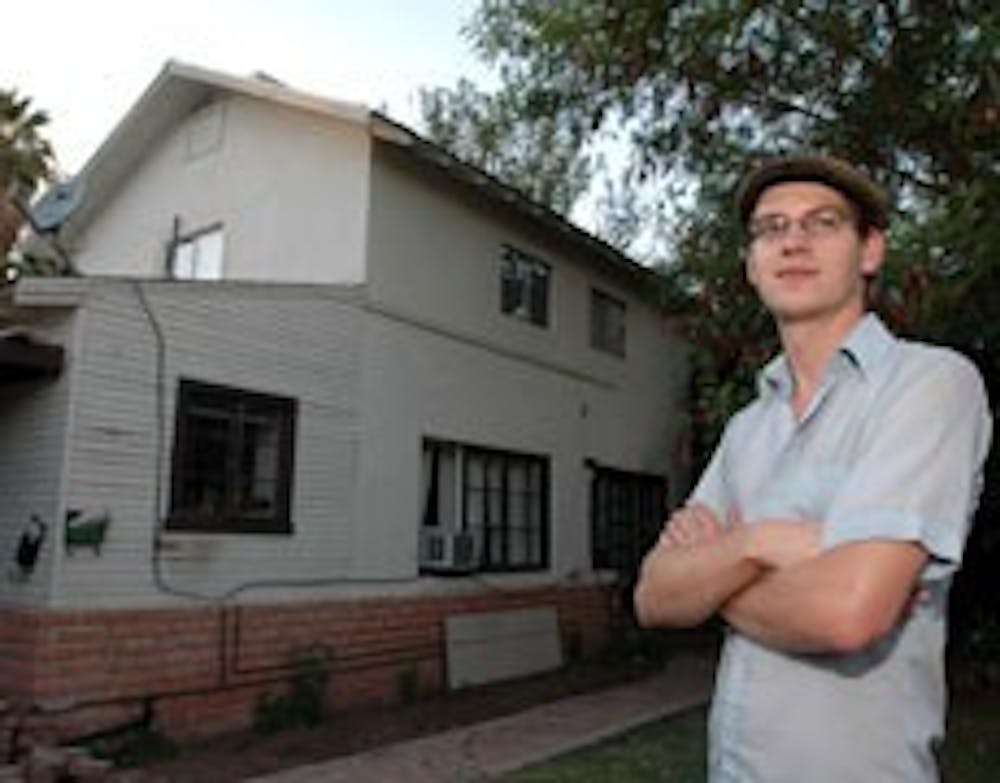
Chris Hassler's home isn't like most in Tempe. It's small, but sits on a massive lot and is surrounded by lush greenery.
"How many homes in Tempe have a basement?" said Hassler, a May graduate, as he descended a creaky wooden staircase into a small cement cellar.
Hassler lives in the Maple-Ash neighborhood west of campus, and his neighbors are battling over a proposed historic designation for the neighborhood.
Supporters like Hassler say a historic designation would preserve the character of the area -Tempe's oldest surviving neighborhood.
"Everyone wants character," Hassler said. "This is it. This is what they've been trying to build."
Opponents say the designation would restrict private property rights.
"What they're trying to do is draw people into a district that they don't want to be in," said Steve Tseffos, a Maple-Ash property owner.
Most of about 160 Maple-Ash homes were built between 1920 and 1960, according to city documents.
A historic designation would require the city's historic preservation commission to review any property change that would require a building permit, such as a structural addition, said Mark Vinson, Tempe's city architect.
Interior modifications or cosmetic exterior changes would not be affected, he said.
"They're not going to get down to what your doorknob looks like," Vinson said.
The historic preservation commission could require a 180-day waiting period before tearing down a structure in the historic district, Vinson said.
If property owners can't compromise with city staff, they are free to clear the land, Vinson added.
Those restrictions limit a homeowner's ability to make changes to his own private property, said Tseffos, who lived in the neighborhood for 20 years before moving.
"They paid money for their property and they want options," he said. "They ought to be able to do what they want to do."
Homeowners who want to preserve their own property should pursue an individual historic designation for their home, Tseffos said.
"What I'm opposed to is them lumping people into a district when they don't want to be in one," he said.
But part of the neighborhood's charm is its collective identity, and that can't be preserved by designating only select homes, said Jenny Lucier, a 20-year resident who is leading the charge for a historic designation.
"The whole is greater than the sum of its parts," she said. "If you deconstruct our neighborhood house by house you lose the point."
Maple-Ash is an "icon," a neighborhood recognized throughout Tempe for its originality, Lucier said.
"I love this neighborhood and it is absolutely Tempe's historic neighborhood," she said.
The area's zoning allows landowners to build multifamily housing, such as condominiums.
Some residents are afraid the zoning makes their neighborhood appealing to developers and hope a historic designation would make it harder to build high-density projects, Haffler said.
"Everyone wants to move to a place with character," he said. "I don't know how knocking down these houses would add character."
Tseffos said the argument is a "scare tactic" because developers haven't tried to buy and merge lots together.
"Where's the development pressure?" he said.
The neighborhood also has inherent deficiencies, Tseffos said. The houses are small, discouraging families from moving in.
"I'm not saying tear them down," he said. "[But] you're only going to attract a certain type of person, probably without children ... because the houses aren't big enough."
Restricting structural additions will further discourage families, he added.
The neighborhood's structure and proximity to campus make it a great place to live, said Megan Kelly, an environmental chemistry junior and Maple-Ash resident.
"Driving through other neighborhoods around Phoenix I feel like a lot of them are stucco houses with tile roofs on the same size lot, spaced out evenly," she said.
"It's kind of boring. The Maple-Ash neighborhood is not like that at all."
Reach the reporter at Jonathan.Cooper@asu.edu.