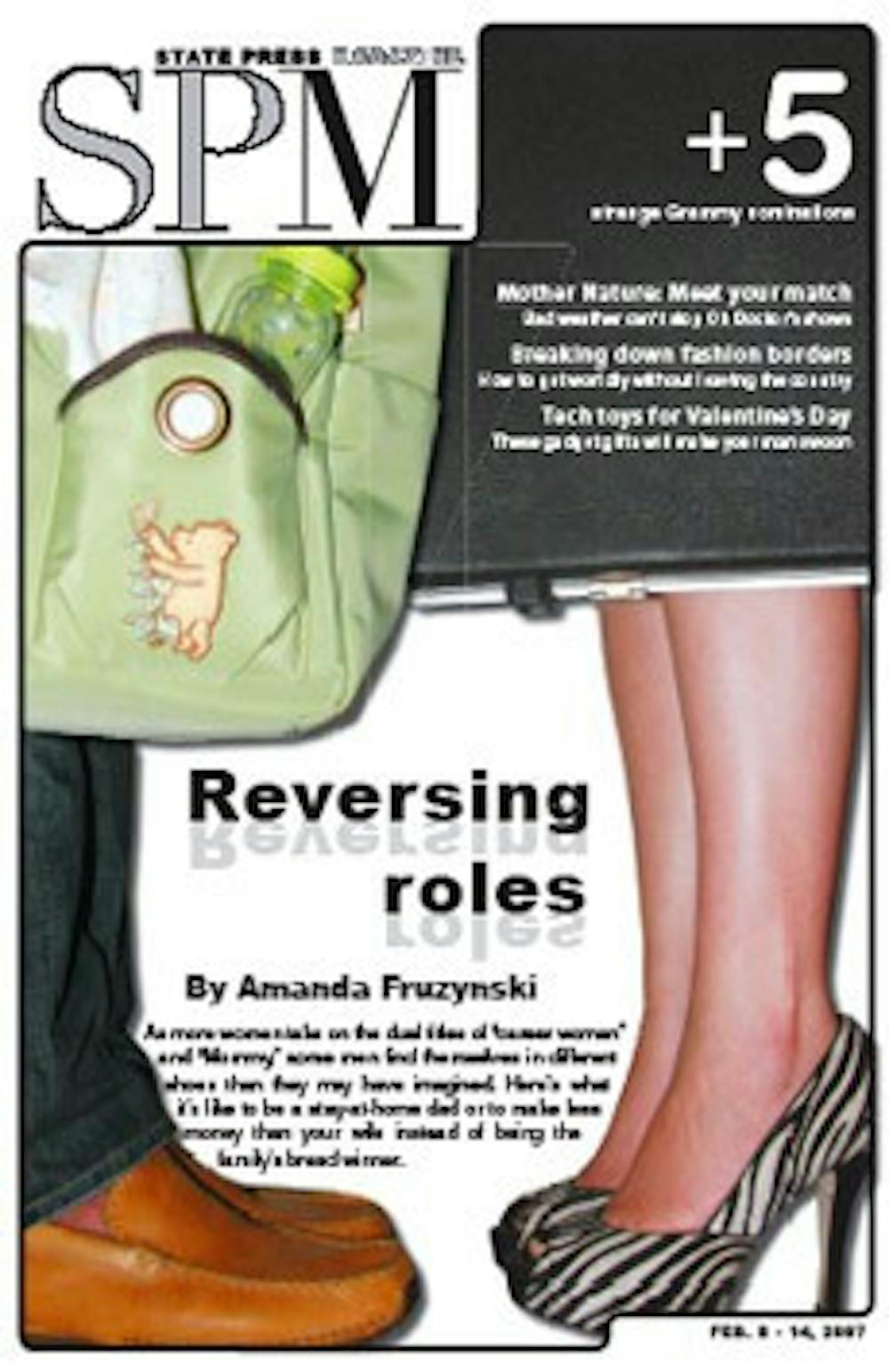
He changes the oil. He fixes things around the house and paints the spare bedroom. Maybe, if he has time, he catches the football game.
But Dan Helt, 37, has more household responsibilities than the occasional Sunday afternoon fix-it project. Helt has been a stay-at-home father to his three sons for almost six years, a result of wanting to raise his children without day care and to allow his wife to pursue her flourishing career.
"Almost our entire relationship, my wife has made more [money] than me," Helt says. "It was a goal to raise our kids [ourselves]. That's why we do what we do."
Stay-at-home dads are becoming more common as women gain ground in higher-earning jobs, creating a new dynamic that has become the norm for some family units. The Sloan Work and Family Research Network reported that in 2002, 20 percent of fathers were the primary caregivers for their preschool-aged children - an increase of 2 percent from 1996. In many families without children, men are also earning less than half of what their wives earn on a yearly basis, challenging the male-breadwinner tradition.
Helt says he has often considered how his job as a stay-at-home dad differs from that of men working outside the home. "It's the hardest job I've ever had. It's 24 hours a day and it never stops."
But Helt isn't alone. Men like Lee Hines and Ben Marcus also have relationships that stray from conventional gender role dynamics, whether it's a being full-time stay-at-home dad or the secondary wage earner to one's wife.
Father knows best
Almost as soon as they got married, Helt and his wife, Arlene, decided that one of them would stay home when they had children. "Naturally we figured it would be my wife," Helt says. After having kids, his wife did stay at home for two and a half years. "But her company wanted her back, and [she would be] making more than I was. We always agreed that when the opportunity arose, we'd switch."
Arlene Helt, 38, says she's happy her husband is so agreeable. "I think it's great that he's willing to spend time with the boys and allow me to go on with my career. But I am a little jealous [of the time he spends with the kids]."
She now works as general manager of sales for a steel-distribution company, the industry where her husband had also previously worked. Dan Helt raises 8-year-old Austin, 6-year-old Ryan and newborn Jacob. He also cooks, cleans and does the laundry. Although he says his many responsibilities aren't discouraging, "when you start looking at your 'honey-do list,' it gets pretty long."
Arlene Helt says he is better with the children than the chores. "I think men tend to view the role as a stay-at-home dad instead of how women see it as a household manager, so he tends to focus more on activities with the boys and isn't as inclined to make sure dinner is planned," she says.
Helt says he's happy with his household management skills. "When I first started as a stay-at-home dad, you had the older ladies and moms saying, 'Oh it's great that you're taking care of the kids,' and I would say, 'No, I'm not taking care of the kids,;I'm raising them. It's the same job that you're doing," Helt says. He admits that he still gets a lot of compliments though, especially because, "some wives have the bumbling husband, like [in the movie] 'Daddy Daycare.'"
Helt does not plan on going back to work anytime soon. He says he enjoys raising his children far too much to go back to his previous job.
His children will have a different outlook because of being raised by an involved father, Helt says. "Later in life, I think they'll be more apt to be a helpful kind of dad. ... It's not like the dads that would just smoke a cigar when their baby was born and then say, 'Here, Mom. Change the diaper.'"
The dynamic of their household has also bred mutual respect between Helt and his wife, he says. "I think my wife is proud to know that I can take care of these kids."
Helt says he is proud of his position as well. "I don't think there's anything wrong with saying my wife makes more than me. ... She's my other half."
Gender roles? What gender roles?
Emily Cripe is a communications third-year doctoral student and has interviewed more than twenty stay-at-home fathers in her research on work-life balance. Cripe has found that children tend to be closer with stay-at-home fathers than with fathers working outside the home.
Lee Hines says he has experienced this firsthand while being a stay-at-home father to his daughter, Andi, for five years. "We have a much stronger relationship than we would have if I had been working full-time," Hines says.
Kathleen Waldron, a lecturer in the ASU department of Gerontology and Social and Behavioral Sciences, has taught classes on personal growth, human relations, marriage diversity and parenting. She agrees that children raised by stay-at-home fathers have an opportunity for a different kind of relationship with their dads. "They get to see their fathers regularly in a nurturing role, which a lot of kids don't get to see."
Like Helt, Hines says he feels gratitude from his wife for balancing household duties and more conventional manly duties. "I take care of my daughter, and when my wife would come home, I would be fixing the water heater and cutting the grass."
Hines says he has dealt with certain stereotypes due to being a stay-at-home dad. "One thing I observed is that guys who were not in that position were envious. They would say, 'I wish I could do that, so I could watch TV all day,' which is a ridiculous statement. This isn't as easy as it looks."
Through her research, Cripe has discovered some of the drawbacks of the stay-at-home father role, such as identity issues. "They are both praised for being involved and questioned or criticized for not taking a more stereotypically masculine role," Cripe says.
Hines and Helt each grew up with a father as the breadwinner and a mother doing most of the child-rearing and household chores. However, like Helt, Hines believes his role as a stay-at-home dad has given his daughter a different outlook on life. "She's not going to have the same views of common gender roles," Hines says.
This viewpoint on changing gender roles has already become more common for men. According to the Sloan Work and Family Research Network, the percentage of males that thought the man should earn the money and the woman should stay at home dropped from 74 percent in 1977 to 42 percent in 2002.
More than just a sugar mama
More women are now earning the primary income in their household, possibly because of a surge in higher-earning women. According to an article on the employment Web site Management-Issues, the Employment Policy Foundation reported that from 1991 to 2001 the amount of women earning $100,000 or more a year more than tripled. With greater numbers of women earning yearly salaries in this higher bracket, there are more relationships where men are no longer the primary wage earners.
Ben Marcus, a 36-year-old social studies teacher and department chair at Tempe High School, is one of the growing numbers of men whose salary is significantly less than that of his spouse. Up until recently, Marcus' wife, Vanessa Jeffery, had been a short-term power trader the utility company SRP. "My wife makes twice as much as I do," Marcus says, adding that this has been the case during their entire five-year marriage.
Marcus and his wife's roles in the home are also nontraditional. "I do most of the cleaning and more of the cooking. She takes care of the finances and anything that requires effective planning and organization," Marcus says.
Marcus says that it has never been an issue that his wife makes more. "I have absolutely no problem with it at all. Any guy who does is stuck in the sexist-pig stage of thinking," he says, adding jokingly. "I can brag about my sugar mama to all my coworkers and friends."
Another positive aspect of this type of relationship is that it gives the couple more flexibility, Waldron says. "They each get to do what they want to do, and the husband can pursue a career field for genuine enjoyment and without worrying over money. They don't have to think, 'Oh my God, I have to go into engineering.'"
ASU graduate Bobby Small has similar feelings about the freedom in a nontraditional wage-earning relationship. "If we were both doing what we enjoyed for a career, I don't think it would matter much at all [who earned more]," Small says.
"I think that at times it would intimidate any guy at some level because of the traditional 'male-bread-winner' home model. I wouldn't marry the kind of woman that would rub it in my face in the first place," he adds.
Marcus, however, has had more experience with other men and women taking issue with his wife earning more money. He recalls dealing with what he calls, "Neanderthal men and women [who] question my manhood."
Starting the role reversal early
Even though she is in a traditionally higher-earning major, Kimberly Buettner, a biology and society junior, has never considered how earning more money than her boyfriend or spouse might affect her future relationships.
"I think that for committed relationships to work, decisions need to incorporate what is both best for each individual as well as for the relationship," Buettner says. "If that means that I make more than my husband or boyfriend, so be it."
Small says he also has no issues with this type of relationship. "I would not have a problem with it based on the assumption that I am with a woman who respects my career even if she is making more money."
Buettner says she doesn't see herself as a future stay-at-home mother or wife. "I personally feel that staying at home can be detrimental to one's social and economic security," she says. "I think it's important to maintain some form of both social and financial independence from your partner because, while you share much of your lives, you are still two individuals."
For Marcus, fulfillment is more important than financial success. There is no point to making money unless you enjoy your career, he says.
"If you enter into a relationship with a woman making more money, do not whine about it. Take on some household responsibilities if she works more and mostly enjoy it," he adds.
Hines also feels that the money comes second to family. "You have to put any jealousy aside," he says. "You're not looking out for yourself. What's good for the family is what you look at."