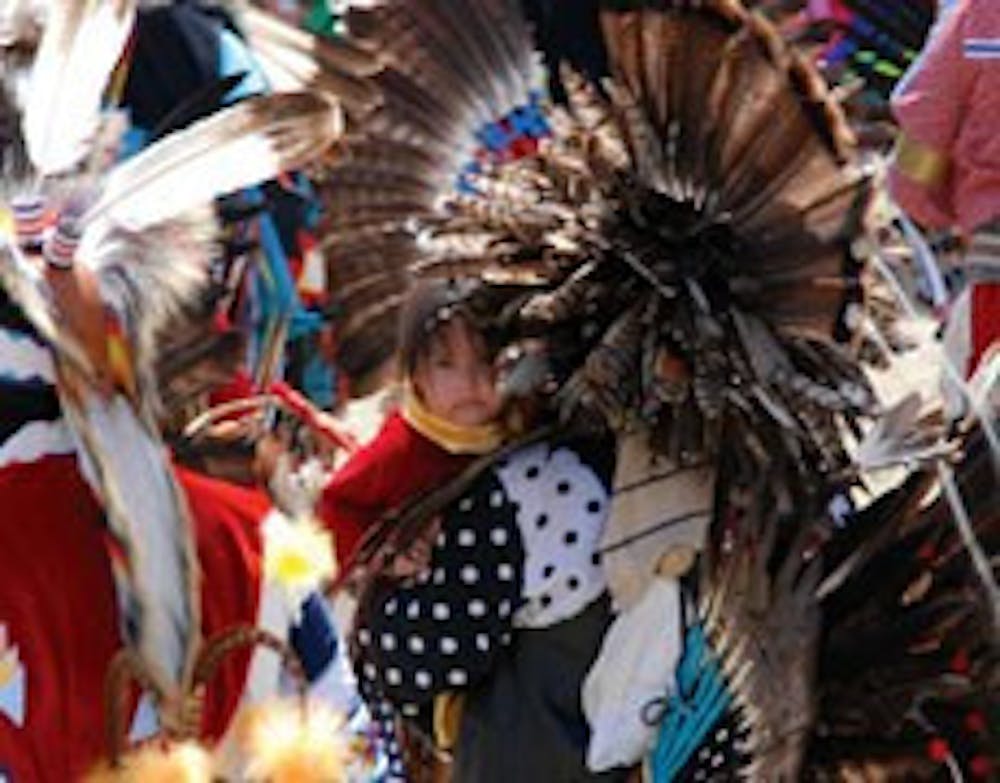
Drums echoed across the ASU marching band practice field this weekend - but they didn't come from the drumline.
American Indians from tribes across the U.S. and Canada wore colorful regalia and danced to spirited beats during the 21st Annual ASU Spring Contest Pow Wow.
The powwow concluded American Indian Culture Week, which featured fry bread sales, American Indian art and a Ms. Indian ASU contest.
Powwows are a borrowed culture from the Plains Indians, said Lee Williams, the event's coordinator.
"The event started back in 1987 as a cultural diversity and awareness vehicle for students on campus," he said.
About 300 dancers participated in this year's event, and there were approximately 12,000 audience members over the weekend, Williams said.
Powwows are multicultural events, said Diedra Vasquez, a psychology freshman and member of the Tohono O'odham/Dine' tribe.
Vasquez has been participating in powwows for as long as she can remember, she said. Her family travels across the U.S. and Canada during the summer to dance in them
"My older sisters and brothers have been involved in powwows since they were small, and they passed it down to us," Vasquez said.
She began dancing in Girls' Jingle Dress and recently switched to Women's Northern Traditional, she said.
Jingle dresses are made from cotton or taffeta and hold "jingles" made from snuff can lids. The sound they make represents waves or thunder. Dancers are judged on their grace and footwork.
The Women's Northern Traditional dance is a war victory dance, Vasquez said.
"Everybody has their own style of dancing and their own uniqueness," she said.
Each dance has its own song, and each song has its own meaning, she said.
One of Vasquez's favorite songs is one her brothers made for her.
The song is called "I am a Child of God" and celebrates Vasquez as an individual, she said.
Talia Tsosie, an interdisciplinary senior, sings in Navajo but doesn't participate in the dances, she said.
Andrea Gonzales, an elementary education junior and member of the Pascua Yaqui tribe, said men in her tribe do most of the dancing.
Dances combine her tribe's indigenous culture with Catholicism, and Lenten ceremonies are the biggest of the year, she said.
Lent is a 40-day season of penitence and preparation for Easter.
But members of her tribe participate in powwows by attending them, not by dancing in them, Gonzales added.
"We all have unique songs, prayers and dances, but a lot of them are meant to stay in our communities," she said.
Both Tsosie and Gonzales are Ms. Indian ASU royalty.
"I wanted to be able to represent our school throughout the American Indian community and encourage the younger ones to go to school," Tsosie said.
She was glad to see all the visitors at the powwow, she added.
"It's a blessing to be here participating and seeing all the tribes from different states gathering together as one," Gonzales said.
Reach the reporter at: aimee.tucker@asu.edu.


