Midnight is about to strike on ASU's Tempe campus. With February fresh in the crisp desert air, Ash Ponders, a religious studies senior, and the gang known affectionately as the Chalkmonauts, start to spread their art across the sidewalks.
"We had been working about an hour," Ponders says. "We made a mural with poems and shapes. Then a police officer approached us and said we would be placed in jail overnight if we were caught chalking again."
And that was it for the Chalkmonauts, who disbanded that February. During the 13 months the Chalkmonauts existed, about 50 different people would contribute, with ages ranging from 18 to 38. Nearly every member was an ASU student or alum.
The Chakmonauts, like all other students and student groups on the ASU campus, are impacted by an ASU regulation regarding posting advertisements and other materials on campus. Without prior approval, materials can only be placed on campus kiosks under the policy, and sidewalk chalking is never permitted. Though only extreme circumstances carry jail time, punishments could include University sanctions and fines.
In their heyday, the Chalkmonauts would meet on Forrest Mall by the Coor building once a month and draw sidewalk messages and art, sometimes spreading all the way to Palm Walk. Ponders says he bought over 30 boxes of sidewalk chalk for the meetings. "Anyone who wanted to could show up and take some chalk," Ponders says.
Painting junior Cynthia Andrews was one of the initial contributors. "I remember hearing about it, and at the time there were only about six people doing it. I went to check it out, and I just loved it," Andrews says. "It was amazing to see a group of students organizing a group that would create and put out their personal messages."
The motivation behind the ordinance is to maintain a tidy image at ASU, says Ellen Newell, assistant director of Grounds Services. "President Crow has challenged us to have the campus at a level one: clean, neat and tidy," she says. "He wants the University to be very attractive … to attract researchers and students and staff, and when you have uncontrolled advertising, it looks trashy."
Newell says the policy has been in place the three years she's been on the job. She says any chalk drawings that are done are usually removed by the ground crew's nightly power washing.
Despite Ponders saying he was threatened with jail time, Newell says her group is "not out to nail people" and usually just warns chalkers about the policy. Most criminal damage cases, where the chalking would fall, result only in fines, says Cmdr. Jim Hardina, spokesman for the ASU Police. Damage must be more than $250 for the crime to be upgraded to a felony under Arizona law.
Hardina says the penalty for chalking would depend on the amount of money it costs to clean up. Other factors would include if it leaves a permanent stain and the message it carries.
"If someone wrote 'Go Devils' on the sidewalk, it probably wouldn't be a big deal," he says.
Hardina said chalking was more of a University issue. A University official could not be reached before deadline to comment for this article on what sanctions would be enforced.
How the law fits under Arizona State Law is still a murky issue, though. The law, in defining criminal damage, carries an exception for materials printed on the ground, calling criminal damage, in part, "drawing or inscribing a message … that is made on any public or private building, structure or surface, except the ground, and that is made without permission of the owner."
Louis Silverman, a Tempe lawyer, says bracketing chalking under a no-posting policy "seems like a stretch."
"Posting and chalking are two different things," he says.
In other chalking-related cases, in August 2002 Santa Cruz Police Department jailed a homeless person for chalking political messages outside of businesses. A Superior Court official ruled that chalking was not protected by provisions for freedom of expression in Santa Cruz.
But cities in other states, including Virginia, Washington and Pennsylvania, have embraced chalking as an art form and have created "Chalk the Walk" festivals in which artists chalk under a theme and receive prizes.
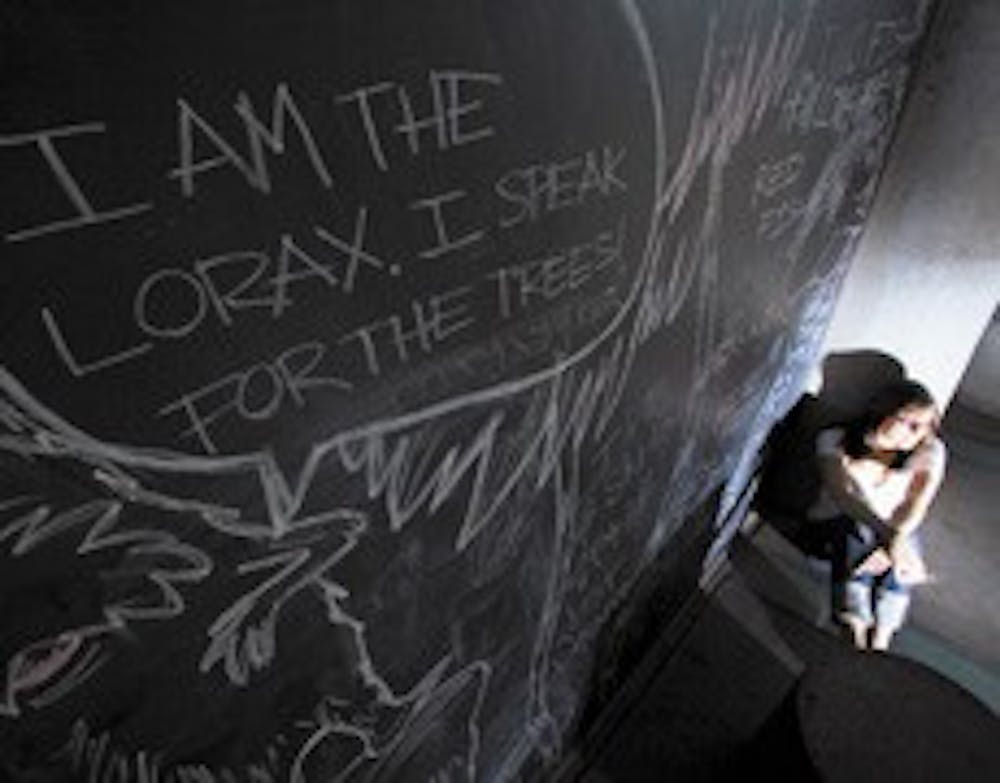
For now, though, Ponders and any other Chalkmonaut is going to have to keep their art strictly to the blackboard in Coor Hall.